Transport and mobility
Getting from one place to another is at the heart of every trip. Whether you are flying across the country, taking a scenic train ride through the countryside, or hopping on a city bus to reach a museum, transport shapes the pace, budget and overall experience of your journey. For many travelers, especially those planning their first independent trip, the sheer number of options can feel overwhelming. This category brings clarity to the world of transport and mobility, helping you understand how each mode works, what it costs, and when it makes sense to use it.
Why Transport Choices Shape Your Entire Trip
Transport is rarely just about moving from point A to point B. It influences how much time you spend traveling versus sightseeing, how much of your budget remains for food and activities, and even how tired you feel when you arrive. A traveler who chooses an overnight train instead of a late flight, for example, saves a night of accommodation and wakes up rested in a new city. On the other hand, a cheap bus connection that takes eight hours may cost less but leave you exhausted for your first day of exploring.
Thinking about transport as part of the experience rather than a pure logistical chore often leads to better decisions. Some of the most memorable moments in travel happen in transit: watching landscapes roll by from a train window, chatting with locals on a ferry, or navigating a busy subway system like a resident.
The Main Modes of Long-Distance Transport
When planning a trip, you will usually choose between four major modes for covering longer distances. Each has distinct strengths depending on your route, budget and schedule.
Air Travel
Flying is the fastest option for long distances and often the only realistic one for crossing oceans or large countries like the United States, Canada or Australia. In recent years, low-cost carriers have made airfare competitive with ground transport on many domestic routes. Keep in mind, however, that the total door-to-door time matters more than the flight itself: getting to an airport two hours early, clearing security and traveling from a distant airport into the city can easily add three to four hours to your journey.
- Best for: long distances, island destinations, tight schedules.
- Watch out for: baggage fees, airport transfer costs and delays.
- Money-saving tip: compare prices across nearby airports and be flexible with dates.
Rail Travel
Trains offer a comfortable, scenic and often city-center-to-city-center alternative to flying. Countries such as Japan, Switzerland, Germany and the United Kingdom have extensive, punctual rail networks, while Amtrak connects major American cities. High-speed services like France’s TGV, Japan’s Shinkansen or Spain’s AVE can rival flying on routes under three or four hours once you factor in airport time.
- Best for: medium distances, scenic routes, travelers who want to work or relax en route.
- Watch out for: limited seat availability during peak season; book early.
- Money-saving tip: rail passes can pay off if you plan several legs in the same country or region.
Coach and Bus Travel
Intercity buses, operated by companies such as Greyhound, FlixBus or Megabus, are typically the cheapest long-distance option. Modern coaches often include Wi-Fi, power outlets and reclining seats. The trade-off is time: buses are slower than trains and subject to road traffic.
Driving and Car Rentals
Renting a car gives you freedom, particularly in rural areas, national parks and regions with limited public transport — think of the American Southwest, the Scottish Highlands or the Australian outback. Before renting, check the age requirements, insurance coverage, and whether your driver’s license is valid at your destination. Remember that driving customs vary: you will drive on the left in the UK, Ireland, Australia and New Zealand, which takes some adjustment for visitors from continental Europe or North America.
Getting Around Within Cities and Towns
Urban mobility deserves its own planning, since the way you move around a destination often determines how much you actually see and enjoy.
Public Transit
Metro systems, buses, trams and light rail are usually the most economical way to explore a city. Many cities offer tourist passes or contactless payment options that cap daily fares automatically. Cities like Tokyo, London, New York and Paris have dense networks that make car ownership unnecessary for visitors. A bit of preparation helps: download the local transit app before arrival and learn how ticket validation works, since fines for unvalidated tickets can be steep.
Rideshares and Taxis
Uber, Lyft and local equivalents operate widely in English-speaking countries, offering convenience at a higher price than public transit. Traditional taxis remain reliable in many places, and official taxi ranks at airports are generally safe. Rideshares shine when carrying luggage, traveling late at night, or heading somewhere not served by transit.
Walking, Cycling and Micromobility
Do not underestimate the simplest options. Walking is free, keeps you healthy and reveals details of a city you would otherwise miss. Bike-share programs and electric scooters have expanded rapidly in cities worldwide and work well for short hops. As a rough rule, if a walk takes under 25 minutes, it is often faster and more pleasant than waiting for a bus.
How to Choose the Right Option: A Simple Framework
When facing a transport decision, a quick comparison of a few key factors will usually point you to the right answer.
- Measure the real distance and time. Under 200 miles (about 300 km), ground transport often wins once airport overhead is counted. Beyond that, flying usually becomes the sensible choice.
- Total up the true cost. Include transfers, baggage fees, parking and petrol, not just the base fare.
- Consider comfort and energy. Arriving exhausted can cost you a full day of your trip.
- Check frequency and flexibility. A cheap ticket on a service that runs once a day is riskier than a pricier option with hourly departures.
- Weigh the experience factor. Sometimes the slow, scenic option is worth a little extra time or money.
Consider a fictional traveler, Sarah, planning ten days in California. She flies into Los Angeles, uses the metro and rideshares while in the city, then rents a car for the coastal drive toward San Francisco, where she returns the car and relies on public transport again. By matching each leg of her itinerary with the appropriate mode, she balances cost, convenience and enjoyment — something a single one-size-fits-all choice could never achieve.
Booking and Timing: Practical Tips That Save Money
Beyond choosing a mode, how and when you book matters greatly.
- Book flights and long-distance trains early for popular routes and holiday periods.
- Off-peak travel times, such as midweek departures, often come with noticeably lower fares.
- Check refund and change policies before purchasing, especially on discounted tickets.
- For rentals and rideshares, verify pick-up locations carefully — airport desks often carry surcharges.
- Keep digital or printed copies of tickets, as signal coverage can be unreliable on regional routes.
Safety, Accessibility and Sustainable Choices
Modern travelers also weigh safety, accessibility and environmental impact. Public transport in major cities is generally safe, but stay alert on crowded vehicles and keep belongings secure. If you have mobility needs, research ahead: many airlines, rail operators and transit systems offer assistance services, though these frequently require advance notice. Environmentally conscious travelers can also note that trains and coaches produce far fewer emissions per passenger than planes or single-occupancy cars, making ground transport a greener choice whenever distances allow.
Common Questions About Transport and Mobility
Should I rent a car or use public transport?
It depends mainly on your destination and itinerary. Cities with strong transit networks reward travelers who skip the car, while rural regions, national parks and multi-stop road trips practically require one. Many successful trips combine both.
How far in advance should I book transport?
For flights and high-speed trains, earlier is almost always cheaper. Local transit rarely requires advance purchase, though some cities require pre-purchased cards or apps.
What happens if my connection is delayed?
Build buffer time into tight connections, especially when separate tickets are involved, as carriers are not always obligated to rebook you across independent bookings. Travel insurance can cover missed connections on significant trips.
Transport and mobility do not need to be the stressful part of travel. With a clear understanding of your options, a habit of comparing total costs and times, and a willingness to match the mode to the journey, you can turn every leg of your trip into a smooth — and sometimes even enjoyable — part of the adventure. The articles in this category go deeper into each mode, offering route-specific advice, booking tactics and on-the-ground tips for getting around with confidence.
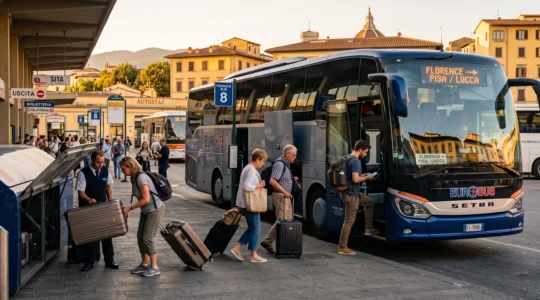
Which bus pass connects Florence, Siena and San Gimignano routes?
The Terracotta Route bus pass connects Florence, Siena, and San Gimignano. Available through Tootbus Tuscany, this intercity route allows travelers to include all three destinations in a flexible itinerary without…
Read more
How do airport transfers simplify your travel experience?
Navigating the complexities of air travel can be daunting, but airport transfers offer a streamlined solution to one of the most stressful aspects of any journey. These services bridge the…
Read more
What are the best public transport options in major cities?
Public transportation is the lifeblood of urban mobility, shaping how millions navigate their daily lives in cities around the world. From underground metros to innovative water taxis, the best public…
Read moreFind the best navigation services to guide you anywhere
Navigation technology has come a long way from the days of paper maps and asking for directions. Today, a wide array of sophisticated navigation services are available to guide us…
Read more