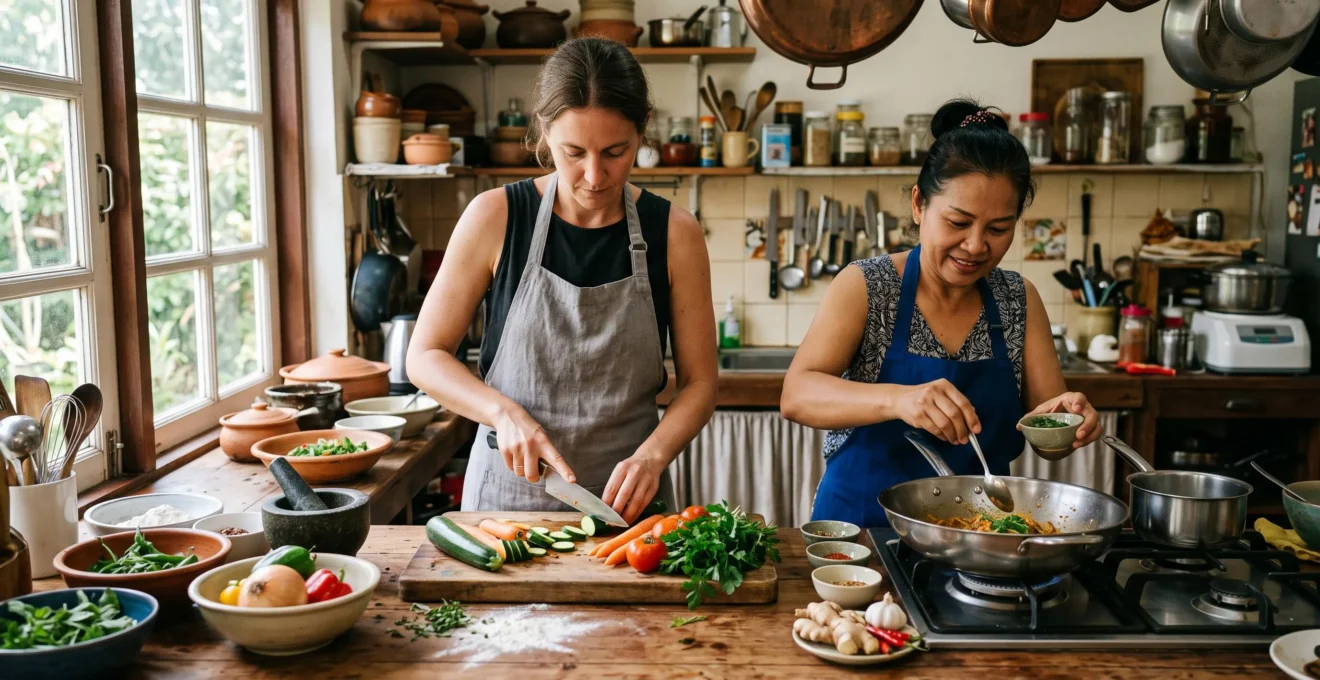
The best traditional cooking class for learning repeatable skills is a genuinely hands-on lesson where you prepare one or two local dishes from raw ingredients, practise essential techniques, taste and adjust your cooking, and leave with recipes you can adapt to ingredients available at home.
A beautiful kitchen, a charismatic chef and an impressive shared meal can make a memorable travel experience. But none guarantees that you will know how to recreate the food once the holiday ends. The difference lies in what the instructor lets you do independently, how much feedback you receive and whether you understand the decisions behind the recipe.
Look for a manageable group, sufficient cooking time and a teacher who explains why ingredients, heat and timing matter. A market visit can add valuable knowledge, but only when it leaves enough time to cook.
The aim is not to become an expert in one afternoon. It is to return home with at least one complete dish you feel equipped to attempt again, along with techniques that extend beyond that recipe.
What makes a traditional cooking class worth booking?
- Choose participation over presentation: prioritise classes where you chop, season, cook and troubleshoot rather than simply assemble prepared ingredients.
- Match the format to your experience: beginners usually benefit from more kitchen practice, while confident home cooks may gain additional value from ingredient sourcing and substitutions.
- Plan for learning, not just dining: check group size, recipes, dietary safety and scheduling before committing to a class.
- Why Do Some Cooking Classes Feel Like You’re Just Assembling Pre-Chopped Ingredients?
- How to Spot a Hands-On Cooking Class From the Listing Without Emailing Back and Forth?
- Market Tour Plus Cooking or Kitchen-Only: Which Works Better on a Tight 4-Hour Afternoon?
- The Allergy Communication Mistake That Can Ruin a Cooking Class Before It Starts
- When Should You Book a Cooking Class So You’re Not Exhausted and Skipping Dinner Later?
- How to Build a Balanced Meal at Any Restaurant Using a 3-Part Plate Rule?
- How to Spot Locally Owned Tours and Shops Using 5 Clues Without Asking Awkward Questions?
- How to Eat Balanced on Holiday Without Counting Calories or Killing the Fun
Why Do Some Cooking Classes Feel Like You’re Just Assembling Pre-Chopped Ingredients?
Some cooking classes feel like assembly lines because the instructor has already completed the most valuable technical work. Ingredients arrive chopped, measured and portioned so participants can finish several attractive dishes within a fixed schedule. The experience may be enjoyable, but it offers limited practice in knife control, seasoning, heat management and cooking independently.
Consider a hypothetical dumpling class. In one version, participants receive prepared filling, ready-made wrappers and an instructor’s demonstration of folding. They assemble dumplings and enjoy the finished meal. In another, they prepare the filling, learn how finely to chop the vegetables, adjust seasoning, fold their own dumplings and understand how to cook them without tearing the wrappers.
Both produce dumplings. Only the second provides substantial practice across the cooking process.
The missing ingredient is often decision-making. Knowing when to add salt, how to judge dough consistency or why a pan needs more heat is more useful than memorising a sequence of movements.
A practical test is to ask yourself during the lesson: Could I buy these ingredients and cook this dish without following every line of the recipe card?
If the answer is no because the instructor handled every difficult stage, the lesson may have taught recognition rather than independent cooking ability.
Class structure matters. A schedule covering five dishes can introduce more flavours, but may leave little time to repeat difficult techniques or correct mistakes. Concentrating on one or two dishes can create more opportunities for feedback and practice. Neither format guarantees a particular result; the important question is how participants actually spend their time.
What practical cooking education research suggests
A small cooking-skills intervention at a community health centre in Detroit, Michigan, involved 45 participants across six hands-on classes. Researchers assessed cooking confidence and gathered follow-up interviews two to four months later.
Participants reported improved cooking confidence (P = 0.004), and follow-up interviewees described using recipes and techniques at home. The findings suggest practical instruction can support learning beyond the classroom, although the study did not examine tourist cooking classes or establish what one lesson can achieve.
The findings are documented in a published study of hands-on cooking classes in Detroit.
When comparing classes, look for what might be called hands-only time: periods when you work directly with ingredients, make your own adjustments and receive individual guidance.
Ideally, you should prepare a complete dish, taste it before serving, understand what needs correcting and learn how to recognise a successful result. A competent teacher should also explain which stages can be prepared in advance without undermining the technique being taught.
Once that distinction is clear, the next challenge is recognising genuine participation before you book, when all you have is a listing, a few photographs and previous guests’ reviews.
How to Spot a Hands-On Cooking Class From the Listing Without Emailing Back and Forth?
To recognise a genuinely hands-on cooking class, examine the verbs in the description, the activities shown in photographs, the group size and the wording of previous reviews. Listings promising that guests will prepare, chop, knead or cook their own dishes offer stronger participation signals than those emphasising demonstrations, watching a chef or tasting finished food.
Start by treating the listing as a description of the teaching method rather than a sales pitch about authenticity.
Words such as “watch the chef prepare”, “live demonstration” and “enjoy a tasting” do not necessarily indicate poor quality. They simply suggest that observation may occupy a substantial part of the session.
By contrast, “prepare your own”, “cook alongside the host” and “learn to knead and shape” indicate activities that are potentially easier to reproduce at home.
Photographs should show the work, not just the results. Look for guests holding knives safely at cutting boards, shaping dough, controlling pans or preparing individual portions. A gallery dominated by group portraits and plated dishes provides less evidence of actual participation.
Next, consider duration and group size together. A class lasting 3 hours or more with around six participants or fewer is a useful starting preference when individual feedback matters. These are practical screening thresholds, not scientifically established guarantees. A well-organised larger class can still provide excellent instruction, while a small class can remain entirely demonstration-based.
Reviews often reveal what the description leaves out. Search for phrases such as “we made everything”, “learned how to” and “received the recipes afterwards”. Compare these with “the chef cooked for us” or “we watched the preparation”. A pattern across multiple detailed reviews is more informative than one enthusiastic comment.
When the format remains unclear, one concise message can resolve the main uncertainty.
Five checks to complete before booking
- Identify the cooking verbs: copy at least two activities that the listing explicitly says guests perform themselves.
- Inspect the photographs: record one visible example of participants preparing ingredients or controlling a cooking process.
- Check the practical format: note the published duration, maximum group size and number of dishes.
- Review guest experiences: save two review excerpts describing what participants actually learned or prepared.
- Confirm the missing details: send one message asking, “Will I cook each dish myself from start to finish, and will I receive the recipes afterward?” Keep the written response with your booking.
The completed checks create a simple comparison record. If a provider cannot explain which steps guests perform, how much guidance they receive or whether recipes are supplied, treat that uncertainty as part of the booking decision.
A strong listing clarifies what you will do. The next decision is how to allocate a limited afternoon between choosing ingredients in a market and developing technique in the kitchen.
Market Tour Plus Cooking or Kitchen-Only: Which Works Better on a Tight 4-Hour Afternoon?
For a four-hour afternoon, a kitchen-only cooking class usually makes more sense for beginners who need sustained practice with basic techniques. A market tour plus cooking can be more valuable for experienced home cooks who already understand preparation and heat control but want to learn how locals select, compare and substitute ingredients. Travel distance and market quality can change that recommendation.
A market visit introduces the part of cooking that recipe cards often overlook: choosing the right ingredients. A teacher can explain which vegetables work at different stages of ripeness, how to recognise fresh herbs or why a particular flour behaves differently from one sold at home.
That knowledge makes a traditional recipe more portable across countries. If you cannot find the original ingredient, understanding its function can help you evaluate an appropriate substitute rather than guessing.
However, four hours remain four hours. Every minute spent travelling, browsing or waiting reduces the time available for preparing, cooking and tasting.
Consider these practical differences before choosing a format.
| Decision factor | Market tour plus cooking | Kitchen-only class |
|---|---|---|
| Best learning focus | Ingredient selection, seasonality and substitutions | Preparation, timing, seasoning and repetition |
| Beginner suitability | Useful when the market visit is short and focused | Usually preferable for sustained technical practice |
| Experienced home cooks | Can deepen understanding of unfamiliar local ingredients | Useful for mastering a specific unfamiliar technique |
| Main limitation | Transport and browsing reduce available kitchen time | Less opportunity to learn how locals source ingredients |
| What to verify | Market distance, itinerary and actual cooking time | Participant tasks, instructor feedback and recipe coverage |
Distance is the hidden variable. A market a short walk from the cooking venue can support a focused ingredient lesson without consuming much of the afternoon. A 40-minute round trip to a market primarily serving tourists may offer less culinary value, particularly if most stalls sell products unrelated to the dishes being prepared.
Before booking, check whether the market visit involves selecting ingredients for the lesson or merely walking past stalls. The strongest connection between market and kitchen occurs when the teacher explains a purchase and then demonstrates how that ingredient behaves during cooking.
A useful compromise is to ask: “Can we visit the market next door for one key ingredient instead of doing the full tour?” Not every provider can change a fixed itinerary, but a short sourcing exercise may preserve the most valuable lesson without sacrificing substantial cooking time.
For example, learning why one leafy green is suitable for a slow-cooked dish while another wilts immediately can be more transferable than visiting numerous stalls without applying that knowledge.
Either choice can produce worthwhile learning if ingredient knowledge connects to practical cooking. Before making the reservation, however, dietary requirements must be addressed as carefully as the itinerary.
The Allergy Communication Mistake That Can Ruin a Cooking Class Before It Starts
The most consequential allergy communication mistake is waiting until arrival to disclose a food allergy or describing it too vaguely for the host to identify the ingredients and preparation risks. Hosts need clear information before booking is confirmed so they can assess whether the menu, equipment and cooking environment can accommodate the participant safely. A promised ingredient substitution alone is not sufficient.
A vague message such as “I have a nut allergy” may leave important questions unanswered. Does the person need to avoid peanuts, particular tree nuts or both? Are there additional ingredients or derivatives that must be excluded?
For someone with a diagnosed food allergy, the specific allergen and the risk of cross-contact matter more than a broad dietary label. An intolerance and an allergy are not interchangeable, and anaphylaxis is a potentially life-threatening allergic reaction rather than a synonym for food sensitivity.
Send the information at the booking stage in a format that clearly identifies:
- The exact foods or ingredients that must be avoided.
- The nature of the restriction and any known history of severe reactions, using the person’s medically established information.
- Whether the kitchen can prevent allergen cross-contact during ingredient storage, preparation and cooking.
- Whether the planned menu is suitable without requiring improvisation during the class.
Cross-contact deserves particular attention. Allergenic proteins can transfer through shared knives, boards, utensils, preparation surfaces and cooking equipment. Removing an allergenic ingredient from the final plate does not necessarily make the meal safe.
FARE‘s advice on avoiding allergen cross-contact explains why thorough cleaning procedures and suitable preparation arrangements matter, including the risks associated with shared equipment and cooking oil.
A translated allergen card can help communicate restrictions when the host and traveller speak different languages. It should accurately list the foods to avoid and the relevant safety requirements. Carrying a physical card provides an additional communication option if a phone is unavailable, but neither a card nor a translation removes the need to verify kitchen practices.
The cuisine itself can complicate accommodation. Peanut ingredients may be central to certain Thai dishes, while wheat is fundamental to many traditional pasta-making lessons. In such cases, ask whether the host can offer a different menu rather than simply replacing one prominent ingredient.
Also check whether an adapted menu changes what you will actually cook. A traveller who cannot participate in dough preparation, for example, might spend much of a pasta class watching others. That affects the learning value even if the dietary restriction is accommodated.
Shared family kitchens should be evaluated individually. Some may have appropriate cleaning and preparation procedures; others may not have separate equipment or the capacity to avoid cross-contact. Home-based does not automatically mean unsafe, just as professional premises do not automatically guarantee safety.
For severe allergies, ask specifically about pans, utensils, preparation areas, oil and cleaning procedures. If the provider cannot confidently explain how the actual lesson will be managed, choose a different activity. Follow your prescribed allergy management plan and carry any prescribed emergency medication.
Once safety and participation are established, the next practical concern is timing. Even an excellent instructor cannot deliver the same learning experience if you arrive exhausted, distracted or already uncomfortably full.
When Should You Book a Cooking Class So You’re Not Exhausted and Skipping Dinner Later?
Book a traditional cooking class on a relatively relaxed day, preferably after you have settled into the destination but before the final part of your trip. Morning sessions work particularly well when the class includes a full meal and you want to protect your evening plans. Afternoon sessions can be equally practical when the food you prepare replaces dinner.
Cooking lessons demand more concentration than many travellers anticipate. You must listen to instructions, coordinate several steps, handle equipment, judge textures and taste ingredients while working within a group.
That is harder after a long flight, an early departure or an ambitious sightseeing itinerary. Fatigue can make it more difficult to follow instructions and remember the decisions that distinguish a recipe from a repeatable skill.
Allow for the entire experience, not just the cooking demonstration. A market visit, ingredient preparation, cooking and a shared meal can occupy four to six hours, depending on the itinerary. Confirm the actual duration because published schedules vary.
Consider a hypothetical class beginning at 10 a.m. and lasting five hours. It would finish at approximately 3 p.m., making the dishes you prepare a substantial late lunch. You can then keep dinner flexible rather than reserving another large meal.
An afternoon class beginning at 2 p.m. and lasting four hours would end at approximately 6 p.m. If a full meal is included, that experience can serve as your evening meal.
The arithmetic is straightforward, but the dietary and learning consequences matter.
Many cooking experiences conclude with participants sitting down to enjoy everything they prepared. This final stage is not merely hospitality. Tasting the finished dishes allows you to compare textures, evaluate seasoning and understand how the individual components work together.
Booking an elaborate dinner immediately afterwards creates a double-meal trap. You may rush through the meal you cooked, feel obliged to eat when already full or cancel another reservation.
Avoid deliberately skipping earlier meals to make space for a cooking class. Arriving excessively hungry can make it harder to concentrate, particularly when the first meal is several hours away. Instead, eat according to your needs and plan around the host’s stated meal schedule.
Timing within the wider trip also matters. After eating a few local dishes, you will have more specific questions: What gives this sauce its depth? Why is this vegetable cut differently? Can that spice blend be recreated at home?
Booking before your final day leaves an opportunity to revisit a market, purchase suitable ingredients or try a technique again while the experience remains fresh.
A well-timed lesson can become the centrepiece of a travel day rather than another obligation. It can also reveal something useful about how traditional dishes form complete, satisfying meals.
How to Build a Balanced Meal at Any Restaurant Using a 3-Part Plate Rule?
To build a balanced meal at a restaurant, identify three practical components: vegetables or fruit, a source of protein, and a starchy staple such as rice, bread or potatoes. Look for these within the traditional dish before ordering extra food or changing the cuisine. The framework is a flexible way to understand meal composition, not a strict diet or complete nutritional guideline.
For food travellers, the goal is to maintain comfortable energy while enjoying local cooking. That means learning how ingredients work together rather than treating unfamiliar foods as nutritional problems.
A traditional curry, for example, might contain vegetables, lentils or meat, and rice. Together, these can provide the three components without requiring a separate Western-style plate arrangement.
The same reasoning can help you understand a rice bowl, a hearty stew served with bread or a vegetable-and-bean dish accompanied by a local staple.
The practical questions are simple:
- Vegetables or fruit: Which produce contributes flavour, texture and variety?
- Protein: Are beans, lentils, eggs, fish, meat or another protein source included?
- Starchy staple: What rice, grain, bread, pasta, potato or similar food accompanies the dish?
These three components are useful for quick decisions, but they are not an official nutritional prescription. Dairy or alternatives, fats and other dietary considerations also contribute to an overall balanced eating pattern.
Importantly, a meal does not need to display identical portions of all three components. The NHS Eatwell Guide explains that food-group balance can be considered across a day or even a week, rather than achieved perfectly at every meal.
This principle is particularly helpful when travelling. If lunch is rich in starch and protein but contains few vegetables, another meal can provide more produce. There is no need to reject a regional speciality simply because it does not fit an idealised plate.
A cooking class can turn this approach into a practical skill. Ask the teacher which ingredients make the dish filling, which provide freshness and how local households typically combine it with vegetables, pulses or accompanying dishes.
Understanding the structure gives you freedom. You may be able to recreate the meal using seasonal vegetables available in your home country, while retaining the preparation technique, spice balance and cultural character of the original dish.
That knowledge is most useful when the teacher explains how people actually prepare and eat the food locally. Choosing the right host therefore matters as much as choosing an appealing recipe.
How to Spot Locally Owned Tours and Shops Using 5 Clues Without Asking Awkward Questions?
To identify a potentially locally owned cooking class, look for five clues: a named host with a credible personal story, a small or home-style teaching venue, seasonal menus, detailed reviews mentioning the instructor, and recipes connected to local or family traditions. These signals help assess cultural connection, but none independently proves ownership or teaching quality.
For a traveller who wants practical skills, the most important question is not whether a venue looks traditional. It is whether the person teaching can explain, demonstrate and correct the techniques that make local food distinctive.
A beautiful commercial kitchen may employ an excellent local chef. A family home may provide extraordinary culinary knowledge but limited structured instruction. Ownership, authenticity and teaching ability are separate qualities.
Use the following five clues to guide your investigation.
- A named host and identifiable background. Look for an instructor’s name, connection to the region and explanation of the dishes taught. Generic descriptions such as “meet a local chef” reveal less than a specific account of their cooking experience.
- A kitchen with a clear teaching purpose. A family kitchen or small workspace may create opportunities for conversation and close observation. However, judge the equipment, cleanliness and organisation on their own merits.
- Menus that reflect local availability. Seasonal variations can indicate that the host works with ingredients used in the area. A fixed menu is not automatically inauthentic, especially when it supports a carefully structured lesson.
- Reviews describing the host’s instruction. Comments mentioning the teacher by name, specific techniques and explanations provide more useful evidence than generic praise for a friendly atmosphere.
- Recipes connected to a place or household tradition. Seek explanations of how dishes are prepared, adapted and served locally. A fusion menu can be creative and worthwhile, but it may not match a traveller’s goal of learning a particular traditional technique.
UNESCO describes culinary heritage in terms of knowledge and practices transmitted between generations, rather than simply the finished dishes. This supports looking beyond a recipe’s appearance to the techniques, ingredients and social traditions that give it meaning.
Yet cultural knowledge alone does not establish that a class provides enough individual practice. A skilled storyteller may be less effective at teaching knife work than an experienced instructor in a professional school.
Family-run experiences can also involve trade-offs. Instructions may be less standardised, language support may vary and the timetable may be more flexible or less predictable. For some travellers, these characteristics contribute to an appealing personal experience. Others may prefer a structured teaching environment with clearly stated learning outcomes.
One unobtrusive verification question is particularly revealing: “What dish would you cook for your family this week?”
The answer can open a useful conversation about seasonal ingredients, household preferences and how the published menu relates to everyday local cooking. It does not verify legal business ownership, but it may reveal the depth of the host’s relationship with the cuisine.
If local ownership is essential to the booking decision, request factual information about who operates the class rather than treating the five clues as definitive proof.
The most rewarding choice combines cultural understanding with practical instruction. Those same qualities can help you enjoy the destination’s food more freely and bring useful habits home.
Key takeaways before choosing your class
- Think beyond the booking: a recipe becomes more valuable when you understand what each ingredient contributes and how to replace it appropriately.
- Let the shared meal teach you: observe how local cooks combine dishes, distribute flavours and adjust portions across a meal.
- Prioritise independent cooking: choose an experience that leaves you with enough practical knowledge to attempt the food again without the instructor beside you.
How to Eat Balanced on Holiday Without Counting Calories or Killing the Fun
Eating balanced meals on holiday does not require calorie counting or giving up memorable dishes. A practical approach is to enjoy local specialities, pay attention to hunger and satisfaction, include varied foods across the day or week, and avoid turning every meal into a nutritional calculation. A traditional cooking class can reinforce that flexibility by teaching you how local meals are prepared and combined.
Travel involves more than eating from restaurant menus. Markets, street stalls, family tables and shared cooking experiences reveal how a cuisine fits into everyday life.
A particularly rich dinner does not make the entire day unsuccessful. Similarly, a simple breakfast or vegetable-based lunch need not be framed as compensation for having enjoyed something indulgent.
Think in rhythms rather than rigid rules. Some days naturally involve celebrations, tasting menus or several unfamiliar dishes. Others may be built around simpler meals, fresh produce and familiar routines.
Food variety matters more than making every plate identical. The three-part vegetables-protein-staple framework can provide a useful reference point, while overall dietary balance also involves other food groups and individual nutritional needs.
Traditional cooking classes offer a different way to understand this balance. Instead of asking whether a dish is “healthy” or “unhealthy”, ask the instructor:
- What would people usually serve alongside this dish?
- Which vegetables or herbs change with the season?
- Is this traditionally an everyday meal or a special-occasion food?
- How would the recipe change for a smaller household meal?
These questions reveal how a recipe fits into a broader eating pattern. They can also help prevent the common travel habit of skipping meals to save room for a large dinner, only to spend the afternoon hungry and distracted.
When a cooking class includes lunch or dinner, let that meal form part of the day’s normal schedule. You can enjoy what you prepared, notice your appetite and make other meal decisions without unnecessary restrictions.
The benefit continues after travelling. Imagine learning a traditional vegetable curry and a simple accompanying lentil dish. If the teacher explains how to adapt the seasoning, use locally available vegetables and choose an appropriate staple, you leave with more than two fixed recipes.
You gain a flexible meal structure that can be adjusted to your preferences, household size and ingredients at home.
The same applies to traditional soups, grain dishes, dumplings, stews and other regional preparations. A technique that teaches you how to develop flavour, recognise doneness or balance acidity can be reused with different ingredients.
Before the lesson ends, confirm that you can access the recipe instructions and ask about ingredients that may be difficult to source in your country. Record the teacher’s recommended substitutions and the sensory cues that matter: how the dough should feel, how the sauce should look or when the seasoning needs adjusting.
Recipes are a useful reference, but understanding the technique makes them adaptable. Repeating one dish at home soon after the trip can help you identify what you remember and what needs further practice. A single class cannot guarantee proficiency, but it can provide a realistic starting point.
Before booking, select one traditional dish you genuinely want to cook at home, then choose a class that lets you prepare it from start to finish. Confirm the hands-on format, recipe access, dietary arrangements and timing. After the trip, use the recipe and your notes to make the dish again, adapting ingredients where appropriate while keeping the techniques you learned.
Can you really learn to cook a traditional dish in one lesson?
Yes, one well-structured lesson can introduce the techniques needed to attempt a traditional dish independently. The outcome depends on your previous cooking experience, the complexity of the recipe, the amount of direct practice and the feedback provided. One session should be considered a foundation for further practice rather than a guarantee of mastery.
Is a private cooking class always better than a group class?
No. Private instruction may provide more opportunities for personalised feedback and adjustments to your experience level, but a small group class can also offer excellent practical teaching. Compare the amount of cooking each participant performs, the instructor’s ability to supervise and the clarity of the lesson objectives rather than relying on the private or group label alone.
What should you bring to a traditional cooking class?
Check the host’s instructions first. Comfortable clothing, closed-toe shoes, tied-back long hair and a way to take notes are sensible preparations. Bring any required dietary information, including a translated allergen card where appropriate. Ask permission before photographing recipes, recording demonstrations or bringing personal cooking equipment.
What if traditional ingredients are unavailable in your home country?
Ask the teacher which ingredients are essential to the dish’s character and which can be substituted. Understanding the role of an ingredient—such as acidity, aroma, texture or thickening—helps you evaluate alternatives. Some substitutions will change the result, so keep notes on the teacher’s recommendations rather than assuming similarly coloured or flavoured ingredients behave identically.
How can you remember cooking techniques after returning from holiday?
Keep the recipe, record practical observations and try preparing the dish again while the process is still familiar. Focus your notes on details a written recipe may omit: visual signs of doneness, ingredient textures, heat adjustments and the reasons for each preparation step. When repeating the dish, identify one technique to practise deliberately rather than changing every ingredient at once.