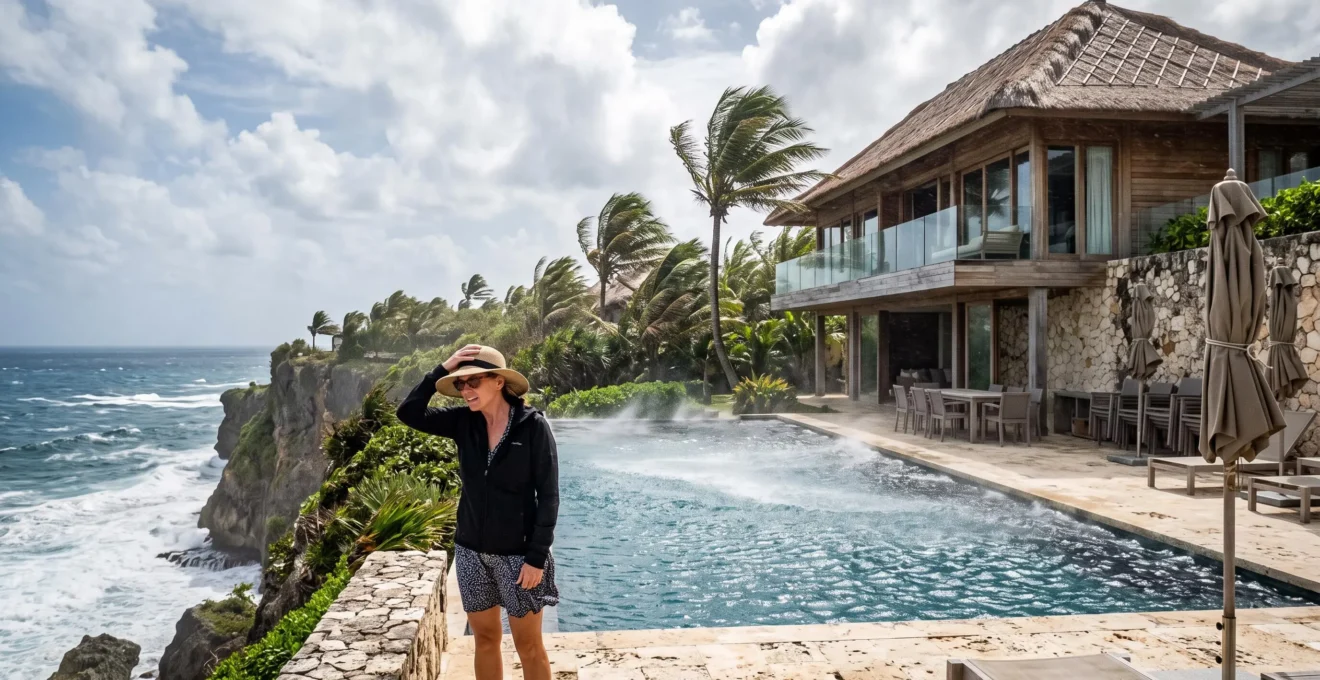
A coastal villa can offer extraordinary ocean views while delivering a surprisingly uncomfortable holiday. Strong afternoon winds may make the terrace unusable, seasonal seaweed can cover the swimming beach, and low tides may leave the shoreline far beyond the property’s advertised beachfront position.
Choosing a comfortable coastal villa means evaluating how the property interacts with its coastline, not simply how close it sits to the water. Wind direction, shoreline orientation, tidal range, wave exposure, beach access and seasonal weather patterns all influence whether the outdoor spaces will work for everyday holiday activities.
These details become particularly important for families with young children, travellers planning to spend most of their time outdoors, and anyone booking a remote villa where alternative beaches are difficult to reach.
The most reliable approach combines location-specific weather information, satellite imagery, tide predictions, recent guest evidence and precise questions answered by the host in writing. No remote check can guarantee perfect conditions, but these checks can expose problems that attractive listing photographs cannot.
Coastal villa essentials before booking
- Check exposure, not just views: compare prevailing wind directions with the terrace, pool and beach orientation during your travel period.
- Verify when the beach is usable: assess tidal range, seasonal seaweed, surf, currents and whether swimming is possible at different water levels.
- Confirm access and contingency plans: establish whether beach access is genuinely exclusive, safe for children and dependable during poor weather.
- Why Can a Coastal Villa Look Perfect but Feel Unlivable When the Wind Picks Up?
- How to Check Wind Exposure and Beach Usability Before You Book a Coastal Villa?
- Beachfront or Lagoon-Side: Which Works Better if You Want Calm Water for Kids?
- The Tide Assumption That Can Make Your “Beachfront” Villa Feel Cut Off Half the Day
- When Should You Book a Coastal Villa to Avoid Storm Weeks and Unswimmable Water?
- How to Check If a Beach Access Path Is Exclusive in 20 Minutes Using Maps and Photos?
- How to Assess Private Island Logistics Before Booking So You Don’t Get Stuck in Bad Weather?
- How to Confirm Private Beach Access Before You Book Without Relying on a Host’s Promise
Why Can a Coastal Villa Look Perfect but Feel Unlivable When the Wind Picks Up?
A beautiful coastal villa can become uncomfortable when its terrace, pool or outdoor dining area faces persistent winds without adequate shelter. Clifftop elevation, gaps between headlands and exposure to prevailing seasonal winds can intensify the problem. The result may be a property with spectacular views but outdoor spaces that are difficult to enjoy for much of the day.
Coastal wind exposure depends heavily on location and orientation. A villa positioned on an exposed promontory can experience stronger gusts than another property farther inland or behind a sheltered hillside. Even neighbouring villas may behave differently if one faces the open sea while the other sits behind vegetation or a substantial building.
Local geography can also redirect air through valleys or gaps between headlands. Elevated terraces may lack the natural barriers found closer to ground level. A hypothetical villa situated 500 metres inland, behind a ridge, could therefore feel calmer than a beachfront property nearby, although distance inland alone does not establish wind conditions.
Two different wind patterns deserve attention. Seasonal winds, including trade winds and monsoon-related flows, can create recurring exposure during particular parts of the year. Daily thermal winds arise as land and sea surfaces heat differently.
The National Weather Service definition of a sea breeze explains that this daytime wind moves from the cooler ocean toward warmer adjacent land. Its strength and timing vary with local weather. A terrace might be pleasant over breakfast but exposed to troublesome onshore winds later in the day; there is no universal starting hour.
Wind affects more than comfort. Persistent gusts can disrupt outdoor meals, move lightweight furniture, disturb pool surfaces and make sun umbrellas difficult to use safely. Salt-laden air also creates maintenance demands for exposed metal fittings and equipment. Families may find that an otherwise attractive pool deck offers too little protection for children.
Vegetation offers useful clues. Trees growing consistently away from the sea, wind-shaped shrubs and sparse exposed planting can indicate recurring wind stress. These signs are not definitive because landscaping, soil and maintenance also influence vegetation.
Professional photographs rarely establish typical weather conditions. A calm-looking terrace demonstrates what the property looks like under the conditions photographed, not whether those conditions are common during your travel dates.
The key distinction is between a beautiful location and a usable outdoor environment. Once that distinction is clear, the next step is to test the property’s exposure using information that can be checked before booking.
How to Check Wind Exposure and Beach Usability Before You Book a Coastal Villa?
To assess a coastal villa before booking, compare historical wind conditions for your travel period with the property’s exact orientation, then check the beach for wave protection, tidal limitations and seasonal seaweed. Satellite imagery, marine forecasts, recent guest photographs and specific host answers provide stronger evidence together than any single listing photograph or general destination weather description.
Start by locating the villa as precisely as possible. A forecast for the nearest town may not represent an exposed headland, narrow bay or offshore island. If the listing hides its exact position, ask for a map pin before making a non-refundable commitment.
Use a marine weather platform such as Windy or Ventusky to inspect wind direction and forecast patterns, where coverage is available. For historical comparisons, use actual archived observations or verified historical datasets rather than assuming a forecast interface provides past measurements. Compare the same calendar period as your intended stay across available years, including typical wind strength, gusts and directional changes.
Next, open satellite imagery and identify the coastline, terrace, pool deck and possible sheltering landforms. A windward pool terrace is a meaningful warning sign when historical winds frequently approach from its exposed side. Look for sheltered courtyards, walls, planting and alternative outdoor seating areas.
Beach usability requires a separate assessment. A headland or offshore reef may reduce incoming wave energy under certain conditions, but neither guarantees safe swimming. Look at the beach’s orientation, visible reef flats, neighbouring inlets and whether the shoreline appears steep or gently sloping.
Review recent guest photographs and comments from the same season as your planned stay. Search specifically for references to washed-up seaweed, unpleasant smells, strong currents, exposed rocks, rough surf or restricted swimming hours. Seaweed accumulation can shift with wind, currents and seasonal conditions, so an isolated photograph should not be treated as a permanent description of the beach.
Ask the host two questions that require concrete answers:
- “Which side of the house is the main outdoor area on relative to the prevailing wind during our travel dates, and is there a sheltered alternative?”
- “Is the swimming beach directly in front of the villa usable at low tide, or does a reef flat or exposed seabed prevent swimming?”
Request recent photographs taken from the terrace toward the sea and from the beach toward the property. Images showing both directions can clarify orientation and access more effectively than isolated promotional photographs.
Five checks to complete before paying a villa deposit
- Confirm the exact location: save a map pin and satellite screenshot showing the villa, beach and surrounding headlands.
- Compare seasonal winds: record the prevailing directions and available historical conditions for your travel week, noting the dataset and dates checked.
- Map outdoor exposure: annotate the terrace, pool, windward side and sheltered areas on a property image.
- Verify beach conditions: collect dated guest evidence and tide information, producing a short list of possible swimming limitations.
- Obtain written clarification: save the host’s answers about wind shelter, low-tide swimming and recent seaweed conditions with your booking records.
If the evidence remains unclear, treat the uncertainty as a booking risk rather than filling the gap with optimistic assumptions. This matters even more when choosing between an open beachfront property and a sheltered lagoon-side villa for children.
Beachfront or Lagoon-Side: Which Works Better if You Want Calm Water for Kids?
A lagoon-side or reef-sheltered villa may be better for families seeking gentle water entry and reduced wave exposure, while an open beachfront villa often suits older children who enjoy waves and long stretches of sand. Neither setting is automatically safer. Water depth, currents, tidal changes, local hazards and supervision matter more than the beachfront or lagoon label.
Open beaches often provide space for walking, games and activities involving waves, but swimming conditions can change with swell and wind. Lagoon-side properties may offer quieter water, although their appeal depends on water circulation, depth and the character of the surrounding shoreline.
Some sheltered lagoons have limited water exchange, muddy areas, odours or biting insects. Others provide clear, well-flushed swimming environments. The word “lagoon” alone cannot distinguish between them.
The following comparison helps identify which setting better matches a family’s expectations.
| Consideration | Open beachfront | Lagoon-side or sheltered bay |
|---|---|---|
| Wave exposure | Can be substantial when swell reaches the coast | Often reduced by shelter, depending on location |
| Young children’s water activities | Requires close assessment of surf, slope and currents | May offer gentler entry if depth and currents are suitable |
| Older children’s activities | May support bodyboarding where local conditions permit | Often better suited to quiet paddling or kayaking |
| Shoreline walking | Potentially longer sandy stretches | May be interrupted by mangroves, rocks or narrow shores |
| Low-tide conditions | Can expose substantial beach or seabed | Can leave shallow flats or isolated pools |
| Potential drawbacks | Surf, strong currents and wind exposure | Variable circulation, insects and restricted swimming depth |
For toddlers, prioritise controlled entry, manageable depth, nearby shade and clear visibility across the swimming area. For older children, consider whether the activities they want are actually suitable for that beach. Families with children of different ages should choose according to the child whose safety requirements are most restrictive, not simply the most adventurous swimmer.
Calm-looking water is not necessarily safe water. The National Weather Service information on dangerous currents explains how rip currents can form near breaks in sandbars and coastal structures, while strong tidal currents may occur around inlets and estuaries. Sheltered appearance should never replace local safety advice.
A further complication is that lagoon conditions are not necessarily permanent. Reefs, sandbars, sediment movement and storm-related changes can influence shelter and water depth. A positive review written two years earlier may no longer describe the exact swimming environment.
Ask whether the lagoon retains sufficient depth throughout the tide cycle, whether it connects to a tidal channel, and whether swimming is permitted and recommended by knowledgeable local operators. Where lifeguards or official beach warnings exist, check their coverage and guidance.
A sheltered setting can improve comfort without eliminating coastal risks. Once the preferred beach type is clear, the next question is whether its water and shoreline will still be usable at the times your family wants to enjoy them.
The Tide Assumption That Can Make Your “Beachfront” Villa Feel Cut Off Half the Day
Beachfront does not guarantee that swimmable water remains close to a villa throughout the day. On shallow, gently sloping coasts with substantial tidal ranges, the shoreline can retreat a considerable distance at low tide. Conversely, high tide can cover a narrow beach almost completely. Both situations can restrict swimming, walking and water activities.
Two physical factors control much of this experience: tidal range and shoreline gradient. Tidal range describes the vertical difference between high and low water levels. A shallow beach can translate a relatively modest vertical change into a significant horizontal movement of the waterline, while a steep beach may show less visible retreat.
Some tropical reef-flat environments expose large areas of sand, coral rubble or seagrass at low tide. In suitable locations, the water may withdraw hundreds of metres. That possibility must be established for the particular beach rather than assumed for all tropical destinations.
For United States destinations, the NOAA Tide Predictions Users Guide explains how to find location-specific stations and view predicted tidal heights. Elsewhere, consult the relevant national hydrographic service, port authority or recognised local tide provider.
Compare high- and low-tide predictions for your travel dates, then investigate the beach profile using satellite imagery, dated photographs and local descriptions. Satellite images can suggest exposed flats and reef structures, but a single image cannot reliably establish beach gradient or calculate the distance to the waterline.
Tidal restrictions affect more than swimming. Direct-access snorkelling may become impractical over exposed reef flats. Kayaks and small boats may need different launch points, while shallow mooring areas may be inaccessible during parts of the tide cycle. Operators should confirm suitable water depths and conditions before scheduling activities.
The reverse problem also deserves attention. A villa positioned behind coastal vegetation or a low bluff may have a usable beach at low tide but very little dry sand at high tide. Depending on local conditions, high water and waves can also make a narrow access route unsafe.
Low tide is not necessarily bad for families. It may reveal interesting rock pools or broad spaces for supervised exploration, provided local conditions are suitable and hazards such as slippery surfaces, marine animals and incoming tides are understood.
Because high- and low-water times shift across the days of a stay, a beach that looks perfect at breakfast on one day may be very different at the same hour later in the holiday.
The goal is not necessarily to find a beach unaffected by tides, which is unrealistic in many destinations. It is to know when the beach works, which activities remain possible and whether those conditions fit the family’s routine. Seasonal weather adds another layer to that decision.
When Should You Book a Coastal Villa to Avoid Storm Weeks and Unswimmable Water?
The best time to book a coastal villa depends on the property’s exposure to seasonal winds, storms, swell and rainfall, not simply the destination’s advertised high season. Travellers should compare the exact travel period with local weather patterns and the villa’s shoreline orientation. No season eliminates storm risk, and a normally sunny period does not guarantee comfortable swimming conditions.
Three overlapping weather patterns are often mistakenly grouped under the label “bad season”. Tropical cyclone seasons describe periods of elevated tropical cyclone risk in relevant regions. Monsoon or rainy seasons involve broader seasonal atmospheric patterns. Transitional periods can bring changes in wind direction, swell exposure and rainfall behaviour.
These patterns are related in some destinations but are not interchangeable. Their timing varies geographically, and none should be assigned universal dates.
For villa selection, the direction of seasonal winds can matter as much as their strength. A coastline sheltered from one prevailing wind direction may face open-water exposure when the seasonal flow reverses.
Consider a hypothetical property on an east-facing shore. If the dominant winds approach from the west during one travel period, the surrounding land might provide substantial protection. During a period of easterly winds and swell, the same property could become much more exposed. This example illustrates the mechanism; it does not describe a verified destination.
Shoulder-season bookings involve a genuine trade-off. They may offer lower advertised rates and fewer visitors, but conditions can be less predictable where seasonal weather systems are changing. The appropriate choice depends on whether the traveller prioritises cost, quiet surroundings, outdoor dining or dependable water activities.
Seaweed is another reason to avoid relying on generic “dry season” descriptions. Floating and washed-up marine vegetation can respond to currents, wind direction, storms and local coastal circulation. Ask specifically about the beach immediately in front of the villa, rather than whether the destination generally experiences seaweed.
A practical booking timeline begins before selecting accommodation. First, identify the region’s officially recognised storm seasons and weather hazards. Next, compare available wind and swell observations for the planned calendar week, preferably across several years. Then check recent reports of swimming restrictions or recurring seaweed accumulation.
Finally, ask the host what guests experienced during the equivalent period in recent years. Specific descriptions of wind, beach cleanliness and swimming access are more useful than assurances of year-round sunshine.
Historical patterns inform risk but cannot predict a particular holiday week. Where reliable observations are unavailable, record that uncertainty and consider accommodation with a sheltered pool, alternative beaches or flexible cancellation conditions.
Even a well-timed stay can disappoint if getting to the beach involves a difficult or shared route. The next check concerns the physical access between the property and the shoreline, which can be verified separately from weather conditions.
How to Check If a Beach Access Path Is Exclusive in 20 Minutes Using Maps and Photos?
A 20-minute remote check can identify whether a villa’s beach access appears direct, shared or potentially obstructed. Satellite maps, street-level images, property plans and recent guest photographs help reveal gates, neighbouring paths, steep sections and possible public routes. This check can expose practical concerns, but it cannot establish legal exclusivity without reliable property and access records.
Start with the property’s exact position, then follow the apparent route to the beach using the most detailed imagery available. Look for paths connecting nearby buildings, fences interrupting the route, retaining walls, steps, roads and possible alternative entrances.
Be careful with property boundaries. Satellite imagery generally shows visible physical features, not legally authoritative title boundaries. A fence may not follow the legal boundary, and an apparently private path may be subject to a public right of way or a shared easement.
Coastal access law also varies substantially by jurisdiction. In England, for example, Natural England‘s guidance on coastal access rights explains how publicly accessible coastal margins can coexist with privately owned land, subject to exclusions and local restrictions. This is an English legal example, not a rule governing every country or beach.
There is no universal basis for assuming that the foreshore below the high-tide line is always publicly accessible. Ownership, public rights and permissible routes must be checked under the applicable local law.
A focused 20-minute investigation can be organised as follows:
- Minutes 0–5: locate the villa and trace the shortest visible route from the building to the sand, marking any roads or neighbouring plots.
- Minutes 5–10: inspect available street-level or ground photographs for gates, stairs, erosion, fences and changes in elevation.
- Minutes 10–15: review recent guest photographs and comments for evidence of shared paths, resort access or unexpected walking distances.
- Minutes 15–20: compare the findings with the listing and prepare precise questions about exclusivity, accessibility and route maintenance.
Recent traveller images can reveal whether a route is steep, uneven, overgrown or difficult when wet. For families, these practical details can be more important than the number of metres between the villa and the shoreline.
Ask how many other properties use the route, whether vehicle access reaches the beach, and whether the final section involves steps or an unpaved track. Confirm lighting, handrails and any restrictions on returning after dark, particularly when children will accompany adults.
Finally, distinguish an exclusive path from an exclusive beach. A private walkway may end on a publicly accessible shoreline. Conversely, guests may have a contractual right to reach a beach through land they do not own.
The result should be a clear record of what can be observed, what the host has confirmed and what still requires legal verification. For remote island properties, however, the route from the villa to the beach is only one part of a much larger access problem.
How to Assess Private Island Logistics Before Booking So You Don’t Get Stuck in Bad Weather?
Private island villas require an additional booking assessment because boats or light aircraft may stop operating before weather becomes dangerous at the accommodation itself. Wind, swell, visibility and other operating conditions can delay transfers or prevent departure. Travellers should confirm transport limits, backup arrangements, essential supplies and emergency procedures before paying for an island stay.
A calm-looking private island can still be difficult to reach. A transfer boat might face rough conditions along an exposed channel even when the villa’s sheltered beach appears comfortable. Light aircraft may have separate limitations involving visibility, wind or landing conditions.
Actual operating thresholds depend on the vessel or aircraft, the operator, local regulations and the route. They should never be inferred from generic weather forecasts.
Ask the operator to confirm the transfer arrangements in writing, including the following:
- The vessel or aircraft type used for scheduled transfers and the relevant operating restrictions.
- Typical departure frequency, luggage allowances and whether transfers are included in the accommodation price.
- Who decides whether a transfer can operate and how cancellation decisions are communicated.
- What happens if arrival or departure is delayed, including accommodation, additional transfer charges and refund or rescheduling policies.
- Whether an alternative route or transport provider exists when the normal service is suspended.
Island self-sufficiency is equally important. A property may depend on scheduled deliveries for food, fuel, medicines or maintenance supplies. Extended rough weather could affect essential services if the island has limited storage or no dependable backup.
Confirm drinking-water arrangements, electricity generation, backup power, communication coverage and the availability of essential food supplies during a prolonged transfer interruption. Travellers with medical needs should establish whether trained personnel, a clinic or necessary medication can be accessed locally.
Emergency evacuation needs particular attention. Ask who coordinates medical assistance, what transport is available, whether evacuation is possible at night and how adverse weather changes the response. A private island’s remoteness can create delays that ordinary mainland accommodation would not.
Travel scheduling can reduce some consequences. Where the wider itinerary permits, place the island stay in the middle rather than at the end of the holiday and reserve a flexible mainland night before an international departure. This does not eliminate disruption, but it provides more room to adapt if a transfer is postponed.
Insurance terms should also be checked carefully. Coverage for travel delay, missed connections, weather-related disruption and medical evacuation varies by policy and circumstances. An accommodation provider’s transfer assurances do not replace the insurer’s written conditions.
The ability to reach and leave a property is fundamental to its suitability. For mainland and island villas alike, the final booking decision should also establish exactly what “private beach access” means in legal and practical terms.
Key takeaways before confirming beach privacy
- Separate ownership from access: a privately owned villa does not necessarily control who can use the beach in front of it.
- Verify the full route: determine whether access depends on a shared path, neighbouring land or a public right of way.
- Protect the booking decision: obtain written, specific statements about shared use and restrictions before accepting non-refundable terms.
How to Confirm Private Beach Access Before You Book Without Relying on a Host’s Promise
To confirm private beach access, establish what the listing means by “private”, identify the legal and physical route from the villa to the shore, and verify whether other people may use either the path or the beach. Written host explanations, property plans, official access records and recent guest evidence are more dependable than a general promise of exclusivity.
The phrase “private beach” can refer to several different arrangements. A villa might have exclusive access to a privately controlled shoreline, share a beach with other rental properties, possess a legal right to cross neighbouring land, or simply offer convenient access to a beach that members of the public can also visit.
These distinctions affect privacy, noise, pedestrian traffic and the suitability of the beach for families seeking an uninterrupted holiday.
Start by examining the wording of the listing. “Private beachfront”, “private beach access”, “exclusive beach” and “direct beach access” are not necessarily equivalent statements. None should be accepted as conclusive legal evidence without reference to the property’s actual arrangements.
Compare the advertised location with available site plans. Determine whether the villa is directly adjacent to the shore, separated by a public road, positioned behind another property or dependent on a designated access corridor.
Ask for a site plan or boundary diagram where available. A marketing plan may help explain the layout but is not a substitute for a legally reliable cadastral or land-registry record.
Where the destination provides official online property maps, check whether the relevant parcel boundaries, access easements and public rights of way can be identified. Local tourism authorities or coastal access agencies may also publish information about public beaches and permitted access routes.
Legal beach ownership and permission to use the beach are separate questions. Private ownership may be subject to public access rights, while a public beach may still be reached from a villa by a private walkway. The applicable rules differ between countries and sometimes between regions within the same country.
Request written answers to the following practical questions:
- Is the beach itself reserved exclusively for guests of this villa, or is only the access path private?
- How many other villas, homes, businesses or resort guests may use the same beach or path?
- Are there any public rights of way, shared access agreements or seasonal access restrictions?
- Is the beach accessible directly from the villa without crossing land controlled by another party?
- Have any access disputes, closures or restrictions affected guests recently?
Recent guest accounts can provide useful corroboration. References to resort guests, vendors, walkers, shared stairways or public beach entrances may explain what the property description omits. Nevertheless, photographs showing other people on a beach do not, by themselves, prove unlawful access or misrepresentation.
The financial consequences can be significant. A family expecting solitude may discover that the shore attracts regular pedestrian traffic or that the beach path crosses a busy resort. Whether this constitutes a refundable misdescription depends on the booking terms, representations made, applicable consumer law and the evidence available.
Keep screenshots of the listing, relevant messages, access diagrams and any explicit exclusivity assurances. If privacy is essential to the booking, ask the host to confirm the precise arrangement through the booking platform before making payment.
Before confirming a reservation, compare the remaining shortlisted villas against the same practical criteria: outdoor wind shelter, seasonal beach conditions, tide-dependent swimming, child-friendly access, verified privacy and weather contingencies. Choose the property whose documented conditions best match how the family intends to spend its days, and resolve any essential unanswered questions before accepting the payment and cancellation terms.
Can a coastal villa be comfortable even if the beach is exposed to strong winds?
Yes. A villa may have a sheltered courtyard, protected pool, wind-screened dining terrace or alternative outdoor spaces even when the adjacent beach is exposed. Assess each usable area separately and ask whether the main facilities remain comfortable during the prevailing winds for your travel period. Wind protection should not compromise ventilation or create other safety concerns.
How can travellers tell whether seaweed is a temporary problem or a recurring seasonal issue?
Compare dated guest photographs, reviews and local beach-condition reports from several periods rather than relying on a single image. Ask the host whether accumulation repeatedly occurs during the same travel months and whether beach clearing is carried out where permitted. Evidence of recurring deposits is more informative than a general assurance that the beach is normally clean, although future accumulation cannot be guaranteed or ruled out.
Is a villa with a swimming pool a good alternative when the sea is unpredictable?
A well-maintained pool can provide an alternative when waves, tides or local swimming warnings make the sea unsuitable. Confirm whether the pool has wind protection, suitable access arrangements, appropriate child-safety measures and reliable maintenance. A pool should be considered an additional amenity rather than proof that the property is safe or comfortable in every weather condition.
What should travellers do if the host cannot confirm whether beach access is exclusive?
Treat exclusivity as unverified. Request specific information about the access route, other permitted users and any relevant property or public access records. If exclusive beach use is essential and adequate evidence cannot be provided, compare alternative accommodation rather than assuming that the listing wording creates a legal guarantee.
Should travellers reconsider a coastal villa if there is no reliable historical wind data for its exact location?
Not automatically. Nearby observations, coastline orientation, local geography and recent guest experiences can still help identify potential exposure, although they cannot replace measurements at the property. Give greater weight to villas with clearly sheltered outdoor spaces, flexible booking conditions and independently supported descriptions. Where outdoor comfort is a central reason for booking, unresolved exposure should influence the final decision.