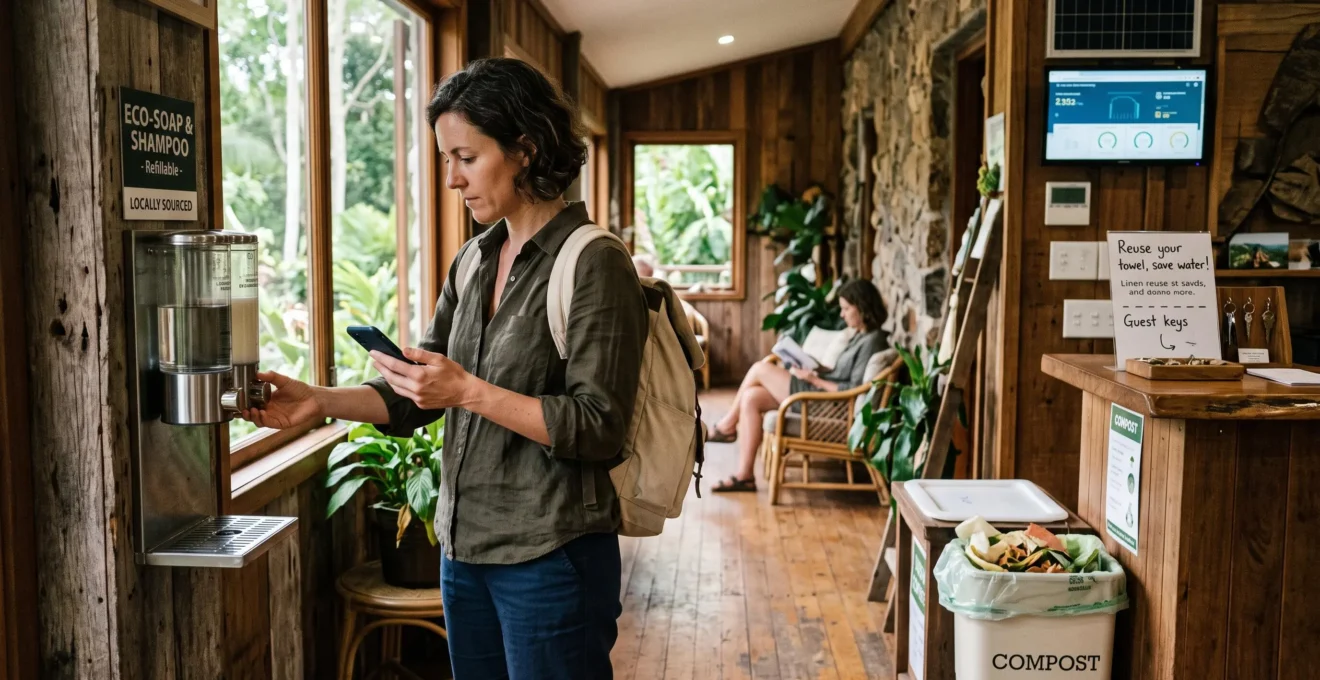
An eco-friendly hotel can offer comfortable beds, reliable hot water and effective cooling while reducing its environmental impact. Equally, a secluded lodge surrounded by trees can operate inefficiently, provide unreliable facilities and rely on vague environmental promises.
The difference is rarely visible in the booking headline. It emerges when you examine how a property generates or purchases energy, manages water and waste, sources supplies, treats staff and handles the practical demands of hosting guests.
Comfort matters in that assessment. A cold bedroom is not evidence of sustainability, and a powerful air-conditioning system is not automatically evidence of waste. Climate, building design, energy supply and the needs of individual travellers all influence whether a particular compromise makes sense.
Before booking, the useful question is not simply whether accommodation calls itself green. It is whether its environmental claims are verifiable, its essential services meet your needs and the journey to reach it supports your wider travel goals.
How to recognise a genuinely responsible stay
- Verify specific environmental practices and independently assessed certifications instead of trusting green labels or attractive scenery.
- Check heating, cooling, hot water, insulation and service arrangements before accepting any comfort-related trade-off.
- Consider transport, length of stay and local spending alongside the accommodation’s own environmental performance.
- Why Do Some Eco-Friendly Hotels Feel Like They’re Cutting Corners Rather Than Cutting Impact?
- How to Check if an Eco-Friendly Accommodation Is Legit Using 6 Listing Clues?
- Eco-Lodge or City Hotel: Which Is Better if You Need Air-Con and Still Want Lower Impact?
- The Eco-Stay Mistake That Cancels Out Your Savings With One Long Transfer
- How Long Should You Stay in One Place to Make Your Trip More Sustainable Without Getting Bored?
- Off-Grid Cabin or Serviced Lodge: Which Is Better When You Need Reliable Heating at Night?
- How to Spot Locally Owned Tours and Shops Using 5 Clues Without Asking Awkward Questions?
- How to Support Local Communities on Holiday Without Paying “Local” Prices for Tourist Traps
Why Do Some Eco-Friendly Hotels Feel Like They’re Cutting Corners Rather Than Cutting Impact?
Some eco-friendly hotels feel uncomfortable because their sustainability measures reduce operating costs without improving the underlying quality of the property. Others use similar measures as part of a wider investment in efficient buildings, responsible procurement and better management. The distinction is whether environmental savings accompany meaningful operational improvements or merely shift inconvenience onto guests.
Consider two hypothetical hotels that both replace daily towel changes with an optional service. One invests in improved insulation, efficient water heating and staff training. The other removes housekeeping but offers little evidence of wider environmental improvements. Guests encounter the same towel policy, yet the operational context is different.
This is the problem with the single-gesture eco hotel: one visible initiative becomes the property’s entire environmental identity. Refillable toiletries, recycled stationery or reduced room cleaning may be useful, but none establishes how electricity is produced, waste is handled or food is sourced.
A quick mental test helps: does the environmental measure require effort from the guest, investment from the property, or both? Guest participation is not inherently suspicious. However, substantial sustainability programmes should also address systems that travellers cannot manage themselves.
The language used in advertising deserves similar attention. Expressions such as “eco-conscious”, “green stay” and “nature-friendly” reveal little unless their meaning is specified. The FTC‘s summary of the Green Guides on environmental claims cautions against broad, unqualified environmental benefits that are difficult to substantiate. This is US guidance, not a universal rule applying identically across English-speaking countries.
Comfort complaints can provide additional context. Repeated reports of weak showers, insufficient heating or unavailable basic amenities justify questions about whether the property’s environmental choices are well designed. They do not, by themselves, prove deliberate greenwashing.
A low-flow shower can be entirely compatible with good water pressure and a satisfying experience if the system is designed appropriately. Poor temperature control, by contrast, may indicate unsuitable equipment or inadequate maintenance rather than an unavoidable ecological compromise.
Before accepting discomfort as part of responsible travel, examine what the property has improved behind the scenes. That leads naturally to the evidence available before booking.
How to Check if an Eco-Friendly Accommodation Is Legit Using 6 Listing Clues?
To check whether eco-friendly accommodation is credible, examine six clues: independently verifiable certification, specific environmental claims, transparent staff and ownership information, responsible sourcing, clear energy and water practices, and photographic evidence of actual infrastructure. Together, these offer a more useful assessment than a sustainability badge or attractive nature photography alone.
Start with what the listing says, then determine which statements can be confirmed independently.
- Named certification. Look for the issuing organisation, the certified property, the certificate’s scope and its validity. A logo without an identifiable certification process is weak evidence.
- Specific claims. Prefer named systems, defined targets, dated measurements and explanations of what is included over adjectives such as “planet-positive”.
- People and management. Check whether the property explains who operates it, how staff are trained and whether it addresses employment and community responsibilities.
- Food and supplies. Look for identifiable sourcing practices, seasonal menus, supplier relationships and measures to reduce purchasing and food waste.
- Energy and water. Seek details about renewable electricity, heating and cooling equipment, water conservation and wastewater treatment.
- Visible infrastructure. Photographs of solar equipment, shaded buildings, gardens or waste-handling facilities can support a claim, but cannot establish actual performance without documentation.
Certification requires particular care. The GSTC‘s explanation of certification, accreditation and recognition distinguishes an independently audited tourism business from the certification body that assesses it and the sustainability standard being applied.
GSTC Recognition concerns alignment of a standard with GSTC criteria. It does not, by itself, verify a particular hotel. GSTC Accreditation concerns certification bodies, while GSTC membership is not accommodation certification.
Programmes and credentials such as Green Key, EarthCheck, LEED and B Corp may offer useful information, but they do not all assess the same things. Building certification, organisational certification and accommodation sustainability certification should not be treated as interchangeable.
A practical two-minute first screening involves opening the property’s sustainability page, checking the named certifier’s public directory where available, and scanning recent negative reviews for terms such as “cold”, “no hot water”, “basic” or “no air conditioning”. Such reviews identify comfort risks, not verified environmental failures.
For example, Green Key‘s official certification programme overview describes criteria addressing management, energy, water, waste, procurement and social responsibility, supported by documented evidence and third-party audits. An audit assesses conformity within its scope at the time of assessment; it does not guarantee uninterrupted comfort.
Five checks to complete before paying
- Find the property’s sustainability statement and save one specific, testable claim.
- Identify the claimed certification, its issuing body and the property-level record, or note that verification is unavailable.
- Record the heating, cooling, hot-water and backup arrangements from the listing or a written response.
- Read recent critical reviews and note any repeated comfort problem with its review date.
- Compare the property’s location and transport options, then save your preferred route and estimated transfer requirements.
A property surrounded by forest is not automatically environmentally efficient. A well-managed urban building may offer more convincing operational evidence, particularly when cooling is essential.
Eco-Lodge or City Hotel: Which Is Better if You Need Air-Con and Still Want Lower Impact?
A well-managed city hotel can be the better environmental and comfort choice when reliable air conditioning is essential, particularly in hot, humid climates. An eco-lodge may be preferable in mild conditions when passive cooling works effectively. The deciding factors are building design, electricity supply, equipment efficiency, climate and the amount of cooling you actually need.
Air conditioning is not a simple dividing line between responsible and irresponsible accommodation. An efficiently cooled room connected to a relatively low-emission electricity supply may perform better than a remote property relying heavily on diesel-generated electricity. Actual comparisons require property-specific energy information.
Passive approaches also deserve attention. Building orientation, exterior shading, ventilation, reflective surfaces and insulation can reduce cooling demand. However, natural ventilation alone may not maintain comfortable indoor conditions during extreme heat or humid nights.
Before booking, consider whether cooling is a preference, a requirement for uninterrupted sleep or a health-related necessity. These situations justify different levels of flexibility.
The following decision grid illustrates how to match the accommodation to your circumstances rather than its branding.
| Stay conditions | Eco-lodge | Serviced city hotel |
|---|---|---|
| Hot, humid nights | Suitable if effective, reliable cooling is demonstrated | Often easier to assess when individual room cooling is documented |
| Mild weather or shoulder season | Passive ventilation and shading may be sufficient | Can also be efficient if cooling is rarely required |
| Health-sensitive traveller | Choose only with dependable temperature control | Potentially preferable when suitable cooling and support are confirmed |
| Electricity and environmental impact | Check generation, storage and backup fuel | Check energy management, equipment and electricity sourcing |
Efficient cooling still benefits from sensible operation: close curtains or shutters when appropriate, use a moderate thermostat setting and avoid cooling an empty room unnecessarily. Humidity control and adequate ventilation remain important.
The strongest pre-booking question is “How is the property cooled and powered?” Ask whether the room uses passive design, fans, an efficient air-conditioning unit or a central system, and whether backup electricity is available.
A lodge designed for its local climate may need little mechanical cooling. A poorly adapted building with a small, inefficient air-conditioning unit can have the opposite result, regardless of its eco-friendly description.
Once room comfort is accounted for, the next question is whether reaching the accommodation creates more environmental impact than its operations can reasonably offset.
The Eco-Stay Mistake That Cancels Out Your Savings With One Long Transfer
A remote eco-lodge can lose some or all of its accommodation-related environmental advantage when reaching it requires substantial additional travel, especially a flight or long private vehicle transfer. The outcome depends on distance, transport mode, passengers, accommodation performance and length of stay. A green property cannot be assessed independently of the journey required to reach it.
Transport is a major component of tourism’s climate impact. Research presented in UN Tourism‘s summary of research on tourism transport emissions, based on work with the International Transport Forum, illustrates the scale of transport-related carbon dioxide emissions.
1,597 million tonnes of CO₂
Estimated global tourism transport-related carbon dioxide emissions in 2016, according to UNWTO and International Transport Forum research published in 2019. This is a historical global estimate, not an individual journey calculation or a measured 2026 figure.
UN Tourism and International Transport Forum, 2019 research, using a 2016 baseline.
For a particular booking, the relevant comparison is the additional journey created by choosing one property over another. The longest section of your trip may already be unavoidable; an extra domestic flight, remote road transfer or repeated excursion is the part that can change with accommodation choice.
A basic calculation starts with the distance travelled and the transport mode. Where suitable emission factors are available, approximate transport emissions can be estimated as distance multiplied by an appropriate emissions factor, adjusted for the factor’s passenger or vehicle basis.
Use consistent boundaries when comparing options. Include relevant outward and return transfers, vehicle occupancy where required, and the same treatment of electricity, fuel and aviation impacts. A distance alone is not an emissions estimate.
Hypothetical comparison: a short remote escape
Imagine two accommodation options for a two-night break. The first is a moderately efficient hotel accessible directly by train. The second is a remote lodge requiring an additional long private road transfer.
The remote lodge may use less energy per guest-night, but the additional journey could outweigh that advantage. Without verified accommodation data, route distances and transport emission factors, the total difference cannot be quantified.
Before choosing the remote option, check whether a shared shuttle, train or public bus is possible. Direct routes, fewer transport legs and activities near the accommodation may also reduce unnecessary travel.
Length of stay matters because a fixed transfer can be spread over more guest-nights when comparing emissions per night. Staying longer does not automatically lower the total emissions of a trip, particularly if it adds activities or extra travel.
A centrally located hotel can therefore be the more responsible choice for a short visit. For longer holidays, a remote location becomes more defensible when unnecessary transfers and daily driving are limited.
How Long Should You Stay in One Place to Make Your Trip More Sustainable Without Getting Bored?
There is no universally sustainable number of nights to spend in one destination. Staying longer can reduce the frequency of transfers and make slower travel more practical, but only when the destination provides enough worthwhile activities nearby. The best duration balances avoided travel, local experiences, accommodation impact and your genuine interest in remaining there.
Instead of starting with a fixed rule such as staying at least a week, examine the destination’s activity density. A small village with limited attractions offers a different experience from a region with walking routes, cultural sites, food experiences and public transport connections.
For an initial planning exercise, assess three elements:
- Variety: Can the surrounding area offer several distinct activities without repeated long transfers?
- Pace: Would a mix of structured experiences and unplanned exploration suit your travel style?
- Access: Are shops, restaurants, walking routes and cultural attractions conveniently reachable?
A useful approach is to choose one meaningful activity for each major part of the stay, then leave time for spontaneous discoveries. For example, a hypothetical week-long booking might combine local walks, a market visit, a guided cultural experience and several flexible days for food or neighbourhood exploration.
This avoids the pressure to schedule a distant excursion every morning simply to justify the booking.
Longer stays can also create opportunities for repeated spending at independent restaurants, shops and activity providers. You may become more familiar with the area, learn which operators are locally rooted and rely less on packaged experiences.
However, a longer booking does not guarantee better outcomes. Accommodation continues consuming resources each day, and additional excursions generate their own impact. A property that requires constant driving to access basic activities may be poorly suited to slow travel.
For remote locations, assess the complete itinerary before committing. A destination that appears peaceful for two nights may become restrictive after several days, especially without a vehicle or reliable local services.
The better alternative may be a well-connected regional base with varied nearby activities, even when the accommodation looks less explicitly ecological.
Wherever you stay, the quality of the room itself remains a practical constraint. In colder climates, heating reliability can matter even more than the property’s location or recommended duration.
Off-Grid Cabin or Serviced Lodge: Which Is Better When You Need Reliable Heating at Night?
A serviced lodge is generally the safer practical choice when uninterrupted overnight heating is essential, provided its heating and backup arrangements are confirmed. An off-grid cabin can also be comfortable and efficient, but its reliability may depend on insulation, fuel supplies, stored electricity and guest involvement. The right choice depends on expected temperatures and your tolerance for managing heat yourself.
Off-grid accommodation can use wood stoves, propane appliances, solar-powered equipment or combinations of different technologies. These systems have different operating requirements, emissions and limitations.
A wood stove may provide effective heat but need attention, suitable fuel and safe operation. Solar storage may be sufficient for some electrical loads without supporting continuous electric heating during prolonged cold weather.
Serviced accommodation can offer staff-managed heating, maintenance support and contingency arrangements, although such support should never be assumed from the word “serviced” alone.
Insulation is as important as heating capacity. A small, well-insulated cabin with appropriate glazing may retain heat effectively, while a larger, draughty property may consume more energy and still feel uncomfortable.
Before paying for cold-weather accommodation, ask the host:
- What provides the room’s heating, and what energy source does it use?
- Is heating included in the booking price, limited by operating hours or billed separately?
- What happens if electricity, stored energy or heating fuel becomes unavailable?
- What indoor temperature can reasonably be maintained overnight under the expected weather conditions?
- Does the building have suitable insulation and glazing, and do recent guest reviews mention cold nights?
Travellers with young children, older guests and people with temperature-sensitive health needs should place particular weight on dependability. A backup system can be valuable even if the primary heating method uses renewable energy.
Check safety as well as comfort. Any combustion-based heating arrangement needs appropriate installation, ventilation, maintenance and relevant alarms. If operation requires guest intervention, obtain clear instructions before arrival.
The environmental comparison remains conditional: reliable heating is not automatically wasteful, and off-grid status does not establish low emissions. Building performance, fuel type and energy demand determine the outcome.
Once essential comfort is secured, responsible travel can extend beyond the accommodation by considering who provides the activities and services you purchase locally.
How to Spot Locally Owned Tours and Shops Using 5 Clues Without Asking Awkward Questions?
Locally rooted tours and shops can often be identified through five clues: a genuine local business presence, identifiable guides or owners, relationships with local suppliers, transparent control of the operation, and services designed around the destination. None proves ownership alone. Together, they help travellers assess where decisions are made and who benefits from their spending.
The aim is not to identify a business owner’s nationality from their appearance or accent. It is to understand how the operation is structured and whether local people meaningfully participate in its work and rewards.
Five practical clues are worth examining:
- A verifiable local presence. Look for an actual operating address, local contact details and registration information where publicly available.
- Named guides and staff. Profiles that explain experience, specialist knowledge and ongoing involvement in the destination provide more context than anonymous promotional photographs.
- Local commercial relationships. Businesses that identify regional suppliers, craftspeople or food producers make parts of their local economic involvement more visible.
- Transparent ownership and control. Check whether the website identifies the operator, parent organisation or franchise relationship rather than relying solely on a local-sounding brand name.
- Destination-specific services. Tours developed around regional knowledge, local access and realistic travel arrangements may indicate meaningful local involvement, although they are not proof of ownership.
Where accessible, business registries and tourism-board listings can help establish who operates a company. Website information, social media replies and management responses to reviews may provide additional evidence of day-to-day involvement.
Ownership structures are not always straightforward. A locally branded company may depend heavily on foreign booking intermediaries or commission arrangements. Conversely, a foreign-founded business may employ local staff fairly, buy locally and delegate meaningful decisions to residents.
The useful assessment therefore concerns where money, employment opportunities and decision-making power sit, not simply who established the company.
These checks apply the same principle used for accommodation certification: do not confuse a marketing identity with independently supportable operational facts.
Visible local participation is useful evidence, but it does not reveal the complete distribution of profits. A locally staffed tour may still pay substantial commissions to outside platforms. Where this matters, compare the operator’s direct booking channel with intermediary arrangements.
Identifying credible operators is only the first step. The next is deciding how to spend fairly without confusing expensive tourist branding with meaningful community support.
What to remember before spending locally
- Look beyond the word “local” and consider who provides the service, controls the business and receives the payment.
- Fair prices should support reasonable compensation rather than reward opaque commissions or aggressive bargaining.
- Apply the same verification mindset to accommodation, transport, tours and shopping instead of treating sustainability as a single booking decision.
How to Support Local Communities on Holiday Without Paying “Local” Prices for Tourist Traps
Supporting local communities means directing a meaningful share of travel spending towards residents and locally rooted businesses while paying fair, transparent prices. The goal is neither to buy everything marketed as authentic nor to negotiate the lowest possible price. Compare who delivers the service, who receives the revenue and whether the experience offers genuine value.
Tourist-facing businesses sometimes use local imagery, traditional décor or regional storytelling without explaining their actual commercial arrangements. A venue may employ residents while sending a significant proportion of revenue to an outside operator, intermediary or ownership group.
This does not automatically make the business exploitative. It does mean that “authentic” is not an adequate measure of community benefit.
The most practical approach is to examine spending categories rather than chasing labels. Directly booked local guides, independent food businesses, artisans and community-run experiences may create clearer opportunities for residents to receive income, although each operator still needs individual assessment.
Purchasing directly can also make it easier to ask where products are made and who provides services. However, direct payment alone cannot establish fair wages, ethical sourcing or the full distribution of profit.
Consider a hypothetical shopping comparison. One shop sells locally made crafts and identifies their makers. Another sells similar-looking items but provides no information about production or origin. The first offers greater transparency, although the buyer would still need evidence to determine exactly how much reaches the artisan.
Price is equally important. Excessive bargaining with small producers can undermine the intention to support them. On the other hand, paying a substantial premium simply because an intermediary calls an experience “authentic” offers no guarantee of local benefit.
A more useful purchasing framework combines three questions:
- Value: Does the price reasonably reflect the product, service, quality and local context?
- Transparency: Is it reasonably clear who produces or delivers what is being purchased?
- Benefit: Is there credible evidence that local residents participate economically or control meaningful parts of the activity?
Where prices are posted, compare like-for-like services and understand what is included. When negotiating is customary, remain respectful and avoid assuming that every quoted price is either fair or inflated. Local pricing norms vary, and apparent differences may reflect service quality, costs or intermediary fees.
This completes a broader assessment of sustainable accommodation across three connected layers.
The first is verified operations: environmental practices, certifications, management and documented improvements. The second is appropriate comfort: cooling, heating, hygiene and reliability matched to personal needs. The third is whole-trip impact: transport, length of stay and participation in the local economy.
No single green label, recycling initiative or local-looking storefront verifies all three. A well-supported decision combines several pieces of evidence and acknowledges what remains unknown.
For your next trip, shortlist two or three properties, verify their environmental claims, ask one direct question about any essential comfort requirement and compare how you will reach them. Then choose the stay that best balances documented responsibility, dependable comfort and practical access to local experiences.
Can an uncertified hotel still be genuinely sustainable?
Yes. A hotel without third-party certification may still operate responsibly, particularly if it provides credible information about energy, water, waste, purchasing and employment. However, self-reported claims offer less independent assurance than an appropriate external assessment. Ask for specific, verifiable practices rather than assuming that either certification or its absence settles the question.
Does an eco-certified hotel guarantee a comfortable room?
No. Environmental certification assesses compliance with defined criteria within the programme’s scope. It does not automatically guarantee comfortable mattresses, effective heating, strong showers or uninterrupted electricity. Check room-specific amenities and recent guest experiences separately from sustainability credentials.
What should you do when a hotel refuses to explain its environmental claims?
Treat unverifiable claims as unconfirmed rather than automatically fraudulent. Request a specific detail such as the certification issuer, electricity source or water-management system. If the property cannot provide satisfactory information, compare another accommodation option with clearer evidence, especially when the environmental claim is important to your booking decision.
Is drinking tap water safe at every eco-lodge?
No. Environmental branding does not establish drinking-water safety. Potability depends on the water source, treatment, testing and applicable local health requirements. Ask the property whether tap water is safe to drink and how that is verified. Where safety is uncertain, follow reliable local public-health guidance and use an appropriately safe drinking-water source.
Should you choose a refundable eco-stay when environmental details are unclear?
A refundable booking may provide useful flexibility while you verify important claims or comfort requirements, provided the cancellation conditions genuinely allow it. Check the deadline, exclusions and applicable charges before paying. Refundability does not make the property more sustainable, but it can reduce the financial risk of choosing before essential information is available.