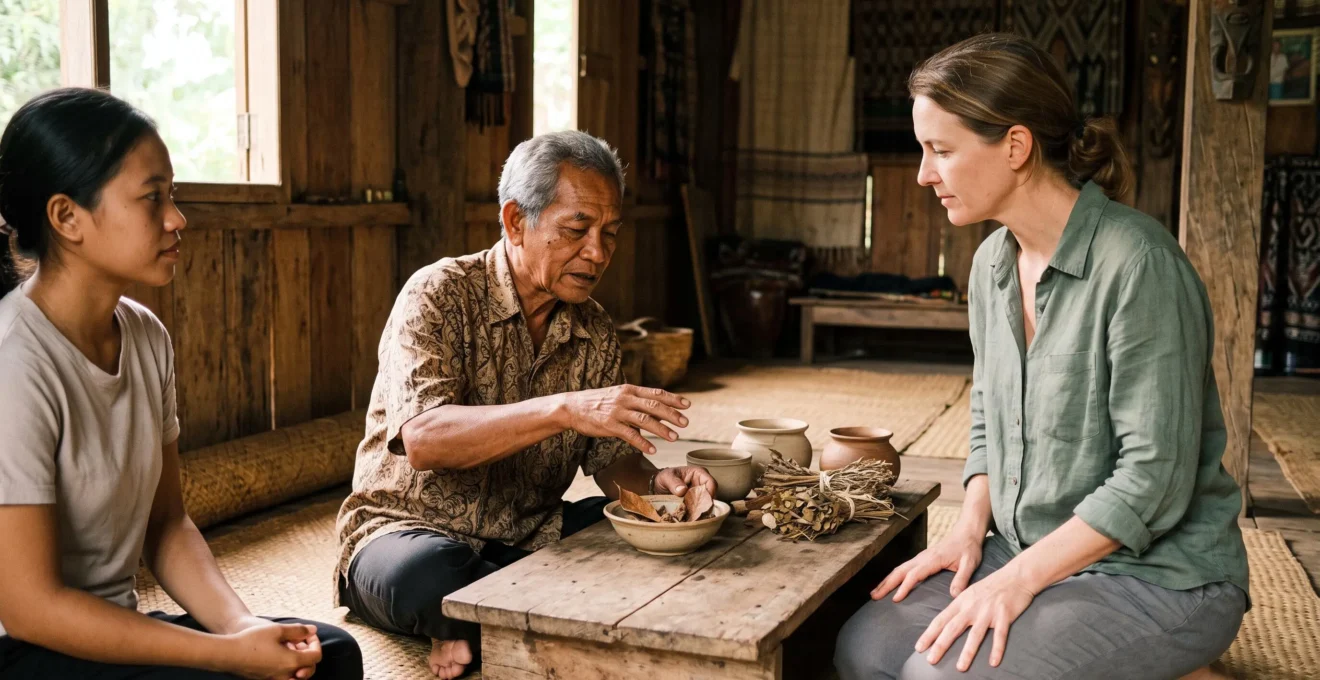
Traditional healing experiences can offer travellers opportunities to learn about cultural knowledge, community relationships and approaches to wellbeing. But an invitation to participate is not the same as booking a spa treatment. Some practices involve spiritual responsibilities, restricted knowledge or health considerations that visitors may not anticipate.
The safest and most respectful approach begins before making a reservation. Identify the specific practice, establish who has authorized its presentation to visitors, ask what participation involves and confirm that everyone can set boundaries. Be especially cautious of guaranteed cures, undisclosed substances and pressure to pay for unexpected rituals.
Respect also means accepting that certain traditions are not available to tourists. A community-led educational activity may provide a more appropriate introduction than requesting access to an intimate ceremony. The goal is not to collect an extraordinary experience at any cost, but to make an informed decision that protects both the visitor and the people sharing their knowledge.
Traditional healing travel: the essentials
- Check cultural permission: Find out who leads the experience, who authorized visitor participation and which activities remain private.
- Verify safety before booking: Ask about ingredients, physical procedures, practitioner competence, health screening, consent and emergency arrangements.
- Respect boundaries throughout: Do not record without explicit permission, never pressure hosts for restricted knowledge and remember that consent can be withdrawn.
- Why Do Traditional Healing Sessions Feel Uncomfortable if You Expect a Spa Experience?
- How to Choose an Immersive Cultural Program That Isn’t Staged for Tourists
- How to Vet an Immersive Cultural Program Using 7 Authenticity Signals Before Booking
- How to Vet an Experience for Fair Pay and Consent Using 7 Questions Before Booking
- How to Spot a Legit Traditional Healer Experience Using 6 Signals Before Booking
- Group Ceremony or Private Session: Which Feels Safer if You’re New to Traditional Healing?
- The Respect Mistake That Can End a Traditional Healing Session Immediately
- When Should You Schedule a Traditional Healing Session So You’re Not Rushing Back to Sightseeing?
Why Do Traditional Healing Sessions Feel Uncomfortable if You Expect a Spa Experience?
Traditional healing sessions may feel uncomfortable because they are not necessarily designed around customer relaxation, entertainment or immediate satisfaction. Their purpose can involve spiritual beliefs, cultural responsibilities and community protocols. Unfamiliar customs are not automatically unsafe, but cultural differences never justify coercion, undisclosed medical risks or ignoring a participant’s boundaries.
A spa normally operates within a customer-service relationship: visitors select a treatment, receive information about it and expect a reasonably predictable experience. Traditional healing may follow a different structure. The practitioner might use prayer, storytelling, chanting, silence or gestures whose meanings are not immediately explained to outsiders.
Some activities may be restricted according to the traditions of the community concerned. A visitor might be welcomed to listen but not participate, or permitted to observe one activity while another remains private.
These boundaries deserve respect. However, cultural unfamiliarity and genuine danger are not the same thing.
Consider three different situations. Hearing unfamiliar chanting may simply reflect a cultural difference. Feeling emotionally unsettled during an activity you knowingly agreed to may represent voluntary discomfort. Being pressured to consume an unidentified preparation or prevented from leaving is a serious warning sign.
A practical safety check asks whether you understand the proposed activities, can communicate your limits and can stop or leave without intimidation. A beautiful setting or friendly host does not replace those safeguards.
Traditional healing is also not a standardized intervention. The WHO‘s questions and answers on traditional medicine describe diverse knowledge systems and practices while emphasizing the importance of safety, evidence, practitioner competence and appropriate regulation.
Visitors should therefore ask what a particular session actually includes. Prayer and storytelling present different considerations from ingestible preparations, intense heat exposure or invasive physical techniques.
Expectations of personal transformation can complicate the encounter. Seeking a guaranteed emotional breakthrough, instant recovery or access to secret teachings may place inappropriate pressure on practitioners and make exaggerated marketing claims more persuasive.
A meaningful encounter does not have to produce dramatic results. Understanding what hosts are willing to share, and recognizing what remains outside the visitor’s role, can be a worthwhile outcome in itself.
How to Choose an Immersive Cultural Program That Isn’t Staged for Tourists
Choose an immersive cultural program by examining who controls the experience, why it is offered and what visitors are genuinely invited to do. A carefully designed demonstration can be culturally legitimate when community members authorize and direct it. Conversely, a ceremony marketed as spontaneous or exclusive can still exploit traditions if cultural custodians lack meaningful control.
The distinction is not simply between authentic and staged. Living traditions evolve, and communities may deliberately create educational experiences for visitors without presenting them as private ceremonies.
Three participation models help clarify expectations:
- Public cultural demonstration: Visitors observe an activity intentionally shared with an audience. The emphasis is on understanding its context rather than receiving personal healing.
- Visitor-oriented learning activity: A guide or practitioner teaches approved knowledge through conversation, workshops, storytelling or demonstrations.
- Traditional healing ceremony: Participants may enter a culturally significant practice governed by particular responsibilities, eligibility rules or restrictions.
These models are not interchangeable. Paying for a tour does not create an entitlement to attend a restricted ceremony or receive intimate cultural knowledge.
Start by identifying your actual objective. If you want to understand local approaches to plants and wellbeing, a community-led medicinal-plant walk may satisfy that curiosity without involving personal treatment. If you seek wellbeing support, establish whether the proposed activity is appropriate for your health needs. If you hope to participate in a specific tradition, first determine whether outsiders are welcome at all.
A hypothetical example illustrates the difference: a visitor discovers two experiences. One offers an educational workshop led by community members who explain what can be shared publicly. The other promises entry into a secret ritual without explaining who authorized it. The workshop may provide the more credible cultural encounter, despite appearing less extraordinary in photographs.
Visual stereotypes are unreliable. Contemporary buildings, modern clothing, online reservations and English-language interpretation do not make a living tradition less meaningful. Nor do remote locations, ceremonial costumes or atmospheric lighting prove cultural legitimacy.
What matters is whether practitioners retain authority over the content, timing and limits of participation. They should be able to decline requests or change activities without being treated as performers obliged to satisfy every visitor.
Once the participation model is clear, the next task is to examine the program’s relationship with the community whose traditions it represents.
How to Vet an Immersive Cultural Program Using 7 Authenticity Signals Before Booking
Seven useful authenticity signals are identifiable cultural leadership, a genuine community connection, permission to share the practice, an accurate description of its purpose, clarity about visitor participation, host-defined rules and respect for restricted knowledge. These are investigative questions, not a universal certification system. No single signal can establish that an experience is authentic or medically safe.
The central issue is cultural authority. According to UNESCO‘s Ethical Principles for Safeguarding Intangible Cultural Heritage, communities and relevant individuals should play a primary role in safeguarding their heritage. The principles also emphasize informed consent, customary access restrictions and protection of the interests connected with cultural knowledge.
Use the following seven signals when assessing an operator:
- Identifiable cultural leadership. Can the operator explain who designed the experience and who makes decisions about what is shared?
- A credible community connection. Is there an understandable relationship between the hosts and the tradition being presented?
- Permission for the specific activity. Have the appropriate people authorized this particular demonstration or form of participation?
- An accurate explanation of purpose. Does the description distinguish cultural learning, spiritual participation and potential therapeutic claims?
- Clear participation boundaries. Can visitors understand whether they will observe, learn, receive treatment or participate in a ceremony?
- Host-established visitor rules. Do practitioners control matters such as photography, clothing, conduct and attendance?
- Respect for private knowledge. Can hosts decline to disclose restricted teachings without pressure or commercial penalties?
Investigate beyond the booking platform. Ask who can modify the itinerary, refuse an activity or cancel a session for cultural reasons. A locally owned program and a business employing local practitioners may involve different governance arrangements, although neither structure alone proves legitimacy.
Check consistency across the website, itinerary and direct correspondence. The community described in the marketing should correspond with the people actually leading the experience, and the proposed activities should match what the operator says visitors may do.
Unexplained contradictions deserve investigation. For example, a website promising unrestricted access to secret ceremonies conflicts with a claim that hosts retain full authority over what may be shared.
Limited online visibility, however, is not proof of wrongdoing. Small community initiatives may have little digital presence. Recommendations through appropriate local organizations or trusted intermediaries may be more informative than polished marketing materials.
Restrictions can be positive evidence of responsible governance. A program that excludes visitors from certain activities, protects private teachings or changes its schedule around community obligations may be demonstrating respect rather than poor hospitality.
Authenticity screening establishes whether the experience appears appropriately governed. It does not answer the separate questions of who benefits financially and whether every individual has freely agreed to participate.
How to Vet an Experience for Fair Pay and Consent Using 7 Questions Before Booking
Vet an experience for fair pay and consent by asking who controls pricing, who receives the money, whether practitioners can decline bookings, who authorized the cultural activity and how individual permissions are handled. Also investigate recording rights and withdrawal procedures. Ethical participation requires more than paying an apparently reasonable fee or accepting an operator’s general assurance.
UNESCO’s 2016 resolution on intangible cultural heritage encourages measures that give communities a leading role in managing tourism connected with their heritage and make them its primary beneficiaries. This supports examining power and economic benefits, without establishing a universal payment percentage or commercial standard.
The following questions help reveal how an experience operates:
- Who sets the price? Determine whether practitioners or relevant community representatives influence the amount charged.
- Who receives the payment? Ask how the fee benefits those providing the cultural knowledge and whether intermediaries retain a substantial share.
- Can practitioners decline a booking? Find out whether hosts can refuse an unsuitable activity without pressure from the operator.
- Have the appropriate cultural custodians authorized the activity? Clarify who has permission to share the particular tradition with visitors.
- Can participants refuse individual activities? Establish whether consent can be withdrawn without humiliation, threats or unexpected penalties.
- Are photography and storytelling permissions negotiated separately? Ask who controls images, personal narratives and their future use.
- What happens if someone withdraws consent? Confirm the practical stopping, refund and departure arrangements before booking.
Fair compensation cannot be reduced to a universal percentage. Payment customs, community governance and the nature of the activity vary. What matters is whether those sharing their knowledge agree to the arrangements and receive a meaningful benefit on terms they understand.
Ask whether gifts or tips are expected and whether they are optional. Unexpected demands for additional payments deserve scrutiny, particularly when accompanied by threats or pressure.
Consent operates at several levels. Community authorization does not automatically establish an individual practitioner’s willingness, and neither replaces a visitor’s personal consent. Each decision may change independently.
Digital rights deserve particular attention. An operator could compensate practitioners while retaining extensive commercial rights over recordings or traditional knowledge. Ask who can publish photographs, reuse stories or authorize promotional material. Paying to attend does not give a visitor unrestricted rights to document the experience.
Clear answers make an experience more accountable. When an operator cannot explain who receives payment, who holds cultural authority or how consent is respected, postponing the booking is more responsible than accepting vague reassurances.
How to Spot a Legit Traditional Healer Experience Using 6 Signals Before Booking
A credible traditional healing experience should show six practical signals: relevant community recognition, an understandable explanation of the practice, transparent pricing, meaningful health-risk screening, clear consent procedures and a credible response to complications. These indicators help identify responsible arrangements, but they do not certify medical effectiveness or guarantee safety. Cultural legitimacy and clinical competence must be assessed separately.
Start by identifying the actual practitioner rather than relying solely on the tour operator’s reputation. Where appropriate, ask a relevant community organization or trusted local intermediary about the person’s role and recognition.
A traditional practitioner’s background may involve forms of cultural authorization that are not publicly documented. Visitors should not demand confidential initiations or restricted teachings as proof of legitimacy.
However, claims about professional qualifications, medical competence or legal authorization may be independently checkable. Requirements differ by country and by the type of service. Investigate applicable local rules rather than assuming that every traditional healer is licensed through the same system.
Use these six signals to evaluate the proposed session:
- Relevant recognition: The practitioner can explain their relationship to the tradition or identify an appropriate source of recommendation without revealing confidential knowledge.
- Clear description: The activities, intended purpose and limits of the session are explained in language you understand.
- Transparent pricing: Fees, optional extras and cancellation terms are disclosed without aggressive selling.
- Health-risk screening: The practitioner asks relevant questions before activities that may affect physical or mental health.
- Consent and stopping procedures: You can decline specific activities and know how to end the session.
- Emergency preparedness: The operator can explain how complications are handled and how appropriate medical assistance can be reached.
Medical risks require particular care. Sessions involving ingestible plants, psychoactive substances, prolonged fasting, intense heat or invasive techniques call for more detailed assessment than observation or storytelling.
For ingestible preparations, establish the ingredients, intended effects and uncertainties in advance. The NCCIH‘s clinical summary of herb-drug interactions explains that herbal products may interact with medicines and that evidence about some suspected interactions remains limited.
Travellers taking prescription or over-the-counter medication should consult an appropriately qualified healthcare professional about possible interactions. Unidentified preparations should not be consumed, and a practitioner who cannot provide essential ingredient or safety information should not be treated as a safe source of treatment.
Traditional use alone does not demonstrate that a particular intervention is safe or effective. A healing experience should never require abandoning necessary medical care.
Be alert to coercive commercial patterns: guaranteed cures, diagnoses followed by escalating charges, surprise payments to remove supposed spiritual threats, undisclosed substances or refusal to explain how you can leave. These warning signs matter more than attractive photographs or favorable review scores.
Five checks to complete before confirming a healing session
- Identify the practitioner. Record their name or appropriate professional designation, claimed role and the trusted contact or organization through which their background can be checked.
- Request a session outline. Obtain a written description of the activities, substances, physical contact and any preparation expected.
- Confirm financial terms. Save the total quoted price, additional charges, cancellation conditions and payment arrangements.
- Resolve health and consent questions. Document the provider’s safety information, obtain qualified medical advice where relevant and confirm how to refuse or stop activities.
- Verify the exit and emergency plan. Save the location, transport arrangements, emergency contact details and the operator’s explanation of what happens if complications occur.
These actions are a practical traveller checklist, not an official accreditation procedure. A written confirmation can clarify expectations, but it cannot independently validate a practitioner’s claims or clinical ability.
If essential information remains unavailable, declining is a reasonable decision. The next consideration is whether a group or private format can support your boundaries without creating additional risks.
Group Ceremony or Private Session: Which Feels Safer if You’re New to Traditional Healing?
A group ceremony may feel safer for newcomers because other participants are present, while a private session may allow clearer communication and greater confidentiality. Neither format is inherently safer. The better choice depends on the activities involved, the quality of supervision, the ability to withdraw and whether you can communicate concerns without pressure or isolation.
Four factors are particularly useful when comparing formats: personal visibility, confidentiality, available support and freedom to leave.
A group may provide social reassurance and an opportunity to observe how hosts interact with participants. However, being watched by others can make it harder to refuse an instruction or admit discomfort.
A private encounter may allow more individualized explanations and sensitive questions. Yet privacy can become isolation if the practitioner controls the location, communication and transport arrangements.
The following comparison is a decision aid rather than evidence that either format is universally safer.
| Consideration | Group ceremony | Private session |
|---|---|---|
| Personal visibility | Other participants may observe your reactions. | Greater privacy may reduce concerns about being watched. |
| Confidentiality | Personal disclosures may be heard by others. | One-to-one discussion may be easier, subject to the practitioner’s arrangements. |
| Available support | Facilitators must be able to assist an individual without neglecting the group. | Access to an interpreter, companion or independent contact may be particularly valuable. |
| Freedom to withdraw | Leaving should not depend on group pressure or a shared transport arrangement. | Leaving should not depend entirely on the practitioner controlling the session. |
For a traveller primarily interested in learning, an introductory group demonstration or non-invasive workshop may be more appropriate than personal healing participation. For someone with specific communication needs, a private conversation may be useful, provided appropriate support arrangements are possible.
Supervision matters more than participant numbers. In a group, ask how facilitators identify distress and assist someone who needs to stop. In a private session, ask whether an interpreter, trusted companion or independent contact can be involved when culturally appropriate.
Before attending either format, establish a discreet way to refuse an activity. Confirm whether leaving requires an explanation and whether transport remains available if the session ends early.
A participant should also be able to question an instruction without being threatened. Cultural respect does not require surrendering bodily autonomy or accepting unwanted physical contact.
Whatever format you choose, the host’s cultural boundaries and your personal boundaries must coexist. That becomes especially important when deciding whether an encounter may be photographed or shared publicly.
The Respect Mistake That Can End a Traditional Healing Session Immediately
One consequential mistake is assuming that permission to attend or participate in a traditional healing session also permits photography, recording or public disclosure. Sacred objects, private conversations and restricted teachings may be protected by cultural protocols. Recording or sharing them without explicit authorization can violate trust, even when the visitor intends to show appreciation.
Access has different levels. Permission to attend means you may be present under agreed conditions. Permission to participate allows specified involvement. Permission to document must be established separately.
Before a session, ask three practical questions: Are phones or cameras permitted? Which people, objects or activities may be recorded? Is anything shared during the encounter expected to remain confidential?
Do not assume that another tourist’s photographs establish permission. Silence, a visible camera or a general social-media-friendly atmosphere does not authorize recording.
UNESCO’s ethical principles recognize customary restrictions on access to intangible cultural heritage, including situations in which broader public access is limited. These restrictions can extend beyond the physical ceremony to the knowledge and relationships involved.
Common mistakes include photographing a restricted object, livestreaming a ritual, publishing an identifiable participant’s personal experience or repeating teachings that were shared only within a particular context.
When a host asks you to stop, comply immediately. Put the device away, avoid arguing during the activity and seek clarification later if the host welcomes the discussion.
If you have already crossed a boundary, acknowledge the mistake and ask the appropriate host what corrective action is wanted. Deleting a recording may be necessary, but do not assume that deletion or an apology automatically resolves every cultural concern.
The same principle works in both directions: respect is not submission to coercion. A host may end an encounter because a visitor violates agreed rules, while a visitor retains the right to withdraw from unwanted touching, dangerous activities or threatening conduct.
When cultural instructions and personal safety appear to conflict, prioritize your safety. You can decline participation respectfully without debating the meaning of the tradition.
Respectful conduct also includes recognizing when a session should end or when participation is no longer appropriate. The practical itinerary should leave enough flexibility for those decisions.
Key takeaways before planning your session
- Choose an experience only when its cultural purpose, activities and participation conditions are clear enough for an informed decision.
- Protect your ability to leave by checking independent transport, available support and access to medical assistance where relevant.
- Allow the host’s responsibilities and your possible aftercare needs to influence the itinerary instead of demanding a fixed sightseeing schedule.
When Should You Schedule a Traditional Healing Session So You’re Not Rushing Back to Sightseeing?
Schedule a traditional healing session when you can accommodate its preparation, actual duration and any practice-specific rest or aftercare without rushing into another commitment. A short educational encounter may fit comfortably into a sightseeing day. Physically demanding or medically significant activities require more caution, and some should not be combined with onward travel at all.
Ask the host what the experience involves from arrival to departure. The advertised ceremony duration may not include orientation, preparation, waiting periods, discussion or recommended rest.
Different activities create different planning needs. Storytelling and a guided cultural workshop may involve relatively little physical exertion, while prolonged fasting, intense heat, ingestible preparations or emotionally demanding practices can affect how someone feels afterward.
Do not assume that any standard recovery period applies to all traditional healing practices. Appropriate precautions depend on the intervention, individual health circumstances and qualified medical advice where necessary.
Transport arrangements deserve particular attention. Avoid scheduling potentially impairing or physically demanding activities immediately before driving, taking a flight or joining a remote excursion when their effects or aftercare requirements are uncertain.
When risk is substantial, consider keeping the remainder of the day free from non-refundable commitments. This protects flexibility without inventing a universal number of recovery hours.
The timing within a longer trip also matters. Early in the journey, travellers may still be adjusting to the destination, climate or local routines. Midway through a trip, they may have greater flexibility, but planned excursions could limit rest. Near departure, flights and transfers create deadlines that may be unsuitable for certain activities.
Choose based on the actual practice rather than a fixed rule about which travel day is best.
A simple scheduling stress test can help:
- What happens if the session begins later than expected or lasts longer than advertised?
- Can the rest of the day remain flexible if you feel tired or need to stop?
- Is suitable transport available without depending entirely on the provider?
- Can you access appropriate healthcare if a complication arises?
- What happens if the host postpones the activity because of community responsibilities?
For higher-risk experiences, establish whether the local setting, available support and your travel schedule are adequate before booking. If a medically significant intervention cannot be assessed properly or any necessary aftercare cannot be accommodated, the better option may be not to participate.
The same respect extends to host scheduling. Community obligations may take precedence over visitor reservations. A responsible operator should explain relevant changes rather than promising that cultural activities will always occur on demand.
Before making a reservation, request the complete activity outline, disclose relevant health considerations to an appropriately qualified professional when necessary and confirm a workable departure plan. If those details cannot be established, choose a less intensive cultural encounter or decline the session. A meaningful travel experience should respect both the host community’s boundaries and your own wellbeing.
Can a traditional healing experience be culturally legitimate without being medically proven?
Yes. Cultural legitimacy concerns a practice’s place within a community, its traditions and the authority of those sharing it. Medical effectiveness and safety are separate questions that require appropriate evidence. A respected traditional practitioner may have cultural authority without possessing clinical qualifications for every intervention offered. Cultural participation should not be mistaken for medically validated treatment.
Is it disrespectful to ask a traditional healer about safety precautions?
No. Respectful questions about ingredients, physical contact, contraindications, consent and emergency arrangements are appropriate before participation. Ask about practical safety matters without demanding restricted ceremonial knowledge. If essential information cannot be provided, particularly where medical risks are involved, declining the activity is reasonable.
Should travellers disclose medical conditions before participating?
Relevant health information may be important when activities involve substances, heat, fasting, physical techniques or other potential risks. Discuss possible contraindications with an appropriately qualified healthcare professional and share necessary information through an appropriate, confidential process. You do not need to disclose unrelated sensitive medical details to a tourism intermediary merely to express cultural interest.
Can travellers attend a traditional healing ceremony without sharing photographs or stories afterward?
Yes, when the appropriate hosts permit attendance. Visitors can value an experience without documenting it publicly. Ask whether attendance, participation, note-taking or private discussion is allowed, and respect any restrictions on recording or sharing knowledge. An experience does not become less meaningful because it remains private.
What should travellers do if they suspect a traditional healing booking is a scam?
Do not make further payments under pressure. Preserve booking descriptions, correspondence and receipts, and contact the payment provider or booking platform about available dispute options. If threats, fraud or unsafe conduct are involved, consider contacting appropriate local authorities or consular assistance. If a substance has been consumed or a medical complication occurs, seek qualified medical help promptly rather than relying on the operator’s reassurances.