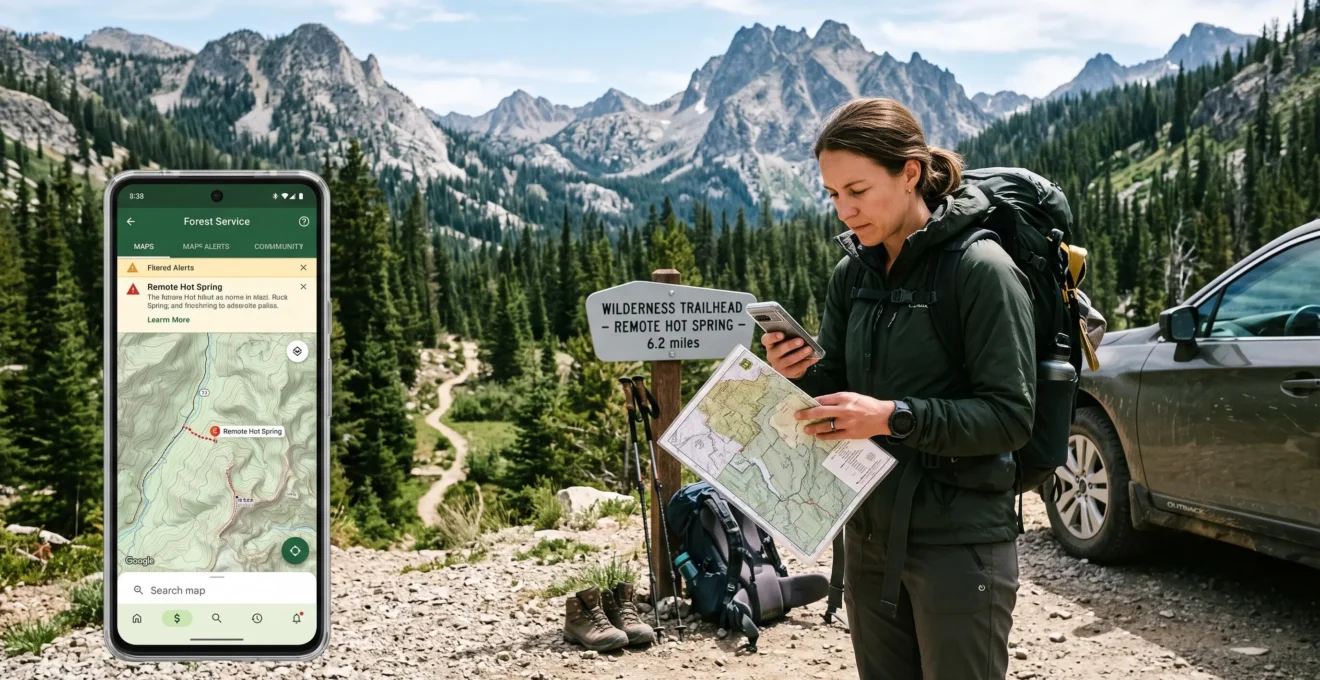
A natural hot spring can look inviting on a map and still be inaccessible, legally restricted, dangerously hot, or unsuitable for bathing. The difficult part of visiting wild geothermal pools is often not finding them. It is establishing whether the route is open, whether soaking is permitted, and whether the water and surrounding terrain are reasonably safe.
The most reliable approach starts before the drive. Identify who manages the land, check current access restrictions, evaluate the final road or trail, and prepare for the return journey. Once there, treat untreated geothermal water cautiously, respect posted rules, and leave the site unchanged.
These precautions matter whether you are exploring remote springs in the United States, travelling through New Zealand’s geothermal regions, or considering a natural bathing spot elsewhere in the English-speaking world. **Local regulations always take precedence over general travel advice.**
A successful visit is one you can complete without trespassing, damaging a fragile environment, or gambling on conditions you cannot verify.
Natural hot spring safety: the essentials
- Check permission before driving: confirm land ownership, current closures, permitted bathing areas, and legal access routes.
- Assess the complete journey: road conditions, water hazards, daylight, weather, and the difficulty of returning dry and warm.
- Protect the spring: avoid soap, litter, pool modifications, and activities prohibited by the land manager.
- Why Do People Get Turned Away From Natural Hot Springs Even After a Perfect Drive?
- How to Check If a Natural Hot Spring Is Open and Safe in 10 Minutes Before You Leave?
- Hike-In Hot Spring or Roadside Soak: Which Is Better if You’re Travelling With One Towel and No Gear?
- The Hot Spring Behaviour Mistake That Gets Sites Closed for Everyone
- When Is the Best Time to Visit Natural Hot Springs to Avoid Crowds and Cold Walk-Backs?
- Why Do Remote Mountain Stays Feel Easy on Maps but Hard in the Last 20 Miles?
- Rustic Hot Spring or Full Thermal Sanctuary: Which Works Better if You Need Quiet and Clean Changing Areas?
- Which Thermal Spring Sanctuary Is Worth It if You Hate Crowds and Strong Sulphur Smells?
Why Do People Get Turned Away From Natural Hot Springs Even After a Perfect Drive?
Travellers get turned away because finding a natural hot spring does not establish permission to visit it. Seasonal wildlife protections, storm damage, geothermal hazards, private ownership, and temporary management decisions can restrict access without removing a location from maps or guidebooks. The relevant land manager’s current notices, not the apparent condition of the road, determine whether entry is permitted.
Three closure mechanisms deserve particular attention.
- Seasonal restrictions: land managers may restrict particular roads, trails, or recreation areas to protect wildlife, including animals vulnerable to winter disturbance. Timing and geographic boundaries vary.
- Environmental hazards: flooding, damaged trails, unstable geothermal ground, wildfire, or severe erosion may make access unsafe.
- Management restrictions: areas may close following safety incidents, resource damage, maintenance needs, or changes to permitted activities.
The distinction between a public map and legal access is especially important. A spring may sit on public land while the only apparent approach crosses private property. Tribal or Indigenous lands can have separate access requirements, and some public recreation sites operate through reservations, permits, or designated entry periods.
Public ownership does not automatically mean unrestricted bathing rights.
The Yellowstone National Park’s swimming restrictions and conditions illustrate the problem. The National Park Service prohibits soaking in Yellowstone’s geothermal hot springs. Its September 29, 2026 update also reported that the Boiling River swimming location remained unavailable following the effects of the 2022 floods, while the designated Firehole Swim Area was closed.
These are distinct restrictions: a prohibited geothermal activity is not the same as a temporarily closed designated swimming area.
If you arrive at a closure, read the posted notice and establish whether it applies to vehicles, the trail, the water, or the entire site. Contact the ranger station, relevant land-management office, or property operator if the wording is unclear.
Choose an alternative only after independently verifying its access and bathing rules. A nearby map pin is not sufficient evidence.
Do not assume that people already sitting in a pool have permission. They may be unaware of a recent closure or may have entered through an unauthorized route. Their presence does not establish a right to follow.
Real access example: Yellowstone’s Boiling River
Flooding in 2022 affected the Boiling River swimming location in Yellowstone National Park. The National Park Service subsequently continued to identify the area as unavailable for swimming in its September 2026 guidance.
The documented lesson is that a historically popular bathing location can remain unavailable long after the original event. Previous visitor photographs or guidebook recommendations cannot establish current permission.
A closed spring is not a failed trip if the restriction is discovered early enough to choose another activity. The next step is building a quick verification routine that reduces the chance of arriving without reliable information.
How to Check If a Natural Hot Spring Is Open and Safe in 10 Minutes Before You Leave?
Start with the responsible land manager’s current alerts, then verify the access road, review dated visitor reports, and assess water-related warnings. Ten minutes can reveal obvious closures and planning problems, but it cannot establish that untreated geothermal water is microbiologically safe. If critical information remains unavailable, postpone the soak rather than treating uncertainty as permission.
A practical ten-minute screening routine prioritizes information by authority and relevance.
- Minutes 0–3 — Official access: identify the property manager and check current closure notices, bathing restrictions, permits, and designated entry points.
- Minutes 3–5 — Road and trail: check official road updates and weather alerts. Use mapping imagery for terrain context, not proof of current conditions.
- Minutes 5–7 — Recent observations: look for date-stamped visitor reports addressing access, flow, temperatures, and visible changes.
- Minutes 7–9 — Water concerns: check for contamination advisories, flood damage, unusual discharge, or other hazards documented by local authorities.
- Minute 9–10 — Decision: record the route, expected return conditions, and unresolved risks before deciding whether to travel.
Official restrictions outrank personal blogs and social media reports. A dated visitor photograph may help explain conditions, but it does not override a closure order.
The BLM Idaho’s official advisories and closures demonstrate why such checks matter. In 2026, the Bureau of Land Management documented road restrictions associated with washouts, erosion, and storm damage, alongside seasonal protections for wildlife.
Those notices illustrate broader public-land access risks; they do not establish closures at every hot spring.
What photographs can and cannot tell you
Visitor photographs may reveal conspicuous sediment, damaged paths, reduced flow, or major changes to the pool. However, lighting, camera angles, and unknown capture dates limit their reliability.
A photograph of clear water cannot confirm the absence of pathogens, hazardous dissolved substances, or dangerously hot inflows. Visible algae also cannot identify specific infectious organisms.
The Centers for Disease Control and Prevention explains that Naegleria fowleri can occur in naturally warm freshwater, including hot springs. Infection is rare but potentially fatal, and exposure can occur when contaminated water enters the nose.
The CDC recommends keeping your head above water in naturally hot geothermal pools. Avoid forcing water into your nose or disturbing shallow sediment. These precautions reduce specific exposure risks but do not make untreated water completely safe.
Never rely on a photo, a visitor’s reported temperature, or the absence of warning signs to certify water quality. A recently changed source, nearby livestock activity, upstream contamination, or unusual discharge can create concerns that photographs cannot resolve.
Likewise, spring runoff may alter water levels, currents, and the mixing of geothermal and cooler water. It does not provide a predictable temperature adjustment.
Five checks to complete before leaving
- Identify the responsible land manager and save the official access or closure notice, including its date or current status.
- Confirm the authorized approach and save the relevant road or trail advisory.
- Find a recent, dated visitor report and record what it actually confirms and what remains uncertain.
- Check available water warnings and record whether site-specific temperature or quality information is missing.
- Save an offline route, an alternative destination, and a return-time plan that another person can verify.
The purpose is not to create false certainty in ten minutes. It is to identify enough reliable information to proceed cautiously, request further confirmation, or decide that another destination is the better choice.
Hike-In Hot Spring or Roadside Soak: Which Is Better if You’re Travelling With One Towel and No Gear?
A legally accessible roadside spring is usually the more manageable choice for a minimally equipped beginner because the vehicle may provide nearby shelter, spare clothing, and a shorter return. A hike-in spring can be rewarding, but wet clothing, changing weather, darkness, and limited supplies increase the consequences of poor planning. Neither option is automatically safe.
The right choice depends on the entire experience, including what happens after leaving the water.
| Practical factor | Roadside spring | Hike-in spring |
|---|---|---|
| Changing privacy | May be limited near busy parking areas | May offer more seclusion, but rarely guaranteed |
| Water temperature | Must be checked at the specific site | Equally site-dependent; remoteness offers no guarantee |
| Weather exposure | Potentially shorter distance to shelter | Longer exposure on trails and at the pool |
| Wet walk-back | Often shorter, depending on parking access | May involve climbing, slippery terrain, or wind |
| Daylight requirements | Shorter approach may simplify scheduling | Requires adequate time for both directions |
| Facilities | Not guaranteed | Typically limited or absent |
The hidden difficulty of a hike-in soak is the return journey. After spending time in warm water, you may be wet, tired, and exposed to cold air. Even a familiar trail can become harder to navigate when visibility deteriorates or rocks become slippery.
A useful decision rule is simple: if you cannot complete the return hike in dry clothing, with adequate daylight and suitable weather protection, do not rely on one towel alone.
This is a conservative planning rule, not a scientifically established distance limit.
The National Park Service’s hiking safety recommendations emphasize insulation, reliable lighting, navigation, weather preparation, and replacing wet clothes promptly. The guidance also warns that cold, wet, windy conditions can cause hypothermia even in summer.
For a short, straightforward approach, a minimal but sensible kit includes:
- Dry bag: protects clothing and electronics from moisture.
- Dry insulating layer: reduces exposure during the return.
- Suitable footwear: provides traction and protects feet outside the pool.
- Headlamp: supplies dependable lighting if the schedule changes.
- Drinking water: helps manage hydration during travel and soaking.
- Wet-clothing bag: keeps damp items separate from dry supplies.
For a remote hike, additional navigation, food, first-aid, and emergency equipment may be necessary. A short packing list is not a replacement for proper backcountry preparation.
Roadside access can make an early or late visit more practical, but it never overrides posted opening hours or night-access restrictions. Hike-in options require a realistic daylight margin, regardless of how attractive a quiet evening soak sounds.
The most enjoyable spring is not necessarily the most isolated. If simplicity matters more than solitude, choosing an accessible location can make the whole day more comfortable.
The Hot Spring Behaviour Mistake That Gets Sites Closed for Everyone
Altering natural hot spring pools, particularly by constructing rock dams or redirecting water, is a serious mistake because it can disturb fragile habitats, change water movement, and create hazards for later visitors. Soap, litter, broken glass, and disruptive behaviour also threaten sensitive recreation areas. Such impacts can contribute to management restrictions, although closures must be assessed individually rather than attributed to one behaviour without evidence.
Natural pools are dynamic environments. Their boundaries, inflows, and drainage channels may have ecological or geothermal functions that are not obvious to visitors.
Moving stones to deepen a pool or create a warmer bathing area may seem harmless, but it can alter flow, damage fragile ground, or redistribute water of different temperatures. Never assume that an existing improvised dam is safe or authorized.
A useful way to understand the stakes is through the possible chain of consequences:
Visitor behaviour → environmental damage or safety hazard → management intervention → potential access restrictions.
This is a general risk pathway, not proof that a specific closure resulted from a specific incident.
The basic low-impact rules are straightforward:
- Keep soap, shampoo, conditioner, and cleaning products out of natural pools, including products marketed as biodegradable.
- Pack out all rubbish, food packaging, and personal hygiene items.
- Never bring glass into or near bathing water.
- Do not dig, construct dams, redirect flows, or modify pool edges.
- Use established routes and durable surfaces rather than trampling vegetation.
- Follow site-specific restrictions concerning alcohol, pets, fires, and group size.
Yellowstone‘s designated Firehole Swim Area provides an official example of strict visitor rules, including restrictions on bathing products, containers, food, and alcohol. Those particular requirements should not be assumed to apply identically at unrelated destinations.
Etiquette that prevents unnecessary conflict
Hot spring etiquette also involves sharing limited space responsibly. Nudity rules vary by jurisdiction and property. Never assume clothing-optional bathing is permitted merely because others are undressed.
Keep noise low, avoid photographing strangers without permission, and respect people who prefer personal space. Children require close supervision around hot water, slippery surfaces, and potentially hazardous geothermal ground.
If a pool is full, wait away from the edge rather than pressuring occupants to move. Where posted quiet hours or occupancy limits exist, follow them.
If you witness destructive behaviour, prioritize your safety. Avoid confrontation, especially where alcohol or aggression is involved. Record the location, time, and observable damage when safe and lawful, then report the issue through the relevant land manager’s official contact channel.
A report can help managers investigate damage and decide whether intervention is needed. It does not automatically mean the site will close.
Respectful behaviour helps preserve both the environment and the experience for other visitors. It cannot guarantee continued access, but it avoids introducing preventable problems into an already sensitive setting.
When Is the Best Time to Visit Natural Hot Springs to Avoid Crowds and Cold Walk-Backs?
A mild-weather weekday with enough daylight for the return is often a sensible starting point for a natural hot spring visit. Winter can offer a striking contrast between warm water and cold air, but icy roads and wet walk-backs raise the stakes. The best timing depends on local access rules, seasonal hazards, weather, and the spring’s actual visitor patterns.
Shoulder seasons may offer a useful compromise where roads remain open and conditions are stable. However, spring snowmelt can increase river flows, and autumn weather may change rapidly at elevation.
Winter requires particular caution. Snow, ice, reduced daylight, and cold wind can turn a short approach into a demanding outing. Some access roads are not maintained year-round.
In warmer months, longer daylight may improve hiking flexibility, but heat exposure and crowded pools can become additional concerns.
| Timing | Potential advantage | Main consideration |
|---|---|---|
| Early morning | May offer quieter conditions | Cold air and early travel hazards |
| Late afternoon | Potentially warmer approach conditions | Limited daylight for the return |
| Weekday | May reduce recreational demand | Local schedules and tourism can change patterns |
| Weekend | Often easier for group travel | Potentially greater parking and pool demand |
| Winter | Distinctive cold-weather soaking experience | Ice, road closures, and greater exposure |
These are planning considerations rather than measured crowd forecasts. Popular springs close to cities, resorts, or major visitor routes may remain busy outside conventional peak periods.
Plan for the cold walk-back
The return from a soak deserves separate preparation. Warm water may make surrounding air feel less threatening while you are bathing, but once outside, wet skin and clothing increase heat loss.
Dry yourself promptly, replace wet clothing, put on suitable insulating layers, and begin the return before conditions deteriorate. Do not extend a soak to the point of exhaustion or assume that feeling warm in the pool protects you from cold exposure later.
If you become severely chilled, confused, unusually drowsy, or unable to coordinate movements, stop treating the situation as an ordinary discomfort and seek appropriate emergency assistance. Hypothermia requires prompt attention.
For a crowded destination, review recent parking observations, dated visitor photographs, and reports from comparable weekdays or seasons. Social media check-ins may offer clues but are incomplete and can be delayed or selectively posted.
Photo metadata, where available, may help establish when an image was captured. It does not prove typical crowd levels.
If reliable crowd information is unavailable, choose a location or schedule that remains acceptable even when the pool is occupied.
A slightly busier soak followed by a comfortable return may be preferable to an isolated evening visit that leaves you walking through darkness in wet clothing.
Why Do Remote Mountain Stays Feel Easy on Maps but Hard in the Last 20 Miles?
Remote mountain routes can look straightforward on digital maps because distance alone does not capture gravel surfaces, steep gradients, seasonal gates, road damage, or vehicle restrictions. The final 20 miles may demand more driving time and concentration than the rest of the journey. For hot spring visits, that difference can undermine daylight plans, fuel reserves, and the return journey.
A navigation app may correctly identify a destination while failing to explain whether the final road is suitable for your vehicle under current conditions.
Common obstacles include:
- Unpaved surfaces with loose gravel, ruts, or washboarding.
- Single-lane mountain roads with limited passing places.
- High-clearance or four-wheel-drive requirements.
- Seasonal gates, flood damage, and washouts.
- Snow-chain or traction requirements imposed by local authorities.
- Limited phone reception, fuel availability, and roadside assistance.
The most important distinction is between a mapped route and a confirmed, legally drivable route.
Before departure, consult the responsible road authority or land manager for access requirements. Satellite imagery can show road alignment and surrounding terrain, but imagery may predate washouts, closures, or changes in road maintenance.
Identify the final reliable fuel stop and confirm that it will be accessible when needed. Check the vehicle’s estimated remaining range against the complete outbound and return journey, including detours, slow terrain, and possible delays.
Use a conservative reserve appropriate to the vehicle and conditions rather than assuming the shortest mapped distance is all you will drive.
Build the itinerary around the weakest road section
Consider a hypothetical traveller staying in a mountain cabin who plans an afternoon soak at a spring shown 20 miles away.
The map suggests a manageable outing, but the last section includes an unpaved climb, an uncertain bridge crossing, and a trail approach. Without checking those conditions, the traveller cannot reliably estimate arrival or return times.
The sensible response is not to invent a fixed driving-time multiplier. It is to verify the route’s current status, establish the required vehicle capability, and allow additional time based on actual terrain.
If the road conditions are unknown, contact the responsible authority before committing. If the route requires equipment or driving experience you lack, select an accessible alternative.
Remote accommodations can compound the problem. The nearest shop, fuel station, or mobile signal may be considerably farther away than expected.
Carry appropriate water, food, navigation information, weather protection, and vehicle emergency supplies. Tell someone where you intend to go and when you expect to return.
The itinerary should also account for fatigue. A difficult approach followed by a long soak can leave a driver poorly positioned for a demanding return.
Set a turnaround point before leaving, based on daylight, weather, fuel, and road conditions. Reaching that point without reaching the spring is a valid reason to turn back.
Remote access becomes more manageable when the route is treated as part of the activity rather than an inconvenience to be ignored. If the logistics feel disproportionate, a managed thermal destination may provide a more predictable experience.
Rustic Hot Spring or Full Thermal Sanctuary: Which Works Better if You Need Quiet and Clean Changing Areas?
A well-managed thermal sanctuary is usually the more predictable choice when clean changing areas, showers, and controlled visitor numbers matter most. Rustic hot springs may offer a closer connection to nature and sometimes fewer visitors, but privacy, sanitation, and water-quality oversight vary considerably. The right option depends on hygiene needs, accessibility, budget, and how much logistical uncertainty you can tolerate.
The appeal of a rustic spring is straightforward: natural surroundings, minimal infrastructure, and the possibility of soaking without a commercial spa atmosphere.
However, the absence of facilities changes the practical experience. You may need to change outdoors, protect belongings from rain, carry wet clothing back to the car, and continue the day without a shower.
The real cost is not limited to an entry fee. It includes travel time, supplies, physical effort, and the ability to leave comfortably.
| Priority | Rustic natural spring | Managed thermal sanctuary |
|---|---|---|
| Privacy | Depends on location and visitor behaviour | May offer reserved sessions or private facilities |
| Changing facilities | Often absent | Usually available, but verify details |
| Hygiene oversight | May lack routine public testing | May operate monitored or treated pools, subject to local requirements |
| Accessibility | May involve uneven natural terrain | Can offer accessible facilities; verify individually |
| Cost | May be free or require an access fee | Typically charges admission |
| Time commitment | May require substantial driving and preparation | Often allows a more predictable scheduled visit |
A managed facility should not automatically be described as certified or pathogen-free. Water monitoring, treatment, and compliance requirements depend on the jurisdiction and the type of pool.
Ask whether the water is untreated geothermal water, mixed, filtered, disinfected, or otherwise managed. Request information about the applicable testing or inspection arrangements when hygiene is a deciding factor.
Comfort involves more than cleanliness
Sulphur-like odours are another consideration. Different geothermal sources have different mineral and gas characteristics, and some facilities may manage odours through water handling or ventilation.
However, a managed sanctuary is not necessarily odour-free, and an untreated rustic spring is not necessarily strongly scented.
For sensitive visitors, current reviews describing particular pools can be more useful than broad claims about the destination.
It is also worth checking whether changing rooms are private, showers are included, and access from the parking area requires stairs or uneven ground.
A sanctuary advertised as peaceful may still have communal changing areas or busy shared pools. A rustic spring may be wonderfully quiet on one visit and crowded on another.
If changing comfort, predictable access, or hygiene oversight is essential, prioritize verifiable facilities over romantic descriptions of wilderness. That leads to the final decision: how to identify a thermal sanctuary genuinely suited to a quiet visit.
Key takeaways before choosing a thermal sanctuary
- Look for published capacity limits or genuinely reservable entry periods rather than vague promises of tranquillity.
- Check the specific pool’s mineral-water characteristics and odour reports before booking.
- Compare what admission includes, particularly towels, changing facilities, pool access, and any separate treatment charges.
Which Thermal Spring Sanctuary Is Worth It if You Hate Crowds and Strong Sulphur Smells?
The best thermal sanctuary for crowd-sensitive, odour-sensitive travellers is one that clearly explains its capacity controls, pool environment, water management, and included facilities. Look for timed admission, documented quiet areas, and recent visitor feedback about specific pools. Reputation and admission price alone cannot establish whether a sanctuary will feel peaceful or comfortable.
Start with how the facility manages visitor flow.
A timed-entry system can be helpful, but it does not necessarily limit the number of people already inside. Ask whether there are capacity limits, whether guests have fixed session durations, and whether quiet areas operate under enforceable rules.
Adult-only areas may reduce certain types of activity, but they do not guarantee silence. Outdoor pools may provide more open-air space, while indoor environments can offer greater weather protection but sometimes concentrate noise or noticeable odours.
How to assess sulphur odours
The characteristic rotten-egg smell associated with some geothermal water is commonly linked to hydrogen sulphide. However, geothermal water chemistry varies from one source to another, so not every thermal pool smells the same.
Water handling and ventilation can affect the visitor experience. Neither a natural setting nor a premium admission fee establishes low-odour conditions.
Before booking, ask the operator:
- Which pools have noticeable sulphur-like odours?
- Are there freshwater, mixed-water, or differently treated pools?
- Are low-odour pools available during the selected admission period?
- Does the facility publish relevant water-quality and operating information?
Smell is not a reliable test of water safety. An absence of noticeable odour does not establish that hazardous gases or other contaminants are absent. Follow safety warnings and avoid any area with suspected dangerous gas accumulation.
What makes the admission price worthwhile?
Compare actual inclusions instead of assuming more expensive facilities provide a better experience.
A useful pre-booking comparison should cover admission duration, towel and robe availability, lockers, changing rooms, showers, thermal-pool access, additional treatment fees, cancellation terms, and accessibility arrangements.
Reviews are most useful when they are recent, specific, and consistent. Look for comments describing the exact session time, pool occupancy, noise levels, changing-room cleanliness, and water odour.
Be cautious about relying on reviews that discuss only scenery or general atmosphere. A destination may be beautiful without meeting your practical needs.
Where reservations are offered, compare quieter-looking sessions with the operator’s stated capacity policy. Weekdays or off-peak hours may help, but they are not a guarantee.
For a hypothetical comparison, consider two facilities. Sanctuary A advertises spectacular scenery but publishes no capacity information. Sanctuary B has less dramatic surroundings but provides fixed session durations, clearly identified quiet areas, and detailed descriptions of pool facilities.
A traveller who prioritizes predictable comfort may reasonably prefer Sanctuary B, provided its current operational information supports those claims. This example illustrates a decision method, not a verified comparison of real businesses.
The final choice should reflect what you are paying for: a particular experience with practical conditions you can verify, not simply an attractive photograph.
Choose one realistic destination, confirm its current admission conditions, and save the relevant access details before travelling. Whether the result is a remote natural pool or a managed thermal sanctuary, a successful soak begins with verified permission, a manageable return, and an environment you can enjoy without unnecessary uncertainty.
Can you enter a natural hot spring if there are no warning signs?
Not necessarily. The absence of signs does not establish landowner permission, legal access, or safe bathing conditions. Determine who manages the property, whether the approach crosses restricted land, and whether soaking is allowed. If ownership or access status cannot be confirmed, do not enter simply because the location appears unoccupied.
How can you tell whether natural hot spring water is too hot?
Appearance, steam, and other bathers’ reactions are unreliable indicators. Geothermal pools may have uneven temperatures and hidden hot inflows. Where bathing is explicitly permitted, use reliable site-specific guidance and an appropriate water thermometer if conditions allow. Do not test unknown geothermal water by stepping directly into it, and never enter a pool with uncertain or potentially scalding conditions.
Is it safe to put your head underwater in a natural hot spring?
Keeping your head above water is the recommended precaution for naturally hot geothermal water. The CDC warns that Naegleria fowleri can occur in warm freshwater and cause a rare but extremely serious infection when contaminated water travels up the nose. Water clarity and ordinary visitor photographs cannot establish the absence of this organism.
Should you visit a natural hot spring alone?
Solo visits require additional caution, particularly at remote sites with limited reception or difficult approaches. Choose an authorized, manageable location, tell someone your route and expected return time, carry appropriate supplies, and avoid uncertain water or terrain. Travelling with a companion provides additional support but does not eliminate geothermal, access, or weather hazards.
What should you do if you arrive and the water looks different from recent photographs?
Do not assume that unusual colour, changed flow, new sediment, or altered pool boundaries are harmless. Conditions may have changed due to weather, flooding, sediment movement, or geothermal activity. Avoid entering the water, check official warnings, and contact the responsible land manager if possible. When the cause remains uncertain, choose another activity rather than experimenting with an unfamiliar pool.