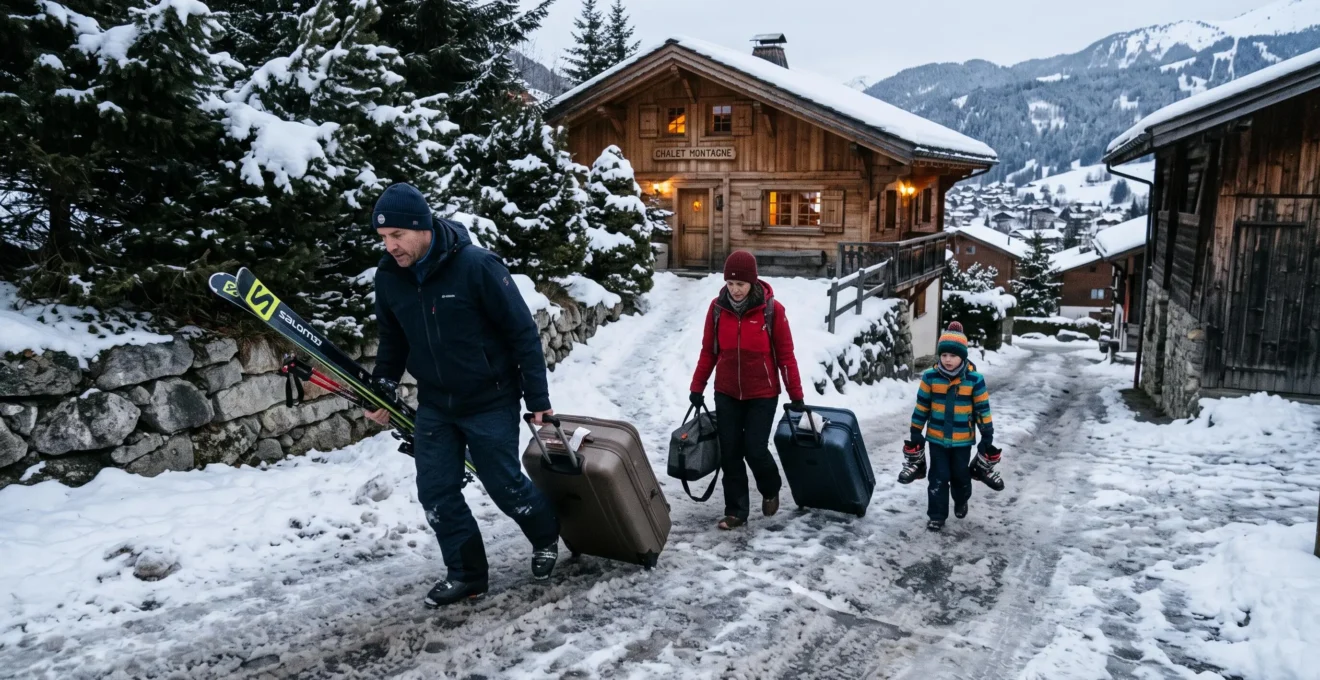
A chalet advertised as five minutes from the slopes can be a poor choice for a ski group. The accommodation may be close to a lift on a map yet separated from it by an icy footpath, a steep road or a shuttle that stops running before dinner. Meanwhile, a less expensive chalet in a well-connected village may offer easier skiing, safer arrivals and more freedom for non-skiers.
Reliable snow access is not the same as ski-in/ski-out access. It means being able to reach operating lifts, return to the accommodation and move around comfortably under the winter conditions likely during your stay. Altitude, piste connections, road maintenance and the abilities of individual travellers all influence that reliability.
For mixed-ability groups, the strongest booking decision is rarely based on the shortest advertised distance. It comes from checking the actual route to the lift, the independence of non-skiers, the heating system and the logistics of arrival. Those details matter especially in December and spring, when snow coverage near lower accommodation can be less dependable.
Choosing an Alpine Chalet: The Essentials
- Prioritise a dependable route to an operating lift over a ski-in/ski-out label or an attractive straight-line distance.
- Verify winter road access, parking, pedestrian gradients and heating arrangements directly with the host before paying.
- For mixed groups, a well-connected village chalet often offers a better balance of skier convenience, non-skier independence and overall cost.
- Why Does a Chalet “5 Minutes From the Lift” Turn Into a 30-Minute Ordeal in Snow?
- How to Check Chalet Access and Winter Roads Before You Book Without Local Knowledge?
- Ski-In/Ski-Out or Village Centre: Which Works Better for a Group With 2 Non-Skiers?
- The Heating Detail That Can Make an Alpine Chalet Feel Miserable After 9 p.m.
- When Should You Arrive in the Alps to Avoid 3-Hour Traffic and Missed Check-Ins?
- Why Do Remote Mountain Stays Feel Easy on Maps but Hard in the Last 20 Miles?
- Why Do “Moderate” Wilderness Tours Feel Brutal After the First 2 Hours?
- How to Plan a Remote Mountain Retreat for 5 Days Without Getting Stuck or Under-Prepared
Why Does a Chalet “5 Minutes From the Lift” Turn Into a 30-Minute Ordeal in Snow?
A chalet described as five minutes from the lift can require a much longer journey because the advertised distance may ignore gradient, snow clearance, ice and equipment handling. A short summer walk becomes slower when travellers carry skis and boots or negotiate a slippery path. For a mixed-ability group, the relevant measure is the actual door-to-lift journey in winter, not the map distance.
Accommodation listings do not always explain how proximity was calculated. Five minutes may refer to driving on clear roads, walking without equipment or reaching the edge of a ski area rather than the lift entrance. A property might also sit above the village, with a direct-looking route that requires descending a staircase or crossing a road before boarding a shuttle.
Winter changes the usable route. A pedestrian shortcut may remain uncleared, an exposed slope can become icy after thawing and refreezing, and a driveway might be passable by car but uncomfortable on foot. Even where the advertised distance is accurate, its practical meaning depends on the conditions.
Read proximity claims as transport instructions rather than marketing descriptions:
- “Five minutes on foot”: ask whether that is on a maintained winter pavement, a staircase or an unsurfaced track.
- “Five minutes by car”: establish where visitors can park at the lift and whether the car park charges.
- “Free shuttle nearby”: request the stop location, winter timetable and service frequency.
- “Pedestrian access”: check whether luggage needs carrying beyond the last vehicle-accessible point.
- “Close to the ski area”: confirm which lift or piste the description actually means.
Group composition makes these distinctions important. An experienced skier travelling light may manage a snowy path without difficulty. Someone carrying two sets of skis, accompanying children or walking cautiously on ice may need substantially longer. A non-skier returning from dinner faces the same terrain without necessarily wearing suitable mountain footwear.
The inconvenience also extends beyond skiing. Grocery deliveries, restaurant outings and unloading luggage become repeated logistical tasks. If the group needs the car for every activity, a supposedly convenient chalet can create more daily work than a cheaper property with a maintained shuttle connection.
The best location is not necessarily the closest chalet to the piste. It is one where the whole group can complete the journeys it needs, repeatedly and without disproportionate effort. Confirming those routes requires a closer look at winter road access.
How to Check Chalet Access and Winter Roads Before You Book Without Local Knowledge?
You can assess Alpine chalet access remotely by obtaining the exact property location, examining the final road approach and asking the host specific questions about winter maintenance. Mapping tools, municipal information and recent guest reviews provide useful cross-checks. The aim is to establish how access works during poor conditions, including where vehicles stop and what happens if the road becomes temporarily impassable.
Begin with the precise address or GPS coordinates rather than the approximate booking-platform pin. Use satellite imagery to identify the access road, parking area, sharp bends and relationship between the property and the nearest cleared main road. Street View can help reveal gradients and road width, although imagery may have been captured in summer and cannot establish present winter conditions.
Winter photographs, where available, can provide additional context. Compare them with summer images to see whether the entrance, steps or driveway remain accessible after snowfall. Local council or municipal road information can help establish which roads receive maintenance, but responsibility and clearing schedules vary by destination.
For France, UK government travel advice for France warns that mountain road conditions can deteriorate quickly in winter. It also explains that prescribed winter equipment is required in designated French mountain areas between 1 November and 31 March. Requirements differ across Alpine countries, so drivers should verify the rules for every country and region on their route.
Ask the host whether the final access road is routinely cleared, who is responsible for it and whether a normal passenger car can reach the property after snowfall. A locally based manager may have useful first-hand knowledge, but specific answers matter more than the management arrangement itself. Cross-check claims against recent winter reviews, resort weather reports and road notices.
One particularly revealing question is: “What was the most difficult access situation you experienced during a recent winter, and how did guests reach the property?” A credible answer should explain the route, disruption and practical arrangements rather than simply repeat that access is easy.
Five Checks to Complete Before Paying a Chalet Deposit
- Request the precise chalet GPS pin and save a map showing its entrance, parking area and final access road.
- Trace the route from the maintained main road and save screenshots highlighting steep bends, narrow sections and any pedestrian-only approach.
- Ask who clears the driveway, steps and parking spaces; obtain written confirmation of the normal winter arrangements.
- Confirm vehicle equipment requirements, parking capacity and the distance from the last reliably accessible parking point; record the host’s answers.
- Ask for the procedure during a snowstorm or road closure, including an alternative arrival point and local contact; save an agreed contingency plan.
No remote check guarantees that a mountain road will remain open during extreme weather. What it can establish is whether access arrangements are sufficiently clear and resilient for your group. Once vehicle access is understood, the next decision is where everyone should stay relative to the lifts and village services.
Ski-In/Ski-Out or Village Centre: Which Works Better for a Group With 2 Non-Skiers?
For a group containing two non-skiers, a village-centre chalet often offers more balanced convenience than an isolated ski-in/ski-out property. Skiers benefit from immediate piste access, but non-skiers may need transport for restaurants, shops and activities. The strongest compromise is often accommodation within a manageable winter walk of both a lift and village amenities, provided the connecting paths are maintained.
Ski-in/ski-out accommodation is particularly useful for groups that ski together, return at similar times and want to avoid carrying equipment. Its value falls when some guests spend their days away from the slopes or when reaching the village requires a car.
A central village chalet reverses the trade-off. Non-skiers can potentially visit cafés, shops or leisure facilities independently, while skiers may have to carry equipment or use a shuttle. The exact advantage depends on the village layout: being central does not guarantee level pavements, accessible routes or frequent transport.
Three practical criteria help distinguish the options:
| Decision criterion | Ski-in/ski-out chalet | Village-centre chalet |
|---|---|---|
| Ski equipment handling | Usually limited when the connecting piste operates | May require walking, a shuttle or ski storage near the lift |
| Non-skier independence | Depends on nearby amenities and public transport | Often better where services are genuinely walkable |
| Transport dependence | Can increase for shopping and evening activities | Can increase for daily skiing |
| Early- and late-season access | May depend on snow coverage of a specific return piste | Can remain practical through road or lift transport |
| Cost assessment | Compare any slope-access premium against actual use | Include shuttle, parking and equipment-storage costs |
For instance, consider a hypothetical group of eight travellers, including two non-skiers. Chalet A sits above the resort and has direct piste access, but the nearest village shops require a drive. Chalet B is beside a maintained pedestrian route connecting the village centre to a lift. If six guests ski and two prefer independent daytime activities, Chalet B may offer better overall value, even if the skiers have a short morning walk.
Snow reliability adds another dimension. The WSL Institute for Snow and Avalanche Research SLF reports that snow-covered days have declined at most monitored Swiss locations, with earlier spring melting an important contributor. Its research on snow and climate change supports checking early- and late-season snow access carefully, but it does not predict whether a particular piste will be open on your travel dates.
Before paying for a slope-side location, identify the actual return piste. Ask whether it is served by snowmaking, how it connects to the accommodation and what alternative transport is available if it closes. Ski-area altitude alone does not establish reliable doorstep access.
For a hybrid location, investigate the lower parts of established ski villages, particularly areas where lift stations, pedestrian streets and everyday services connect. Check the shuttle’s actual winter frequency and last return departure, not simply whether a shuttle exists.
A slightly longer but consistently usable lift journey can serve a mixed group better than expensive doorstep skiing. However, convenience outside the chalet is only part of the experience. The indoor environment matters just as much, especially to guests spending more time at home.
The Heating Detail That Can Make an Alpine Chalet Feel Miserable After 9 p.m.
The critical heating detail is whether the chalet provides controllable warmth throughout the building or relies heavily on a single living-room stove. A wood burner can make the lounge comfortable while bedrooms remain cooler, particularly if they lack separate heating. Before booking, establish the type, distribution and operating arrangements of the heating system, rather than assuming that a fireplace guarantees overnight comfort.
Some rental properties use programmed central heating or thermostats that lower temperatures overnight or during unoccupied hours. That does not automatically indicate poor accommodation: well-insulated chalets may retain heat effectively. Problems arise when guests cannot adjust the system to suit the group or when bedrooms depend on heat moving from another room.
Dover District Council‘s biomass heating advice distinguishes standalone wood stoves, primarily intended for room heating, from boilers connected to central heating. That distinction is useful when evaluating a chalet advertised with a traditional fireplace.
A stove described as an ambience feature might be supplementary to central heating, or it might be an important source of warmth. The photographs alone cannot establish which. Similarly, visible electric radiators do not reveal whether every bedroom can be heated independently or whether electricity charges apply.
Before booking, request a room-by-room description of the heating arrangement. Confirm whether the property has central heating, individually controlled bedroom radiators, underfloor heating or a wood-based system requiring manual attention.
Then clarify the operational details: whether heating is included in the rental price, whether usage is capped, whether logs are supplied and what happens if fuel runs low. For a manual wood stove, ask whether the central system maintains adequate warmth without needing someone to reload the fire overnight. Follow the manufacturer’s operating instructions and never assume an appliance should be left burning unattended.
For mixed groups, thermal comfort has a direct effect on the usefulness of the chalet. Non-skiers may spend extended periods indoors reading, working or relaxing. Someone returning early from the slopes may also need a warm room before the rest of the group arrives.
Look beyond the fireplace photograph. A useful listing should provide enough information to understand bedroom warmth, daytime temperature control, drying facilities for wet clothing and any charges associated with fuel or electricity.
Comfortable accommodation supports the entire group rather than just those returning from the pistes. Even a well-heated chalet, however, can start a holiday badly if arrival is delayed by winter traffic or an inaccessible mountain road.
When Should You Arrive in the Alps to Avoid 3-Hour Traffic and Missed Check-Ins?
To reduce the risk of Alpine traffic delays, choose the arrival window after checking holiday calendars, route-specific congestion forecasts and your host’s check-in arrangements. Saturdays during winter school holidays can be particularly demanding on major resort approaches, but no single arrival time guarantees a clear road. The safest plan combines a realistic journey estimate, a flexible check-in arrangement and a generous weather contingency.
Traffic pressure depends on several overlapping schedules. French school holidays vary by educational zone, while holiday departures from the United Kingdom, Belgium, the Netherlands and neighbouring countries can increase traffic along international approaches. The exact routes affected depend on the destination and travel date.
The final approach may be particularly vulnerable because motorway traffic converges onto fewer valley roads. Heavy snowfall, incidents or temporary restrictions can make an already congested arrival more difficult. A three-hour delay is a scenario to plan around, not a standard or predictable amount of congestion.
When selecting travel dates, compare the relevant school holiday calendars and consult the official traffic forecasts for the journey. Historic congestion patterns are useful warnings, but a forecast from a previous holiday season should not be treated as a prediction for a new departure date.
A practical arrival strategy is to aim for late morning or early afternoon where the route, accommodation access and luggage arrangements allow it. An early arrival does not guarantee access to the chalet before check-in, so confirm whether luggage storage or early parking is available.
More importantly, negotiate what happens if the drive overruns. A self-check-in system, secure key collection or an accessible local contact can reduce the consequences of missing a scheduled handover. Confirm the arrangements before departure, including any restrictions on late arrival.
Night-time arrival is a separate concern. A road that appears straightforward in daylight may be harder to navigate in darkness, particularly with fresh snow, limited visibility or an unfamiliar final driveway. Mobile coverage may also be unreliable in some mountain locations.
Ask the host which arrival periods typically cause difficulty in that particular valley and whether recent guests have encountered recurring bottlenecks. Local experience may reveal a troublesome junction, lift-area access road or check-in pattern that broad traffic forecasts do not capture.
The objective is not to promise a congestion-free journey. It is to avoid turning an ordinary delay into a missed check-in or an unsafe final ascent. For remote chalets, that last approach deserves its own assessment.
Why Do Remote Mountain Stays Feel Easy on Maps but Hard in the Last 20 Miles?
Remote mountain stays often appear straightforward on maps because the route is represented as a continuous road rather than a changing sequence of driving conditions. The last 20 miles may involve narrow bends, steep gradients, limited passing places and snow-covered access tracks. Even a short final section can require careful driving, suitable winter equipment and additional time beyond an ordinary navigation estimate.
On a regional map, a remote chalet may seem only a small distance from the nearest town. But the valley road, mountain ascent and final driveway can have very different characteristics.
The last few miles are especially worth examining. A paved road may narrow after leaving the village, followed by hairpin bends or a private track. Some roads remain open and maintained throughout the winter; others have different maintenance arrangements or may close temporarily during severe conditions.
Vehicle suitability is not simply a question of having four-wheel drive. Tyre condition, the legally required winter equipment, ground clearance, vehicle dimensions and driver experience all matter. A larger vehicle may have difficulty manoeuvring on narrow sections or in small parking areas.
For an evidence-based assessment, ask the host to identify the final three to five kilometres of the approach using GPS waypoints. Review each segment for:
- Steep climbs, descents and exposed corners.
- Road width, passing places and barriers.
- Winter maintenance responsibility and likely clearing arrangements.
- Any vehicle restrictions or required equipment.
- The last place where parking or turning around is feasible.
Estimate journey time for the actual road rather than converting distance using motorway speeds. Mapping estimates are useful for initial planning but do not guarantee travel times under winter conditions.
The consequences of isolation extend beyond arrival. A remote chalet may offer privacy and quiet, yet a forgotten grocery item can require a considerable round trip. A group using separate vehicles may also have different abilities to negotiate the final approach.
For longer stays, establish how the group would respond if a road closed temporarily. Identify whether local support is available, where essential supplies can be obtained and how the host communicates road updates.
Remoteness can be an advantage when everyone accepts its practical demands. Those demands also apply to winter excursions, where apparently modest walking routes can prove more strenuous than expected.
Why Do “Moderate” Wilderness Tours Feel Brutal After the First 2 Hours?
A wilderness tour described as moderate can become unexpectedly demanding because winter conditions increase effort and complicate route-finding. Fresh snow, altitude, uneven footing, equipment weight and cold weather can make progress slower than on a dry summer trail. For mixed-ability groups, the difficulty rating matters less than the actual route, current conditions and fitness of the least experienced participant.
Descriptions such as easy, moderate and panoramic are not universal measures. Different activity providers may use different classification systems, and a rating may assume suitable equipment, previous mountain experience and favourable weather.
A walking route that seems manageable on a summer map can become significantly harder under snow. Deep or unconsolidated snow increases physical effort, while icy surfaces require suitable traction and careful foot placement. Snowshoes can help in appropriate terrain but do not remove the challenges of steep slopes or unstable snow.
Altitude can also affect how quickly some travellers fatigue. Combined with cold, exposure and additional clothing, it may reduce the pace the group can comfortably sustain. The problem often becomes noticeable after a prolonged effort, when fatigue accumulates and the return journey still remains.
For a group with varied fitness levels, establish realistic limits before reserving an excursion. Discuss the distance and elevation gain that everyone can manage, not just what the strongest members find comfortable.
Check the intended turnaround time, daylight remaining and whether the itinerary includes reliable opportunities to shorten the outing. A shuttle, lift or alternative trail is only a valid contingency if it actually operates and can be reached safely in the expected conditions.
Consult the local tourist office, activity provider or qualified mountain guide about current trail conditions. Ask whether the published rating refers to a winter route and whether snowshoes, traction equipment or specialist guidance are necessary.
Snow can conceal paths and familiar landmarks. Where terrain presents avalanche exposure, route selection and the relevant official avalanche information require particular attention; inexperienced visitors should not treat a summer hiking description as sufficient preparation for winter backcountry travel.
For mixed groups, it may be better to arrange separate activities on the same day: a guided mountain excursion for experienced walkers and a maintained village walk or accessible leisure activity for those who prefer a gentler pace.
A successful mountain holiday accommodates different energy levels without forcing everyone into the same activity. That flexibility becomes particularly valuable during a five-day stay, when weather, transport and supplies must all be managed together.
Key Takeaways Before Making the Final Booking Decision
- Choose the chalet whose essential routes remain practical under plausible winter conditions, even if its advertised distance is greater.
- Assess daily freedom for non-skiers and reliable warmth indoors alongside access for skiers.
- For a remote property, agree on transport, supplies and contingency responsibilities before the group commits.
How to Plan a Remote Mountain Retreat for 5 Days Without Getting Stuck or Under-Prepared
A five-day remote mountain retreat works best when access, food, heating, transport and activity alternatives are organised before arrival. Establish which roads and lifts the group depends on, confirm essential supplies and assign practical responsibilities. For mixed-ability travellers, plan enough flexibility that poor weather or a closed piste does not leave non-skiers isolated or force everyone to abandon the day’s plans.
Start by creating a single shared information document. Include the chalet’s precise location, host contact details, access instructions, parking arrangements, heating controls and the nearest useful village services. Make essential details available offline in case mobile reception is unreliable.
Shopping deserves early attention. Confirm the location and opening arrangements of the nearest supermarket, whether grocery delivery is available and whether the chalet provides basic cooking supplies. Remote accommodation may require purchasing most provisions before the final mountain ascent.
Transport preparation should match the route and destination. Verify winter tyre and chain requirements in the relevant countries, check the vehicle’s suitability and carry appropriate emergency supplies. For French mountain travel, UK government guidance specifically recommends essentials such as food, water, warm clothing and medicines in the vehicle.
The five-day schedule should leave room for changing conditions rather than assume uninterrupted skiing.
| Day | Main priority | Practical alternative |
|---|---|---|
| Day 1 | Arrive in daylight where possible, unload supplies and learn the chalet systems | Delay non-essential outings if road or weather conditions deteriorate |
| Day 2 | Skiing for active members; village services or a pre-booked activity for non-skiers | Use accessible indoor activities if outdoor conditions are poor |
| Day 3 | Flexible group activity, with a suitable winter walking option | Split into smaller groups according to ability and preferences |
| Day 4 | Second ski day or planned excursion, subject to operating conditions | Choose local activities that do not depend on a remote road or lift |
| Day 5 | Pack, check the departure route and leave with a weather allowance | Adjust the departure arrangement if the access road is temporarily affected |
This timetable is an illustrative planning framework, not a prediction of weather or resort operations. The important principle is to avoid making every day’s success depend on the same lift, road or activity.
Assign responsibilities within the group. One person can monitor travel and road information, another can coordinate meals and provisions, and another can confirm bookings or activity changes. Clear responsibilities reduce the risk of everyone assuming that someone else has handled a critical detail.
For an isolated chalet, understand the basic operating systems before arrival. Confirm how heating and hot water are supplied, whether any wood storage requires management, and who to contact for power, water or heating failures. Ask whether the property has experienced service interruptions and what arrangements apply if one occurs.
A communication plan is equally useful. Save the property manager’s number, an alternative local contact and the appropriate emergency contact information for the destination country. Download offline route maps and agree on a practical meeting arrangement if group members lose mobile coverage.
The final booking decision should combine all these factors rather than focusing only on rental price. A simple comparison makes hidden inconveniences easier to identify.
For example, the following scoring method is a hypothetical decision tool, not an externally validated rating system. Give each shortlisted chalet a score from 0 to 2 for every criterion: 0 for unsuitable or unverified, 1 for acceptable with limitations, and 2 for clearly suitable with supporting information.
| Criterion | Chalet A | Chalet B |
|---|---|---|
| Winter road and parking access | 0–2 | 0–2 |
| Dependable route to operating lifts | 0–2 | 0–2 |
| Independence for non-skiers | 0–2 | 0–2 |
| Heating and indoor comfort | 0–2 | 0–2 |
| Arrival and check-in flexibility | 0–2 | 0–2 |
| Supplies and disruption contingency | 0–2 | 0–2 |
| Maximum total | 12 | 12 |
Record the evidence behind each score. A host’s written confirmation, a winter shuttle timetable and verified heating arrangements are more useful than an unsupported numerical rating. Critical safety concerns should never be cancelled out by a high overall score: if access is unsuitable for the group’s vehicle or abilities, the property needs further investigation regardless of its other advantages.
Once the practical criteria are satisfied, compare the total trip cost. Include the rental, any required transport, parking, heating surcharges and ski equipment storage. A chalet without a ski-in premium may be good value if the saved accommodation cost is not consumed by daily transport or inconvenient access.
Shortlist two suitable chalets, complete the comparison with the whole group and ask each host to confirm any outstanding access or comfort details in writing. Book the property that offers the most dependable overall experience within the available budget—not simply the lowest advertised price or shortest distance to the slopes.
Is a higher-altitude Alpine chalet always more snow-reliable?
No. Higher altitude can improve the likelihood of natural snow under comparable conditions, but chalet access also depends on slope orientation, snowmaking, piste operations and road maintenance. Check the specific lifts and return routes for your travel period rather than assuming that the chalet’s elevation guarantees usable ski access.
Can a chalet without ski-in/ski-out access still be convenient for beginners?
Yes. A chalet with an easy connection to a beginner-friendly lift or ski school meeting point may be more convenient than slope-side accommodation beside difficult terrain. Check how beginners will reach their lessons, whether they need to carry equipment and whether a practical route back is available without skiing challenging pistes.
Should every vehicle in a chalet group carry snow chains?
Equipment requirements depend on the country, region, vehicle and road conditions. In designated French mountain areas, prescribed winter tyres or approved traction devices are required during the relevant winter period. Other Alpine countries have different rules. Drivers should confirm the applicable requirements, including any rental-car restrictions, before departure and ensure they know how to use the equipment safely.
What should travellers do if the chalet access road closes before arrival?
Do not attempt to bypass a closure or drive onto an unsafe road. Contact the host or local manager, follow official road information and establish whether there is a safe alternative parking or arrival point. If the accommodation cannot be reached, review the agreed check-in arrangements and booking terms before arranging alternative accommodation. Agreeing on these procedures before departure makes the decision easier.
How far in advance should a group confirm chalet access arrangements?
Confirm the permanent access arrangements before booking, especially road maintenance, parking, winter equipment requirements and pedestrian routes. Recheck operational details as departure approaches, then consult current road and weather information shortly before travelling. These checks serve different purposes: booking-stage verification establishes suitability, while pre-departure checks help manage changing conditions.