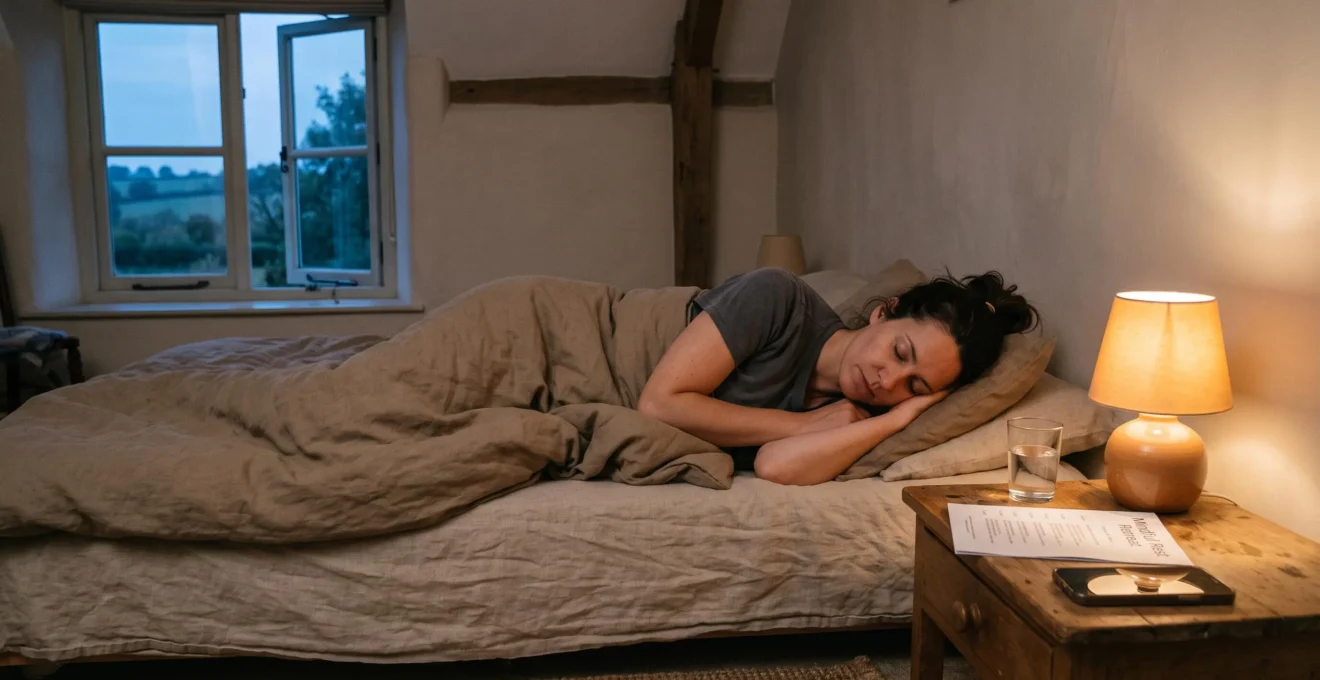
A rejuvenation retreat can feel wonderfully relaxing during the day yet leave you staring at the ceiling at midnight. Beautiful scenery, expensive treatments and packed wellness programmes do not necessarily translate into better sleep.
For an overworked professional with just three nights available, the most promising retreat is usually one that protects regular sleep hours, provides a comfortable bedroom, limits unnecessary stimulation and offers gentle, optional recovery activities. Whether that means a spa retreat, guided meditation programme or partly silent stay depends on what is keeping you awake.
Three nights are enough to observe whether a change of environment and routine helps you settle, but not enough to establish lasting recovery or treat chronic insomnia. The useful question is therefore not which retreat promises the biggest transformation. It is which retreat removes the obstacles to sleep you already experience, without introducing new ones.
That distinction makes the schedule, travel arrangements, bedroom and post-retreat routine more important than the destination’s wellness branding.
What matters most when choosing a sleep-focused retreat
- Prioritise recovery space: Choose optional activities, unstructured afternoons and quiet evenings over an intensive programme.
- Match the format to your stress: Guided meditation may suit racing thoughts, while gentle body-based activities may appeal when physical tension dominates. Neither is a proven three-night insomnia treatment.
- Protect sleep beyond the retreat: Check the bedroom, minimise travel disruption and rehearse a small routine you can maintain at home.
- Why Do Some “Relaxing” Retreats Leave You More Tired by Day 3?
- How to Read a Retreat Schedule in 10 Minutes to Predict Whether You’ll Actually Rest
- Silent Retreat or Spa Retreat: Which Works Better if Your Mind Won’t Switch Off at Night?
- The Retreat Mistake That Stops You Sleeping Even in the Quietest Location
- When Is the Best Time to Book a Rejuvenation Retreat to Prevent a Full Burnout Spiral?
- How to Choose Between Guided and Silent Meditation Without Wasting Your First Session
- How to Start Mindfulness With 3-Minute Routines That Survive Past Day 2
- How to Choose a Meditation Session if You Can’t Sit Still for 10 Minutes
Why Do Some “Relaxing” Retreats Leave You More Tired by Day 3?
Some relaxing retreats leave guests more tired because their programmes replace workplace demands with another form of performance pressure. Back-to-back workshops, treatments and group activities can create cognitive and social fatigue, while travel disruption reduces opportunities for sleep. For someone already overstimulated, a quieter schedule may be more restorative than a programme filled with wellness experiences.
The paradox begins when relaxation becomes an obligation. A day involving sunrise yoga, nutrition workshops, group discussions, afternoon treatments and evening ceremonies may look appealing in a brochure. But every scheduled activity requires attention, transitions and sometimes social engagement.
Even enjoyable experiences can feel demanding when someone arrives with little mental capacity left. Guests may spend the day following instructions and meeting people rather than noticing what their bodies need.
A useful distinction is between two forms of recovery:
- Passive recovery: Sleeping, resting without a goal, spending time alone and enjoying periods without scheduled demands.
- Active recovery: Gentle yoga, massage, guided relaxation, mindful walking and other intentional wellness activities.
Both can be valuable. The problem arises when a retreat offers so much active recovery that passive recovery barely fits into the day. This is a practical programme-design concern, not a scientifically established ratio of activities to rest.
Travel can further complicate the picture. According to the CDC Yellow Book guidance on jet lag, rapid travel across time zones can temporarily disrupt circadian timing, causing sleep problems, daytime sleepiness and impaired alertness.
That matters especially on short stays. A traveller crossing several time zones may still be adjusting when the retreat is almost over. A nearby destination with an ordinary sleep schedule may therefore serve a three-night recovery goal better than a more exotic location.
Marketing language deserves scrutiny. Descriptions such as “immersive”, “transformational” and “full programme” are not automatic warnings, but they should prompt questions about intensity. Phrases such as “optional activities”, “unstructured afternoons” and “free evenings” provide more specific clues about recovery opportunities.
A rejuvenation retreat should leave room for doing less, not simply offer more appealing things to do. The next step is determining whether its published timetable actually allows that freedom.
How to Read a Retreat Schedule in 10 Minutes to Predict Whether You’ll Actually Rest
You can assess a retreat schedule in ten minutes by counting structured activity hours, identifying mandatory sessions, checking when evening activities finish and reviewing the first morning’s start time. These signals cannot predict individual sleep outcomes, but they reveal whether a programme protects the uninterrupted downtime and consistent routines that make a sleep-focused stay more practical.
Start with the daily timetable rather than the retreat’s description. A programme advertised as restorative can still occupy nearly every hour between breakfast and bedtime.
Use this straightforward schedule audit:
- Count structured hours. Add up workshops, treatments, organised movement, group meals with required attendance and other fixed commitments.
- Identify what is optional. Mark activities you can skip without missing essential programme content or facing pressure to participate.
- Inspect the evening. Note the last scheduled activity, dinner timing and whether guests can begin winding down when they choose.
- Check the following morning. Look for compulsory sunrise sessions or unusually early breakfasts that could shorten your preferred sleep window.
- Compare with home. Ask whether the retreat offers more genuine freedom than a calm weekend in your usual environment.
A late fire ceremony, stimulating group conversation or extended evening workshop is not necessarily harmful. Its relevance depends on your normal bedtime, how activating you find the activity and whether participation is optional.
The National Heart, Lung, and Blood Institute recommends consistent sleep and waking times, relaxing bedtime routines and avoiding behaviours that can disrupt sleep. Its recommendations for insomnia treatment and healthy sleep habits also address evening meals, alcohol, caffeine and bedroom conditions.
These are general sleep recommendations, not a validated retreat-scoring system. Still, they offer a sensible framework for questioning programmes that leave little room for a familiar bedtime routine.
When information is incomplete, ask the retreat two questions: “What percentage of scheduled activities can guests skip freely?” and “What does a typical guest’s final hour before bedtime look like?”
Five checks to complete before booking
- Download the full daily timetable: Save one document showing each scheduled activity and its start and finish time.
- Mark compulsory activities: Produce a highlighted schedule separating mandatory and optional commitments.
- Calculate free time: Write down the unstructured hours available on each day, excluding sleeping time.
- Check your bedtime window: Record the latest evening finish and earliest required morning start for every retreat day.
- Request written confirmation: Keep the retreat’s answers about optional attendance and typical evening routines alongside your booking information.
The most useful comparison is not between retreats with the highest number of wellness activities. It is between those that provide enough flexibility to respond to your energy levels.
Once the timetable passes this test, the next decision concerns the activities themselves: whether silence, physical relaxation or a combination better addresses your particular form of stress.
Silent Retreat or Spa Retreat: Which Works Better if Your Mind Won’t Switch Off at Night?
Neither a silent retreat nor a spa retreat has been established as consistently better for sleep after three nights. A guided or partly silent programme may appeal to travellers troubled by repetitive thoughts, while gentle spa treatments may feel more suitable for persistent physical tension. For beginners experiencing both, a flexible hybrid retreat is often the more manageable choice.
The distinction is about what each environment offers, rather than a proven ranking of effectiveness.
Silence reduces conversation, social obligations and some external stimulation. It may give someone who spends the working day responding to messages an opportunity to notice and disengage from habitual mental reactions.
However, less external stimulation does not automatically produce less internal activity. For some people, silence makes worries more noticeable, particularly when they have little experience with meditation.
Spa-oriented retreats take a different route. Massage, warm-water experiences, gentle movement and relaxation rituals primarily offer body-focused experiences. These may feel appealing when stress appears as tight shoulders, jaw tension or an inability to become physically comfortable.
The comparison is best understood as a decision aid, not a clinical assessment.
| Personal situation | Potentially suitable format | What to verify |
|---|---|---|
| Frequent planning, replaying conversations or mental overactivity | Guided meditation with optional periods of silence | Short introductory sessions and supportive instruction |
| Physical tension and difficulty feeling comfortable at rest | Gentle spa or body-focused retreat | Treatment flexibility, quiet evenings and comfortable accommodation |
| High stress with no previous meditation experience | Hybrid retreat with guided practices and optional treatments | Freedom to reduce intensity or skip sessions |
| Previous positive experience with silent meditation | Structured silent retreat with suitable guidance | Teacher availability, session duration and opportunities for support |
| Only three nights available | Accessible, low-intensity format with minimal travel disruption | Travel timing, first-day flexibility and bedroom conditions |
The evidence warrants caution. The NCCIH review of complementary approaches to sleep disorders reports mixed or insufficient evidence for several meditation and relaxation interventions as stand-alone insomnia treatments.
It also notes that relaxation techniques can occasionally be associated with increased anxiety or intrusive thoughts. These findings do not demonstrate that silent retreats are inherently harmful, but they challenge the assumption that greater meditation intensity always leads to greater relaxation.
Consider a hypothetical traveller who spends evenings mentally rehearsing tomorrow’s meetings while also experiencing shoulder tension. A hybrid retreat might offer a short guided body scan, an optional massage and an unscheduled evening. That combination addresses both preferences without requiring the traveller to commit to prolonged silence or a crowded spa programme.
Previous meditation experience and current stress tolerance matter at least as much as the retreat’s label. A flexible format also allows you to discover which practices feel useful without making the whole trip depend on them.
Even an appropriate programme can disappoint if the bedroom undermines sleep. That makes accommodation quality the next essential booking decision.
The Retreat Mistake That Stops You Sleeping Even in the Quietest Location
One easily overlooked retreat mistake is booking for scenery and seclusion without checking the actual sleeping environment. Thin walls, light leaking through curtains, unfamiliar bedding, ventilation noise or shared accommodation can make a beautiful destination uncomfortable at night. For a three-night stay, bedroom suitability may matter more than the remoteness of the property.
A countryside retreat can be peaceful outdoors yet noisy inside. Mechanical ventilation, neighbouring rooms, corridors and early-morning housekeeping may affect sleep even when there is no traffic nearby.
Similarly, a minimalist bedroom can photograph beautifully but provide limited control over light, temperature or bedding. A guest accustomed to a supportive mattress and dark bedroom may struggle with an unfamiliar sleeping arrangement.
These details deserve attention because sleep depends partly on the conditions in which the body settles, not simply on how calm the surrounding landscape appears.
There is another important complication: the first-night effect.
Experimental sleep research has documented changes in sleep measures during the first recording night. A 2024 study in Sleep, involving experiments with 45 and 30 participants, reported first-night disturbances in familiar as well as unfamiliar environments.
45 and 30 participants
The two experiments in the 2024 first-night-effect study used polysomnography to investigate sleep across nonconsecutive nights. The findings support the possibility of an adaptation effect, not a guarantee of poor sleep on the first retreat night or recovery by night three.
Wick, Combertaldi and Rasch, Sleep (2024), PMID: 39126649.
A disappointing first night therefore does not necessarily mean the retreat was a poor choice. Nights two and three may offer a more informative personal comparison, although there is no established rule that three nights are sufficient for adaptation.
Another avoidable disruption is changing familiar habits too abruptly. A traveller who consumes caffeine regularly might decide to stop completely on arrival. Sudden cessation can trigger withdrawal symptoms, including headaches and fatigue, making the opening days less comfortable.
If reducing caffeine is part of your goal, gradual changes before departure may be easier to tolerate than an abrupt retreat-day reset. Seek individual guidance where appropriate, especially if caffeine use is substantial or other health factors are involved.
Before booking, send one concise email asking whether private rooms are available, whether windows can be darkened effectively, how noise is managed after dinner, whether temperature controls are adjustable and what pillow or mattress alternatives can be provided.
Written answers are more useful than a general assurance that the property is peaceful.
Once the room and programme are suitable, timing becomes the deciding factor. A restorative break taken too late, or followed immediately by intense demands, may offer less lasting value than one planned around the realities of your workload.
When Is the Best Time to Book a Rejuvenation Retreat to Prevent a Full Burnout Spiral?
The most useful time to book a rejuvenation retreat is when persistent stress signals are emerging but you still have enough capacity to rest, make choices and maintain changes afterwards. Waiting until exhaustion becomes overwhelming may make a short retreat insufficient. Persistent insomnia, low mood or significant functional impairment deserve professional assessment rather than reliance on a wellness holiday.
The decision should begin with your current condition, not an arbitrary date on the calendar.
Someone experiencing occasional restless evenings after a demanding project may benefit from a brief, low-pressure break. Someone who has been waking exhausted for weeks, struggling to function or relying increasingly on substances to manage the day needs a more careful assessment.
The following framework is a practical planning guide, not a diagnostic tool.
| Current situation | Reasonable next step | Retreat considerations |
|---|---|---|
| Temporary stress with generally adequate sleep | Consider preventive rest and workload adjustments | A short, flexible retreat may be sufficient for a restorative break |
| Repeated difficulty winding down, increasing irritability or unrefreshing sleep | Review sleep habits and assess whether symptoms warrant healthcare advice | Prioritise gentle activities, quiet evenings and manageable travel |
| Persistent exhaustion, insomnia, low mood or impaired daily functioning | Consult a qualified healthcare professional | Do not treat a retreat as a substitute for assessment or treatment |
Retreat duration should reflect your needs and circumstances. A long weekend may provide a useful interruption to stressful routines, but it cannot automatically reverse prolonged exhaustion. A longer stay is not a guaranteed solution either.
Work timing matters. Booking immediately before an intense deadline may leave little opportunity to preserve the changes you make. If possible, arrange a lighter first day back, avoid unnecessary late meetings and keep your first evening at home relatively free.
That return buffer is a practical way to support continuity, rather than an intervention with a proven effect on retreat outcomes.
It is also important to distinguish stress recovery from treatment for insomnia or burnout-related health concerns. Cognitive behavioural therapy for insomnia, commonly called CBT-I, is generally recommended as a first-line treatment for long-term insomnia. A retreat offering meditation or relaxation does not provide the same structured clinical care.
Use changes in sleep, mood, concentration and daily functioning to decide whether a break is appropriate or whether medical support should come first.
A well-timed retreat creates breathing room. The practices chosen during that breathing room determine whether the experience also teaches a useful skill for everyday nights.
How to Choose Between Guided and Silent Meditation Without Wasting Your First Session
Choose guided meditation for your first session if you feel mentally overloaded, unfamiliar with meditation or unsure how to direct your attention. Silent meditation may suit people who already feel comfortable observing their breath or thoughts without instruction. Neither format guarantees better sleep, but short, supportive sessions can help you explore a practice without adding unnecessary pressure.
Guided meditation gives your attention an external reference: a teacher’s voice, instructions to notice breathing or cues to relax different areas of the body. This structure can make the task feel more approachable when your thoughts are moving quickly.
Silent meditation removes that verbal support. Experienced practitioners may appreciate the freedom, while beginners sometimes spend the session wondering whether they are doing it correctly.
A sensible sequence during a short retreat is to begin with guidance and experiment with silence only if the initial practice feels manageable.
That sequence is a beginner-friendly teaching strategy, not an established method for producing cumulative sleep improvements over three nights.
For an explicitly sleep-oriented retreat, look beyond the general label “meditation”. Session descriptions provide better information about what you will actually practise.
- Guided body scan: Directs attention through physical sensations and may provide a repeatable pre-bedtime relaxation exercise.
- Gentle breath awareness: Encourages noticing ordinary breathing without forcing a particular rhythm.
- Supported silent sitting: Allows quiet practice while retaining access to teacher guidance.
- Long intensive meditation: May be appropriate for experienced participants but is not automatically suitable for a stressed beginner seeking rest.
Breathing exercises should remain comfortable. If a technique creates dizziness, discomfort or heightened anxiety, stop or return to natural breathing.
Teacher style also matters. Before booking, ask about typical session lengths, whether beginners can leave or change posture, and how instructors respond when participants become anxious or overwhelmed.
Some people experience meditation as calming; others find certain techniques unsettling. A supportive programme allows for that difference instead of presenting discomfort as a necessary stage of transformation.
The goal is to learn a practice you can use independently, not to complete the longest session on the timetable.
Once a technique feels helpful, it becomes more valuable to repeat a small version consistently than to master increasingly elaborate retreat practices. The real test begins when ordinary life resumes.
How to Start Mindfulness With 3-Minute Routines That Survive Past Day 2
A three-minute mindfulness routine is more likely to remain practical when it is attached to an existing daily habit rather than reserved for spare time. Choose a fixed cue, keep the practice simple and rehearse it during the retreat under conditions similar to home. Three minutes is a manageable starting point, not a scientifically established minimum for improving sleep.
Retreats make healthy routines easier to remember because they temporarily remove competing demands. At home, messages, commuting, family responsibilities and irregular evenings return.
The challenge is therefore habit transfer: making a practice work without the retreat’s timetable, teacher or atmosphere.
Choose one reliable daily event as an anchor. This might be pouring your morning coffee, putting your phone on charge in the evening or getting into bed. Pick a cue that happens on ordinary workdays as well as weekends.
Then follow a simple three-minute sequence:
- During the first minute, notice your posture and the physical sensations of sitting or lying down.
- During the second minute, follow your natural breathing without trying to control it.
- During the third minute, notice where attention has wandered and gently return it to your chosen physical sensation.
There is no requirement to empty your mind. Noticing distraction and returning attention is part of the practice.
During the retreat, rehearse this home version at least twice. Use the same duration, cue and posture you realistically expect to use after returning. Practising in ordinary clothes rather than depending on a dedicated meditation setting can help expose practical obstacles early.
The routine should also have a minimum viable version. On a difficult day, a short period of comfortable breathing and attention may be easier to maintain than abandoning the practice because three minutes feel impossible.
Motivation often weakens when improvements are difficult to notice. For two weeks after returning, consider tracking one sleep-related observation, such as estimated time to fall asleep or the number of nights with remembered awakenings.
This is personal monitoring, not a validated test of mindfulness effectiveness. Sleep varies for many reasons, and excessive monitoring can itself become stressful.
If tracking makes bedtime more anxious, simplify it or stop. A short practice should reduce demands rather than create another performance target.
The most sustainable habit is one that fits an ordinary evening. That principle becomes especially important for travellers who find conventional seated meditation uncomfortable from the start.
What to remember before your first meditation session
- Physical restlessness is useful information about session suitability, not evidence that meditation is impossible for you.
- Choose a posture and duration you can repeat comfortably rather than copying the most intensive practice offered.
- A flexible retreat should allow beginners to change position, choose movement or stop a session without pressure.
How to Choose a Meditation Session if You Can’t Sit Still for 10 Minutes
If sitting still for ten minutes feels uncomfortable, start with a short movement-based or supported meditation session instead of forcing prolonged seated practice. Walking meditation, mindful stretching, gentle breath awareness and lying-down body scans provide alternatives. Restlessness is common, particularly under stress, and does not mean you are unsuited to meditation or unable to develop a calming routine.
Traditional seated meditation is only one way to train attention. Remaining completely motionless may feel unnecessarily demanding when your body is tense, your mind is busy or you have slept poorly.
Movement-based practices give attention a physical task, which some beginners find easier to engage with.
| Session format | What you do | When it may be useful |
|---|---|---|
| Walking meditation | Walk slowly while noticing steps, balance and contact with the ground | When sitting still feels frustrating or uncomfortable |
| Mindful stretching | Move gently while observing physical sensations without forcing a stretch | When tension or a desire for movement dominates |
| Yoga nidra or lying-down guided relaxation | Follow spoken attention cues while resting in a supported position | When physical comfort and low-effort practice are priorities |
| Breath awareness with counting | Count comfortable natural breaths and restart when distracted | When a simple mental task helps maintain attention |
These options can help you find an approachable format, but none has been established as the best three-night retreat intervention for insomnia. Yoga nidra should not be assumed to provide the same physiological benefits as sleep itself.
When reviewing a retreat programme, look for descriptions such as “body-based”, “gentle”, “walking”, “lying-down” or “beginner-friendly”. Ask whether the teacher allows participants to sit in a chair, lie down or move when necessary.
A practical progression is to choose the shortest comfortable session, repeat it for the first two days and extend it only if doing so feels helpful. There is no need to wait until sleep has improved before experimenting with seated meditation, nor any obligation to progress to it.
Forcing a long session on the first day can create frustration and make further practice less appealing. The better target is a positive, repeatable experience that does not compete with the retreat’s primary goal of rest.
Importantly, meditation should not become a test you must pass to deserve recovery. If a session increases agitation, switch formats, shorten it or take time away from structured practice.
Choose one manageable session format, confirm that the room and timetable support your normal sleep needs, and keep a simple record of how you feel across the three nights. After returning, continue only the practices that remain comfortable and useful in everyday life. That is a more meaningful measure of rejuvenation than how many activities you completed.
Can a three-night retreat permanently reset your sleep schedule?
A three-night retreat may help you establish more consistent sleep timing and practise a calming routine, but it cannot guarantee a permanent sleep reset. Sleep patterns depend on ongoing habits, stress, health conditions, environmental factors and circadian timing. Lasting improvement generally requires maintaining suitable routines after returning home.
How can you tell whether your sleep actually improved during the retreat?
Compare simple observations such as estimated time to fall asleep, nighttime awakenings, morning alertness and daytime energy. Record a few nights before departure and during the stay, then continue briefly afterwards if helpful. These observations may reveal a personal trend, but three nights are too few to establish a reliable treatment effect or separate retreat benefits from normal sleep variability.
Is a retreat close to home better than an international wellness destination?
For a short stay focused on sleep, a nearby retreat can be advantageous because it may involve less travel fatigue, simpler arrival arrangements and fewer time-zone changes. International destinations are not automatically unsuitable, but travel across several time zones introduces additional circadian adjustment demands. The practical choice depends on journey length, time zones, accommodation quality and the amount of rest available on arrival.
Should you take sleep supplements or change medication during a retreat?
Do not change prescribed medication or introduce sleep supplements solely because a retreat promotes a sleep reset. Supplements and medications can have side effects, interactions or timing considerations. Discuss changes with an appropriate healthcare professional, particularly if you have persistent insomnia, take regular medication or experience significant daytime impairment.
What should you do if sleep becomes worse during the retreat?
Start by checking manageable factors such as room noise, light, temperature, activity intensity, caffeine timing and travel-related disruption. Reduce optional commitments and keep sleep and wake times reasonably consistent. Avoid forcing meditation that increases distress. If sleep problems are severe, persistent or accompanied by concerning physical or psychological symptoms, seek appropriate healthcare advice rather than attempting to solve them through additional retreat activities.