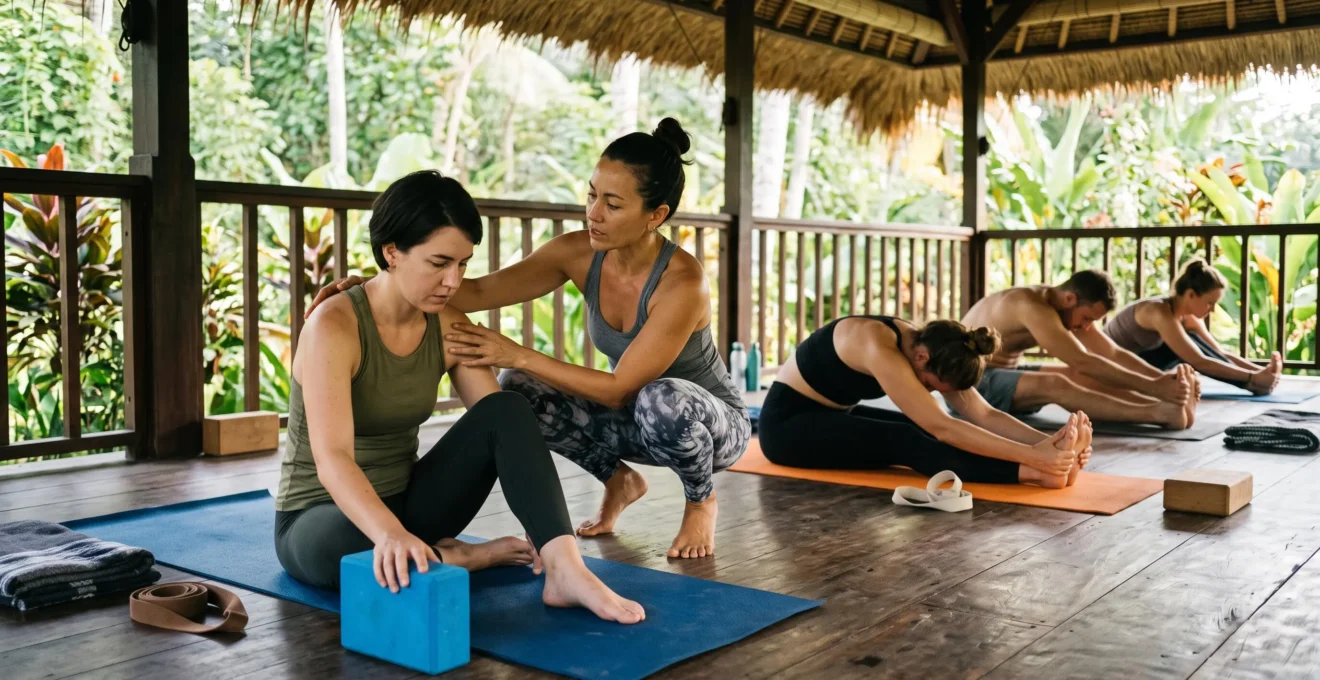
The best yoga retreat for someone who isn’t flexible is usually a beginner-focused or genuinely adaptable mixed-level programme combining alignment instruction, manageable movement sessions and sufficient recovery. A week of daily practice can help you become more confident and comfortable in your body, but meaningful progress does not require touching your toes, mastering inversions or completing every class.
The challenge is that yoga retreats often look remarkably similar online. A peaceful setting, morning practice and an attractive wellness itinerary reveal little about how demanding the teaching will be. A retreat described as suitable for everyone may still involve fast transitions, unfamiliar postures and several hours on the mat.
Choosing well means examining more than the destination. Your current mobility, experience, recovery needs, tolerance for group instruction and preferred balance between activity and rest all matter. Seven days is enough to learn useful movement skills and establish a foundation, provided the programme respects your starting point rather than forcing you to keep up with experienced practitioners.
Choosing a beginner-friendly yoga retreat in seven days
- Prioritise teaching over labels: Look for small groups, individual modifications, introductory alignment sessions and instructors experienced with beginners.
- Check the full daily workload: A balanced programme combines active practice, gentler sessions and genuine opportunities to rest.
- Measure progress realistically: Better movement control, more comfortable transitions and a sustainable home routine matter more than dramatic flexibility gains.
- Why Yoga Retreats Make Inflexible Beginners Feel Out of Place by the Second Class
- How to Tell if a Yoga Retreat Is Gentle or Intense Using Only the Schedule and Style Names
- Vinyasa or Yin Retreat: Which Works Better if You Sit at a Desk 8 Hours a Day?
- The Alignment Mistake That Can Trigger a Shoulder Injury During Retreat Week
- In What Order Should You Schedule Yoga, Workshops and Excursions to Avoid Overtraining?
- Silent Retreat or Spa Retreat: Which Works Better if Your Mind Won’t Switch Off at Night?
- Why Do You Feel Stiff on Holiday Even If You Walk a Lot Every Day?
- How to Stay Active on Holiday With 20 Minutes a Day Without Feeling Like You’re Training
Why Yoga Retreats Make Inflexible Beginners Feel Out of Place by the Second Class
Beginners can feel comfortable during their first retreat class but suddenly out of place during the second because unfamiliar sequences, faster instructions and visible differences in flexibility become harder to ignore. The novelty of arrival fades, while mixed-level teaching may assume knowledge that new participants do not have. This is a teaching-fit problem, not proof that someone is unsuitable for yoga.
On the first morning, enthusiasm can make unfamiliar movements feel like an enjoyable challenge. By the next session, mild soreness, fatigue and the effort of remembering posture names may compete for attention. A teacher saying “move through your vinyasa” might give experienced students sufficient information while leaving beginners wondering what to do next.
Mixed-level groups can magnify that uncertainty when everyone receives the same verbal instructions. Seeing another guest fold deeply forward or transition smoothly into downward-facing dog may shift attention away from personal sensations and toward comparison.
Before booking, examine the retreat’s teaching culture rather than relying on reassuring descriptions. Group photographs showing only advanced postures, teacher biographies without clear beginner-teaching experience and reviews that say “beginners welcome” without describing actual support are reasons to ask more questions. None independently proves that a retreat is unsuitable.
Physical discomfort and emotional discomfort require different solutions. If a posture demands more mobility or strength than you currently possess, look for skill-tiered classes with props, accessible variations and individual feedback. If the main difficulty is embarrassment about being the least experienced guest, a dedicated beginner cohort may be more reassuring than an otherwise excellent mixed-level retreat.
A useful day-one baseline includes three observations: how comfortably you can move into a forward fold without forcing it, how steadily you can breathe during a simple standing posture, and how you feel after an appropriately challenging session. Repeat those observations near the end of the week without turning them into a competition.
What research actually shows about seven-day progress
A randomised study of a seven-day residential yoga programme examined 80 participants with chronic low-back pain. Researchers compared an intensive yoga-based programme incorporating postures, breathing, meditation and education with a supervised physical-exercise programme.
The yoga group showed greater improvements in selected spinal-flexibility measures and pain-related disability. This demonstrates that short-term changes are possible in the population studied, but it does not establish equivalent outcomes for healthy beginners or every commercial yoga retreat.
That distinction matters. Seven days should provide a learning opportunity, not a deadline for achieving a particular posture. Flexibility varies between people, and more movement is not automatically better movement.
Once you know what supportive instruction looks like, the next decision is whether the timetable gives your body enough opportunity to learn and recover.
How to Tell if a Yoga Retreat Is Gentle or Intense Using Only the Schedule and Style Names
The clearest way to estimate retreat intensity is to combine yoga style names with the daily timetable. Restorative and Yin classes generally indicate slower practice, while Power, Ashtanga and fast Vinyasa often suggest greater physical demands. However, posture duration, teaching approach, session frequency and recovery time can make two retreats using identical labels feel completely different.
Start by decoding the language used in the programme. The following categories describe common teaching tendencies, not standardised intensity ratings.
| Yoga style | Typical characteristics | What to check before booking |
|---|---|---|
| Hatha | Deliberate pace, individual postures and attention to breathing | Slow does not always mean easy; ask about long standing holds and strength demands. |
| Yin | Long-held, mostly floor-based postures with relatively little active movement | Ask whether props and shorter holds are available, especially for sensitive joints. |
| Restorative | Highly supported resting postures using blankets, bolsters and other props | Check whether sessions are genuinely restful or simply labelled as slow yoga. |
| Iyengar | Detailed alignment instruction, posture precision and frequent prop use | Ask whether the class is designed for beginners and whether demanding holds are included. |
| Vinyasa | Flowing sequences coordinating movement with breathing | Check the pace, number of plank transitions and availability of alternatives. |
| Ashtanga | Structured, physically demanding sequences with repeated transitions | Confirm whether beginners receive an adapted introduction rather than joining an established sequence. |
| Power | Fitness-oriented flow with substantial muscular effort | Ask about strength expectations, session length and recovery options. |
| Rocket | Dynamic sequences inspired by Ashtanga, potentially including advanced balances | Check whether introductory sessions avoid advanced transitions and inversions. |
Next, audit the schedule itself. Count the time allocated to physical practice separately from meditation, meals, talks and free time. A timetable containing three hours of active yoga and a timetable containing one active class plus two hours of guided relaxation impose different demands, even if both advertise three hours of daily wellness activities.
Look carefully at double sessions. “Morning flow and evening Yin” may offer an effective balance when the morning class is accessible and the evening practice allows genuine recovery. “Morning Power and afternoon Vinyasa intensive” indicates a substantially heavier workload.
As a conservative planning heuristic for an inexperienced guest, treat more than two physically demanding sessions in one day as a reason to investigate further. This is not a medically established maximum. Your training background, class length, intensity and recovery capacity determine what is appropriate, and some beginners will need much less.
Rest indicators are particularly valuable: an unstructured afternoon, optional workshops, a day with no vigorous practice and the ability to replace a demanding class with meditation or supported relaxation.
The NCCIH overview of yoga effectiveness and safety notes that yoga ranges from gentle to physically demanding forms. It also recommends qualified instruction, appropriate modifications and extra precautions for people with relevant health conditions.
Five checks to complete before booking a yoga retreat
- Mark every physical session: Produce a seven-day timetable showing active mat hours separately from meditation and relaxation.
- Identify demanding combinations: Highlight days containing multiple strong flows, intensives or challenging excursions, creating a list of potential fatigue days.
- Request modification details: Obtain a written explanation of how teachers adapt postures, transitions and class pace for beginners.
- Confirm recovery options: Record which sessions are optional, which can be replaced with gentler practice and whether attendance is flexible.
- Check the entry requirements: Save the instructor’s response confirming whether your current experience, mobility and relevant limitations match the programme.
A timetable that looks manageable on paper still needs to suit how your body moves during ordinary life, particularly if much of that life happens at a desk.
Vinyasa or Yin Retreat: Which Works Better if You Sit at a Desk 8 Hours a Day?
For someone sitting at a desk eight hours a day, a retreat combining accessible Vinyasa with supported Yin or Restorative practice is often more versatile than either style alone. Dynamic yoga can develop strength, coordination and active mobility, while slower sessions provide opportunities to explore comfortable movement ranges. Existing pain, floor mobility and exercise experience should determine the balance.
Long working days often involve sustained hip flexion, limited spinal rotation and prolonged arm positions around a keyboard. These habits can contribute to perceived stiffness, although they do not establish that particular muscles are permanently shortened or that everyone with a desk job has the same posture-related problems.
Vinyasa offers repeated transitions between standing, balancing and floor positions. Appropriately scaled sequences can help develop the muscular control needed to move through newly accessible ranges. However, prolonged plank holds, repeated lunges and quick transitions may exceed the capacity of someone starting from a largely sedentary routine.
Yin typically uses longer-held passive positions with relatively little muscular effort. It provides time to explore comfortable range and breathing, often with props. Yet passive stretching is not a substitute for building strength and movement control, and staying longer in a painful position does not make it beneficial.
The practical choice depends on what your body currently tolerates.
| Your starting point | Suggested emphasis | Important adjustment |
|---|---|---|
| Generally comfortable, but inactive for much of the day | Introductory active yoga with slower sessions | Build intensity gradually rather than joining advanced flows immediately. |
| Difficulty getting down to or standing up from the floor | Supported Hatha, alignment-based or accessible classes | Request chairs, blocks and adapted floor transitions. |
| Frequently sore after exercise | Shorter active sessions with ample recovery | Avoid repeated strength-heavy classes on consecutive days. |
| Persistent or unexplained pain | Individual assessment before selecting intensity | Consult an appropriate health professional rather than using yoga to self-diagnose. |
| Comfortable with movement but mentally overstimulated | Moderate active practice plus slower evening sessions | Choose a timetable that includes guided breathing and unhurried transitions. |
Consider two hypothetical programmes. Retreat A offers vigorous Vinyasa every morning followed by another active session in the afternoon. Retreat B includes an accessible morning flow, optional alignment instruction and supported Yin in the evening. For an inactive beginner, Retreat B may provide a more manageable combination of movement practice and recovery.
That does not make Yin universally preferable, nor does it establish that one style produces faster flexibility gains. A Yin-only programme might feel insufficiently active to someone seeking strength and coordination, while a Vinyasa-heavy week could cause enough fatigue to discourage participation.
Check the active-to-passive balance across the full week, not just one representative day. A mixture of manageable challenge and recovery offers more flexibility when your energy changes.
For desk workers who struggle to settle at night, a slower evening class may also provide a useful transition away from work-like stimulation. Sleep benefits are possible, but individual responses and the evidence for specific yoga styles vary.
Whatever combination you choose, movement quality matters most when repeated sessions begin to expose unfamiliar joints to greater workloads.
The Alignment Mistake That Can Trigger a Shoulder Injury During Retreat Week
A potentially risky mistake during intensive yoga practice is repeatedly lowering through Chaturanga with the shoulders collapsing forward, insufficient upper-body control or a movement range that exceeds current strength. When fast Vinyasa sequences repeat these transitions across several daily classes, fatigue can further compromise technique. Beginners should reduce repetitions, use supported variations or skip the movement when control deteriorates.
Chaturanga Dandasana is commonly described as a low plank. In many flowing classes, it appears between a high plank and a backbend, sometimes several times in one sequence. Supporting body weight while lowering demands coordinated shoulder, trunk and arm strength.
A beginner may try to keep pace by dropping the chest quickly, allowing the shoulders to move excessively forward or widening the elbows without sufficient control. These patterns can increase discomfort or place demands on structures that are not yet prepared for repeated loading.
Elbow position is only one part of alignment. Keeping the elbows relatively close to the ribs may help some practitioners maintain control, but there is no single universally safe angle. Shoulder anatomy, strength, symptoms and teaching technique all matter.
Use the first class as a movement-quality check. Can you lower slowly without your shoulders collapsing, your trunk sagging or your breathing becoming strained? If not, try a teacher-approved variation with knees supported, lower only through a manageable range or omit Chaturanga altogether.
Ask the teacher directly: “Could you show me a lower-load alternative to Chaturanga that I can repeat safely throughout the week?” An experienced instructor should be able to demonstrate options and help you recognise when to reduce intensity. A modification is a normal teaching tool, not an admission of failure.
Retreat schedules create an additional challenge: accumulated fatigue. A movement that feels controlled during an early class may become less stable after several days of activity, particularly when sleep, hydration or recovery have been insufficient.
Distinguish ordinary post-exercise soreness from symptoms that deserve more attention. Generalised muscle tenderness that improves with rest may occur after unfamiliar activity. Sharp shoulder pain, sudden weakness, instability or pain that worsens with movement should prompt you to stop the provoking exercise rather than push through.
Persistent pain, marked weakness or restricted function warrants assessment by a qualified healthcare professional. Severe pain, deformity or sudden substantial loss of function requires prompt medical evaluation. Symptoms alone cannot reliably identify which shoulder structure is injured.
The NCCIH safety guidance identifies sprains and strains among the common yoga-related injuries and notes that serious injuries are uncommon. It does not establish Chaturanga as the leading cause of retreat injuries, so the movement deserves practical caution rather than disproportionate fear.
Protecting your shoulders is partly about technique, but it is also about how you distribute challenging activities over the week.
In What Order Should You Schedule Yoga, Workshops and Excursions to Avoid Overtraining?
Schedule demanding yoga sessions, intensive workshops and excursions so that hard activities are separated by easier periods, rather than concentrating them into the same day. Keep foundational instruction early, allow recovery after unfamiliar exertion and preserve flexibility later in the week. For beginners, attending fewer sessions with good technique can be more productive than completing every activity while exhausted.
A seven-day retreat often combines different demands: morning flow, posture workshops, hiking, sightseeing and evening practice. Each activity may seem manageable individually, but their combined workload can exceed what your body normally tolerates.
Begin by identifying which activities depend on previous instruction. An introductory alignment workshop on day two may teach modifications required for later dynamic sessions. Skipping it for an optional excursion could leave you less prepared for subsequent classes.
Standalone experiences, such as a guided meditation or introductory philosophy discussion, are usually easier to rearrange without affecting practical progression.
A hypothetical beginner-friendly week might use the following sequence:
| Day | Main priority | Recovery consideration |
|---|---|---|
| 1 | Arrival, gentle movement and orientation | Avoid judging your capacity immediately after travel. |
| 2 | Foundational alignment and introductory active practice | Learn suitable variations before increasing intensity. |
| 3 | Moderate practice and an optional excursion | Keep later activity gentle if the excursion is strenuous. |
| 4 | A more challenging workshop, if appropriate | Choose a restorative evening rather than additional hard practice. |
| 5 | Recovery-focused practice and optional free time | Assess fatigue before resuming stronger sequences. |
| 6 | Personalised technique and manageable active practice | Focus on quality and repeatable skills. |
| 7 | Gentle practice, reflection and home-routine planning | Leave with energy rather than accumulated exhaustion. |
This is a planning example, not a clinically validated training protocol. If the retreat builds progressively toward a particular workshop, follow the instructor’s sequence where appropriate instead of automatically moving the hardest activities earlier.
Track fatigue using two questions each morning: Is stiffness or soreness lasting longer than yesterday? Has sleep or appetite changed noticeably while physical activity has increased?
One difficult morning does not prove overtraining. Travel, unfamiliar food, temperature and stress may also affect recovery. However, worsening soreness, persistent fatigue or disrupted sleep provides a reason to reduce intensity and discuss the pattern with your instructor. Significant or persistent symptoms deserve medical advice.
The financial pressure to attend everything can be surprisingly powerful. When excursions, workshops and treatments are included in the retreat price, skipping one may feel wasteful. Decide before arrival which optional activities you are willing to miss if recovery becomes a priority.
For example, give a demanding hike priority over an optional afternoon Power class, or preserve an essential alignment workshop by moving sightseeing to a free period. The aim is to protect the experiences that support your goals.
Physical recovery is only one side of the experience. Travellers seeking relief from mental overstimulation also need to choose the right kind of quiet.
Silent Retreat or Spa Retreat: Which Works Better if Your Mind Won’t Switch Off at Night?
A silent retreat removes conversation and external stimulation, while a spa retreat generally emphasises comfort, treatments and relaxation. Neither automatically resolves a racing mind. For a first-time retreat guest who struggles to switch off at night, a structured programme with gentle movement, guided relaxation and optional quiet periods may feel more manageable than either complete silence or an entirely passive spa schedule.
The distinction matters because wellness marketing often presents silence, massage, meditation and rest as interchangeable experiences. They are not.
A silent retreat may involve extended periods without conversation, digital devices or ordinary social interaction. Depending on the format, participants may spend substantial time in seated meditation or structured contemplative practice.
Some people find this settling. Others may become more aware of persistent worries when their usual distractions disappear. Silence is not inherently harmful, but someone unfamiliar with meditation should not assume that a week of intensive quiet will immediately feel restful.
A spa retreat offers a different environment. Massage, thermal facilities, comfortable accommodation and unscheduled leisure may help create a pleasant break. However, a relaxing setting alone does not necessarily provide practical strategies for managing recurring thoughts at bedtime.
Before choosing, distinguish two patterns:
- Physical restlessness: If prolonged inactivity makes you uncomfortable, consider gentle movement, walking and regular opportunities to change position.
- Repetitive thinking: If worries become louder when external activity stops, look for guided breathing, structured meditation and predictable evening routines rather than assuming prolonged silence is the best starting point.
These patterns can overlap, and persistent sleep problems may have causes that require professional assessment.
22 randomised trials
A systematic review involving 1,348 adults with insomnia examined exercise interventions, including yoga. The findings suggest potential improvements in several sleep outcomes, although evidence certainty varied and only four included trials were assessed as having low risk of bias. The review did not compare silent and spa retreats or establish the best time of day for yoga.
BMJ Evidence-Based Medicine review of exercise interventions for insomnia
A practical compromise is a retreat offering device-free evenings, optional silent breakfasts or short guided meditation periods. These formats let you experience quiet without committing to an intensive silent programme for an entire week.
If you are curious about silence but concerned about rumination, ask whether teachers provide individual guidance, whether participation is flexible and how guests can request support if they become distressed.
A gentle evening class may also provide a predictable transition toward bedtime, although research does not establish that evening Yin is superior to other yoga styles or class times for sleep.
The most suitable retreat creates conditions you can tolerate and enjoy, rather than demanding an unfamiliar form of stillness simply because it promises peace.
Why Do You Feel Stiff on Holiday Even If You Walk a Lot Every Day?
You can walk extensively on holiday and still feel stiff because walking repeatedly uses a relatively limited range of familiar movements. Long flights, car journeys, unfamiliar beds and extended periods sitting or reclining can leave other movements feeling restricted. A high daily step count therefore does not guarantee that your hips, shoulders and spine are prepared for the wider range of postures used in yoga.
Walking provides valuable physical activity, but its movement demands differ from those of a yoga class. Normal walking repeatedly moves the hips, knees and ankles through a habitual pattern. It usually involves less sustained spinal rotation, shoulder loading and end-range movement than a varied yoga session.
That explains why someone comfortable exploring a city on foot may struggle with a deep lunge, a seated twist or repeated transitions between standing and the floor. These activities require different combinations of mobility, strength and control.
Travel can add temporary discomfort. Sitting for long periods may make the first movements after arrival feel awkward. Carrying luggage can fatigue the shoulders and back, while disrupted sleep may alter how strenuous activity feels.
Dehydration can also affect wellbeing and physical performance, although it should not automatically be treated as the explanation for joint stiffness. Pain or restricted mobility may have other causes.
If your itinerary permits, arriving a day before the retreat begins is a useful planning option. It gives you time to recover from the journey, explore the environment and avoid rushing directly from transport into a challenging class. This is practical travel advice, not a proven method for increasing flexibility.
On arrival, describe how your body feels rather than relying solely on your usual fitness level. A teacher who understands that you have just completed a long journey can suggest an accessible starting point.
The first day’s programme is especially revealing. Gentle exploratory movements, accessible standing poses and opportunities to discuss limitations suggest a teaching approach that accommodates different starting conditions.
By contrast, a retreat opening with an obligatory fast flow or demanding posture workshop may be poorly matched to a traveller who arrives tired and stiff, even if that person is otherwise active.
Do not force a stretch to compensate for travel discomfort. Gradual movement and comfortable mobility work are generally more appropriate than trying to achieve a dramatic range immediately. New swelling, severe pain or persistent mobility loss should not be dismissed as ordinary holiday stiffness.
Once the first-day stiffness has settled and you understand which movements help you feel comfortable, the most useful final step is deciding what you can sustain after returning home.
What to carry beyond your retreat week
- Identify the two or three movements that genuinely improve your comfort and control, rather than collecting as many postures as possible.
- Ask your instructor to help adapt those movements to your home environment and current abilities.
- Choose a practice schedule that fits ordinary working days and travel, so progress does not depend on retreat-level free time.
How to Stay Active on Holiday With 20 Minutes a Day Without Feeling Like You’re Training
A 20–minute daily yoga routine can help you continue practising skills learned during a retreat without recreating a full class. Combine comfortable joint movements, two or three personally relevant postures and a short breathing or relaxation period. The aim is a repeatable habit that supports movement confidence and wellbeing, not a fixed amount of exercise guaranteed to preserve flexibility.
The most valuable retreat takeaway is often knowing what your body needs rather than memorising a long sequence. Someone who spends most days sitting may benefit from accessible hip movement, thoracic rotation and shoulder control. Someone who feels tense after travel may prefer gentle whole-body mobility and slow breathing.
Before leaving, ask your teacher to identify a small number of movements you can perform confidently without supervision. Confirm how to use props, how to scale each posture and which sensations indicate that you should stop or modify.
Here is a practical template that can be adjusted to your needs:
| Duration | Activity | Purpose |
|---|---|---|
| 4 minutes | Gentle joint mobility, such as comfortable shoulder circles, easy spinal movements and supported hip movements | Reconnect with movement without beginning at maximum intensity. |
| 8 minutes | Two or three teacher-approved postures, such as a supported low lunge, accessible standing pose or gentle thoracic rotation | Practise the movement skills most relevant to your needs. |
| 4 minutes | Slow transitions, comfortable balance practice or a gentle supported stretch | Develop control and coordination without rushing. |
| 4 minutes | Comfortable breathing, guided relaxation or quiet rest | Finish with a manageable transition into the rest of your day. |
The routine is an illustrative planning tool, not a scientifically validated minimum dose for maintaining retreat-related mobility gains. The ideal frequency and duration depend on the individual and the activities being practised.
Consistency makes this approach practical. A demanding hour-long routine can become difficult to maintain once work and travel obligations return. A shorter programme may be easier to repeat because it requires less preparation and fewer decisions.
The US Centers for Disease Control and Prevention recommends starting physical activity gradually, choosing enjoyable activities and scheduling regular opportunities for movement. Its guidance supports sustainable exercise habits but does not prescribe a specific daily yoga routine.
To reduce friction, attach your practice to something you already do. You might use the same quiet period before breakfast, practise after returning from work or spend a few minutes moving before your evening shower.
Leave your mat or necessary props somewhere accessible when practical. On travel days, use a shorter version rather than treating one missed session as a failure. If a posture becomes painful or difficult to control, adjust it instead of assuming that repetition will solve the problem.
Progress is better judged by repeatable quality than intensity. Moving with greater awareness, recognising fatigue earlier and knowing how to modify a posture are valuable outcomes even without dramatic changes in range.
Before booking, ask the retreat organiser whether the final day includes individual guidance for continuing practice. Choose the programme that matches your present abilities, makes modifications easy to request and gives you a routine worth taking home. Seven days can be the beginning of genuine progress without becoming a test of how far your body can bend.
Do you need to practise yoga before attending your first retreat?
Not necessarily. Some retreats are explicitly designed for complete beginners, while others expect familiarity with common poses and transitions. Check the programme’s entry requirements, ask whether teachers explain foundational movements and confirm that beginner modifications are available. A few introductory classes at home may improve familiarity, but they are not a universal prerequisite.
Can you attend a yoga retreat if you cannot touch your toes?
Yes. Touching your toes is not a requirement for practising yoga. Props, bent knees and accessible variations can help you work within your current movement range. The important considerations are whether the retreat offers appropriate instruction and whether you can participate without forcing painful or unstable positions.
Should you disclose an existing injury or medical condition before booking?
Yes, relevant injuries and health conditions should be discussed with the retreat organiser so you can understand whether suitable modifications are available. Seek advice from a qualified healthcare professional when a condition may affect your ability to participate safely. Yoga instructors can adapt practice within their expertise, but they cannot replace medical diagnosis or treatment.
What should you pack for a beginner-friendly yoga retreat?
Pack comfortable clothing that allows unrestricted movement, suitable footwear for non-yoga activities and a reusable water bottle. Ask whether mats, blocks, straps, blankets and bolsters are supplied. If you use a particular support for comfort, confirm that an equivalent will be available. There is no need to purchase specialist equipment before checking what the retreat provides.
Is it acceptable to skip yoga sessions during a retreat you have already paid for?
Generally, yes, when attendance is optional under the retreat’s rules. Check those conditions before booking. If you are fatigued, uncomfortable or developing pain, reducing the workload may be more appropriate than completing every session. Ask which workshops build on earlier instruction before skipping foundational classes, and never let the cost of a session override an important health concern.