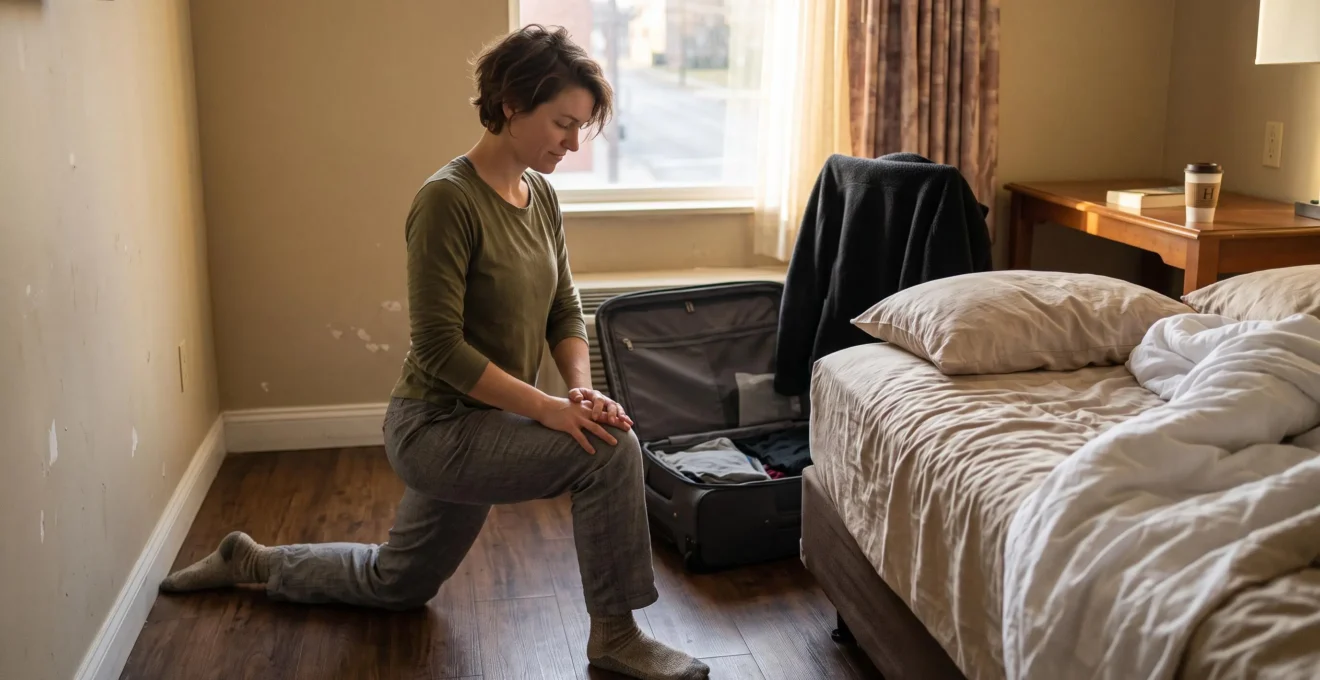
Staying active on holiday doesn’t require a gym membership, running shoes packed for every occasion, or a workout that interrupts your morning. A few minutes of comfortable movement, combined with the walking and exploring you’re already doing, can help you maintain an enjoyable activity routine without turning your trip into a training programme.
The simplest approach is to use 20 minutes as a flexible daily movement budget. You might spend part of it loosening up after a long journey, take a relaxed walk somewhere interesting, and finish with gentle movements before bed. On busy sightseeing days, your walking may already provide plenty of aerobic activity.
The distinction matters. According to the World Health Organization, physical activity includes everyday movement and leisure activities, not just structured exercise. Its WHO guidelines on physical activity and sedentary behaviour recommend 150–300 minutes of moderate-intensity aerobic activity per week for adults, alongside muscle-strengthening activities and less sedentary time. Twenty minutes of moderate activity daily adds up to 140 minutes weekly, so this holiday routine is a practical starting point rather than a complete replacement for those recommendations.
Holiday movement: the essentials
- Move differently, not necessarily more: break up long periods of sitting with comfortable changes of position, even when you’re walking a lot.
- Use two everyday triggers: pair short movement breaks with existing habits, such as morning coffee and your evening shower.
- Protect your enjoyment: choose familiar footwear, manage walking distances, and keep demanding activity away from bedtime if it affects your sleep.
- Why Do You Feel Stiff on Holiday Even If You Walk a Lot Every Day?
- How to Build a Simple Holiday Movement Routine Using 2 Daily Triggers and No Equipment?
- Hotel Gym or Outdoor Walk Plan: Which Works Better if You Hate Exercising Indoors?
- The Footwear Mistake That Can Ruin Your Trip With Knee Pain by Day 3
- When Should You Exercise on a Trip to Avoid Soreness and Still Sleep Well?
- Vinyasa or Yin Retreat: Which Works Better if You Sit at a Desk 8 Hours a Day?
- How to Audit Wi‑Fi, Desk Setup, and Receipt Tracking in 60 Minutes After Check-In?
- How to Set Up a 3-Week Business Stay So You Don’t Burn Out After the First 5 Days
Why Do You Feel Stiff on Holiday Even If You Walk a Lot Every Day?
You can walk thousands of steps on holiday and still feel stiff because walking doesn’t move every joint through its full comfortable range. Long flights, restaurant meals, bus journeys, and unfamiliar sleeping arrangements can also leave you spending hours in the same positions. Your step count measures how much you walk, not how varied your movement has been.
Imagine spending a day exploring a city. You walk between attractions, sit through lunch, stand in museum queues, and return to your hotel by train. Although you’ve been on your feet for hours, most of your activity has involved the same repeated walking pattern, interrupted by sitting or standing relatively still.
Walking is valuable physical activity, but it doesn’t automatically provide much comfortable twisting, overhead reaching, squatting, or movement in other directions. When those positions are missing from your day, you may notice stiffness when standing up, bending down, or reaching for luggage.
Think about positions per day, not just steps per day. As an informal self-check, ask how many different positions you’ve used. Have you sat, stood, reached overhead, rotated your torso, bent your knees, or lowered yourself towards the floor?
A hypothetical 15,000-step sightseeing day might involve mostly sitting, standing, and walking. That’s plenty of repetition, but relatively little variety. Counting positions isn’t a validated medical assessment or a proven way to prevent stiffness; it’s simply a useful prompt to notice what your day has been missing.
Travel can also introduce unfamiliar physical demands:
- Luggage: carrying a heavy shoulder bag on one side may make your neck or shoulders uncomfortable.
- Transport: remaining seated in a confined position can make your first few movements feel awkward.
- Sleeping arrangements: an unfamiliar mattress or pillow may affect comfort and sleep quality.
- Climate and hydration: temperature changes can affect how comfortable you feel, while inadequate hydration can contribute to general travel discomfort.
These influences vary between travellers. Persistent stiffness, swelling, weakness, or significant pain shouldn’t automatically be attributed to ordinary travel fatigue.
The useful response isn’t necessarily another long walk. Try standing after an extended sitting period, reaching comfortably overhead, rotating your upper body, or gently moving your hips and ankles. Choose movements that feel easy rather than forcing a deeper stretch.
Once you recognise the difference between movement quantity and variety, it becomes easier to build short activity breaks around your actual holiday plans rather than adding another demanding commitment.
How to Build a Simple Holiday Movement Routine Using 2 Daily Triggers and No Equipment?
Build a holiday movement routine by linking two short activity blocks to events that already happen every day. For example, move for ten minutes after morning coffee and another ten minutes before your evening shower. Choose comfortable movements that fit beside your hotel bed, require no equipment, and can be shortened whenever your plans change.
The method is called trigger pairing: an existing habit becomes your reminder to move. Instead of checking the clock or finding motivation, you simply connect a small action to something you’re already going to do.
For a practical 20-minute routine, give the two blocks different jobs.
Trigger one: prepare for the day. After breakfast or coffee, move gently through positions that feel comfortable after sleeping or travelling. This might include standing hip movements, shoulder circles, controlled torso rotations, and a few relaxed sit-to-stand repetitions.
Trigger two: change position after the day. Before showering or getting ready for bed, choose slower movements based on what you’ve been doing. After hours of walking, you might prefer easy ankle movements and gentle hip mobility. Following a long drive, standing and reaching may feel more welcome.
The purpose is not to achieve a particular stretch depth or number of repetitions. It’s to make movement accessible without extra preparation.
Use a simple selection test: can you do the movement in normal travel clothes, within a small clear space, and stop immediately if your taxi arrives? If not, save it for another occasion.
There will also be mornings when your routine disappears under an early departure or an unexpected delay. On those days, use a one-move fallback. Stand up, gently turn your upper body from side to side, or perform a few comfortable shoulder rolls. It may take less than a minute.
That fallback won’t provide the same activity volume as a longer session. Its purpose is to keep the routine manageable rather than turn a disrupted day into a reason to abandon it.
Your five-step holiday movement setup
- Choose your morning trigger: write down one dependable event, such as finishing coffee, that will remind you to move.
- Choose your evening trigger: identify a second recurring event and add it beneath the first.
- Select four comfortable movements: record two for each trigger that you can perform without equipment or pain.
- Clear your movement space: identify a safe area beside the bed where you can stand, turn, and reach without hitting furniture.
- Write a fallback rule: note one movement you’ll use on unusually busy days, so the reduced version is already decided.
These short blocks can complement your existing holiday activity. If you spend the day walking, there’s no need to add a workout simply to reach an arbitrary number on a fitness tracker.
Hotel Gym or Outdoor Walk Plan: Which Works Better if You Hate Exercising Indoors?
An outdoor walking plan is usually the more appealing starting point if you dislike exercising indoors and want movement to feel like part of your holiday. A hotel gym is more useful when you need predictable conditions, specific equipment, or shelter from unsafe weather. The better option is the one you’ll comfortably use without sacrificing your enjoyment or recovery.
For someone who associates exercise with obligation, entering a hotel gym can feel like returning to a familiar chore. Walking through a neighbourhood, exploring a park, or visiting a local market may feel different because the main activity is discovery.
That doesn’t make outdoor walking inherently superior. A gym can provide controlled conditions and access to strength exercises that ordinary sightseeing may not offer.
Choose based on what your day is missing, rather than which option looks more athletic.
| Decision factor | Outdoor walking | Hotel gym |
|---|---|---|
| Holiday enjoyment | Combines exploring with activity | Offers a dedicated indoor session |
| Movement variety | Routes can include hills, turns, and changes of terrain | Equipment allows selected movement patterns |
| Intensity control | Depends on route, pace, and conditions | Often easier to adjust precisely |
| Weather exposure | Affected by heat, rain, and air quality | Usually more sheltered and predictable |
| Equipment needs | Generally requires suitable footwear | Equipment depends on the available facilities |
| Main limitation | Distance and terrain may be underestimated | May feel repetitive or inconvenient |
A practical compromise is to make outdoor exploration your default and the hotel gym an optional alternative. Switch indoors when outdoor conditions become unsuitable: extreme heat, poor air quality, unsafe routes, or darkness in an unfamiliar area.
There is one important catch. Sightseeing can quietly turn a relaxed walking plan into an endurance challenge. An unfamiliar city might encourage you to continue to the next attraction even when you’re already tired. Uneven pavements, stairs, hills, and heat can add to the effort.
Set a flexible turning point rather than committing to an ambitious distance. If you start feeling uncomfortable, take a break, use public transport, or shorten the route.
A short indoor session can sometimes be less tiring than another long walk. Equally, a relaxed walk through a pleasant neighbourhood may be more enjoyable than forcing yourself onto a treadmill.
Whichever option you choose, the aim is comfortable, sustainable activity. Your footwear and the total amount of walking deserve particular attention when sightseeing becomes more demanding than usual.
The Footwear Mistake That Can Ruin Your Trip With Knee Pain by Day 3
A common holiday footwear mistake is switching suddenly to unfamiliar shoes while also increasing your walking distance. New trainers, flat sandals, or footwear very different from your everyday pair may feel comfortable initially but become troublesome during long sightseeing days. Knee discomfort can develop as activity accumulates, although pain appearing specifically on day three is not a predictable medical rule.
The problem isn’t necessarily that a particular shoe is objectively bad. It’s often the combination of an unfamiliar footwear experience and an unusually demanding walking schedule.
Imagine regularly wearing comfortable trainers for short journeys at home, then spending several consecutive holiday days walking long distances in thin sandals. Your feet and legs now face different conditions at the same time as your total walking demands increase.
Changes in footwear can influence gait, comfort, and how forces are distributed through the lower limbs. However, the relationship between heel height, cushioning, walking technique, and knee symptoms is complex. A change in shoes does not automatically cause knee pain, and footwear alone cannot explain every knee problem.
Symptoms might appear after repeated activity rather than during the first walk. That’s one reason it makes sense to test holiday shoes before departure, especially if you expect much more walking than usual.
Before travelling, try your intended shoes on a day that resembles your expected sightseeing. Walk on familiar routes, include normal breaks, and pay attention to rubbing, pressure, knee discomfort, or shin pain. This is a practical comfort check, not a clinically validated injury-prevention test.
If discomfort appears during your trip, don’t assume that more walking will make it disappear. Reduce the demands on the painful area, reconsider your route, and avoid activities that aggravate symptoms. If another familiar pair of shoes is more comfortable, it may be worth using instead, although alternating footwear is not an established treatment for knee pain.
The NHS advice on knee pain and running injuries recommends gradual progression and appropriate footwear, while recognising that knee pain has several possible causes. The guidance concerns running rather than holiday sightseeing, so it shouldn’t be treated as proof that any particular type of sandal causes travel-related knee injuries.
Significant or worsening pain, swelling, difficulty bearing weight, or problems following an injury warrant medical assessment. Don’t continue walking through these symptoms simply to preserve your itinerary.
Comfortable footwear helps remove one avoidable source of disruption, but recovery also depends on how much activity you do and when you do it. The next decision is how to fit movement around sleep.
When Should You Exercise on a Trip to Avoid Soreness and Still Sleep Well?
Schedule demanding activity when you feel sufficiently rested and have time to recover, while keeping movement close to bedtime gentle if that suits your sleep. Evening exercise isn’t automatically harmful, but vigorous sessions ending very near bedtime may disturb sleep for some people. On trips across time zones, appropriately timed outdoor light exposure can also support adjustment.
The important distinction is intensity rather than a universal exercise curfew.
A quiet walk after dinner, gentle shoulder movements, or relaxed stretching may fit comfortably into an evening routine. A hard interval session immediately before bed presents a different demand.
A systematic review of evening exercise and sleep published in Sports Medicine examined 23 studies involving healthy adults. Overall, evening exercise did not generally impair sleep. However, the authors suggested that vigorous exercise ending within approximately one hour of bedtime might negatively affect some sleep outcomes.
23 studies
The systematic review assessed the acute effects of evening exercise on sleep in healthy adults. Its findings do not establish a universal best exercise time or specifically address holiday travellers.
Stutz, Eiholzer and Spengler, Sports Medicine, published online in 2018.
For a low-pressure holiday routine, try putting any deliberately strenuous activity earlier in your waking day. Keep your evening trigger for movements that feel calming and comfortable. If a later workout doesn’t affect your sleep, there’s no evidence-based reason to assume that all evening exercise is unsuitable.
Crossing time zones adds another consideration. Jet lag occurs when your internal biological timing no longer matches local time. Sleepiness, disrupted sleep, and reduced alertness can make a normal day feel surprisingly demanding.
The CDC Yellow Book chapter on jet lag disorder explains that natural light exposure can help with circadian adjustment, but its timing matters. Morning and evening light can shift the internal clock differently depending on travel direction and circumstances. An outdoor walk can combine light exposure with gentle activity, but a morning walk is not universally the correct jet lag intervention.
There’s also a familiar holiday trap: spending a day sitting in transport and then attempting a demanding late-night workout to compensate. That sudden increase in effort may leave you sore, tired, or less enthusiastic about moving the next day.
On disrupted days, a short comfortable movement break is often a more manageable choice than trying to make up for every inactive hour.
Sleep and recovery become even more relevant when your holiday includes structured activities, such as a yoga retreat, where the daily exercise intensity may be determined by a timetable.
Vinyasa or Yin Retreat: Which Works Better if You Sit at a Desk 8 Hours a Day?
Vinyasa yoga may appeal to desk workers who want active, flowing movement, while Yin yoga may suit those looking for a slower, less physically demanding experience. Neither style is automatically better for stiffness caused by sitting. Choose according to your current ability, preferred pace, comfort, and the overall activity demands of your holiday.
A desk-based working week often contains long periods in relatively similar positions. A retreat can offer an opportunity to explore different movements, but the best choice depends on what you enjoy and how accustomed you are to physical activity.
Vinyasa typically links movements with breathing through flowing sequences. Classes may involve repeated transitions, standing positions, and upper-body loading. The physical demands vary considerably between teachers and sessions.
Yin usually involves slower transitions and longer-held positions, often supported by props. Some travellers prefer its quieter pace, particularly when their holiday priority is rest rather than energetic activity.
Here’s a practical way to compare the two without assuming either style provides a medical treatment for desk-related discomfort.
| Your priority | Vinyasa retreat | Yin retreat |
|---|---|---|
| Active movement | Often the stronger match | Less focused on continuous movement |
| Quiet, slower sessions | Depends on class pace | Often the stronger match |
| Beginner-friendly options | Look for gentle or introductory classes | Look for supported positions and modifications |
| Existing physical discomfort | Adapt transitions and demanding positions | Avoid forcing long holds into pain |
| Compatibility with sightseeing | Account for physical fatigue from classes | Account for time spent in sustained positions |
It’s tempting to select Yin for poor sleep or Vinyasa for tight hips and shoulders, but those symptoms alone aren’t reliable indicators of which style will help. Individual experiences vary, and neither approach is guaranteed to resolve stiffness, sleep difficulties, or stress.
One risk is booking an intensive retreat without considering your current activity level. Daily demanding Vinyasa classes can represent a substantial jump in physical workload. That may leave a beginner with soreness that competes with hiking, sightseeing, or other holiday plans.
A gentler programme, optional classes, or a combination of styles may be more enjoyable. Ask organisers about class intensity, modifications, rest opportunities, and beginner suitability before booking.
The 20-minute framework can adapt to either choice. After an active yoga session, additional intense exercise may be unnecessary. A brief comfortable walk or a few easy changes of position might be enough. On a quieter retreat day, you may prefer a longer exploratory walk.
The same principle applies beyond retreats: make the environment support the amount of movement you want. For travellers who also work from their accommodation, that starts with a few practical decisions at check-in.
How to Audit Wi‑Fi, Desk Setup, and Receipt Tracking in 60 Minutes After Check-In?
A practical 60-minute check-in audit should deal with essential connectivity and payment details first, then make your room comfortable for working and moving. Test the Wi‑Fi, organise receipts, check your desk and chair, and identify a small movement area and safe walking route. The goal is to remove everyday friction, not spend your arrival completing an elaborate checklist.
Even on a leisure holiday, you may spend time booking transport, planning activities, checking messages, or doing occasional work. When these tasks happen from a hotel bed or low table, you may end up remaining in the same uncomfortable position for longer than intended.
A quick room setup helps make movement easier to incorporate into your stay.
Consider the following allocation as a suggested planning method, not an established travel-health protocol.
| Time allowance | Task | Practical result |
|---|---|---|
| First 15 minutes | Test Wi‑Fi and essential connectivity | Confirm that required apps and services work |
| Next 15 minutes | Organise payment records and receipts | Keep necessary documents in one accessible place |
| Next 15 minutes | Adjust the desk and seating area | Identify a comfortable position for brief work sessions |
| Next 5 minutes | Scan the room for movement space | Choose a clear, stable area for your daily routine |
| Final 10 minutes | Find a practical walking route and settle in | Identify an accessible route without an ambitious distance target |
If you don’t need to work during your stay, the desk check can be brief. Focus instead on finding a comfortable place to sit when planning activities and somewhere to leave your belongings without blocking the floor.
For occasional laptop use, aim for a supported sitting position, a screen you can view comfortably, and a setup that doesn’t require prolonged awkward reaching. Adjust what you can, and change position regularly rather than expecting one posture to remain comfortable indefinitely.
The five-minute movement scan is especially useful. Check whether there is enough room beside the bed for comfortable standing movements, whether the floor is clear, and whether you have a stable surface nearby if you need support.
Also identify one easy route outside the hotel: perhaps a nearby park, a well-lit street, or a short walk to breakfast. You aren’t committing to walk it every day. You’re simply removing the need to search for an option when you’re tired.
Once the basic environment is ready, leave the room and enjoy your destination. On longer stays, the greater challenge is keeping these simple habits useful after the initial excitement has worn off.
What matters most on a longer stay
- Choose a small movement routine that remains possible on demanding workdays, not just quiet holiday mornings.
- Protect recovery by reviewing sleep, walking demands, and social commitments before adding more activity.
- Treat repeated difficulty finding 20 minutes as a reason to simplify the routine and reconsider your schedule.
How to Set Up a 3-Week Business Stay So You Don’t Burn Out After the First 5 Days
For a three-week business stay, establish simple movement, sleep, and meal routines during the first two days, then adjust them as work demands increase. Keep the 20-minute movement plan flexible, choose convenient walking routes, and protect recovery rather than adding ambitious exercise goals. A consistent, manageable routine can support wellbeing without becoming another work obligation.
Business travel often combines several disruptions: unfamiliar accommodation, long meetings, irregular meals, different sleeping arrangements, and social commitments outside normal working hours.
By the middle of the first week, the initial energy of arriving somewhere new may have faded. That doesn’t mean everyone experiences a predictable five-day crash. It means a demanding itinerary can make ordinary recovery habits harder to maintain.
Rather than treating movement as an additional fitness target, use it as a small routine that anchors the day.
A phased approach makes this easier to manage.
Days 1–2: make movement convenient. Identify your morning and evening triggers, locate an easy walking route, and decide where you’ll move inside your accommodation. Keep the first sessions comfortable, especially after travel.
Days 3–5: protect recovery. Pay attention to whether work, dinners, and sightseeing are competing with sleep. If your schedule is demanding, shorten optional activities instead of forcing extra workouts into the remaining time.
From week 2: maintain the lowest-effort version. Keep the routine that requires the least preparation. You might prefer ten minutes in the morning and ten minutes in the evening, or combine gentle mobility with a convenient walk during a break.
Business stays create a scheduling challenge that ordinary holidays may not. Free time isn’t always predictable. A movement break may need to fit between meetings, before breakfast, or after returning to the hotel.
Check your calendar and identify realistic opportunities rather than relying on spare time appearing naturally. A short activity break is easier to maintain when it doesn’t regularly conflict with professional commitments or necessary rest.
By mid-stay, review how the routine feels. If 20 minutes has become difficult to accommodate, reduce the target temporarily. Use the one-move fallback, take an easy walk when practical, or return to your normal routine once the schedule allows.
A recurring lack of time or energy may also indicate that your workload, travel commitments, or recovery opportunities deserve attention. Movement can support an enjoyable routine, but it cannot compensate for chronically inadequate sleep or an unsustainable schedule.
Before your next trip, choose two dependable daily triggers and a handful of movements you already find comfortable. Put them into practice on your first morning, then let the routine adapt to the journey. The goal is to return home having enjoyed your time away, not having completed a perfect training schedule.
Is 20 minutes of movement a day enough to stay healthy on holiday?
Twenty minutes a day can make a useful contribution, but the type and intensity of activity matter. Twenty minutes of moderate aerobic activity daily totals 140 minutes weekly, below the WHO’s lower recommended weekly target of 150 minutes for adults. Gentle stretching and mobility do not necessarily provide the same aerobic benefits. Walking, other activities, muscle strengthening, and overall sedentary time also matter.
Can you stay active on holiday without bringing any fitness equipment?
Yes. Comfortable walking, standing mobility movements, shoulder circles, and gentle sit-to-stand repetitions can all be performed without specialist equipment. Choose movements suited to your ability and surroundings. A clear floor area and stable support may be useful, particularly if balance or joint comfort is a concern.
Should you stretch when your muscles are sore from sightseeing?
Gentle, pain-free movement may feel comfortable after an unusually active day, but stretching isn’t a guaranteed way to prevent or eliminate muscle soreness. Avoid forcing painful positions, reduce demanding activity when necessary, and allow time for recovery. Severe pain, swelling, marked weakness, or difficulty walking should prompt medical assessment rather than continued exercise.
What if you miss your daily movement routine while travelling?
Missing a day doesn’t require compensation. Resume your normal routine when convenient, or use a shorter version when transport delays and other commitments interfere. There’s no need to double the duration or intensity the following day. Your overall activity pattern matters more than maintaining an uninterrupted streak.
How can older travellers adapt a 20-minute holiday movement plan?
Adapt the duration, pace, and movements to current ability, balance, and comfort rather than age alone. Short, comfortable walks, supported standing movements, and gentle changes of position may be suitable options. Travellers with significant balance difficulties, recent injuries, or medical conditions affecting activity should seek individualised professional guidance. The routine should remain manageable and free from movements that provoke pain.