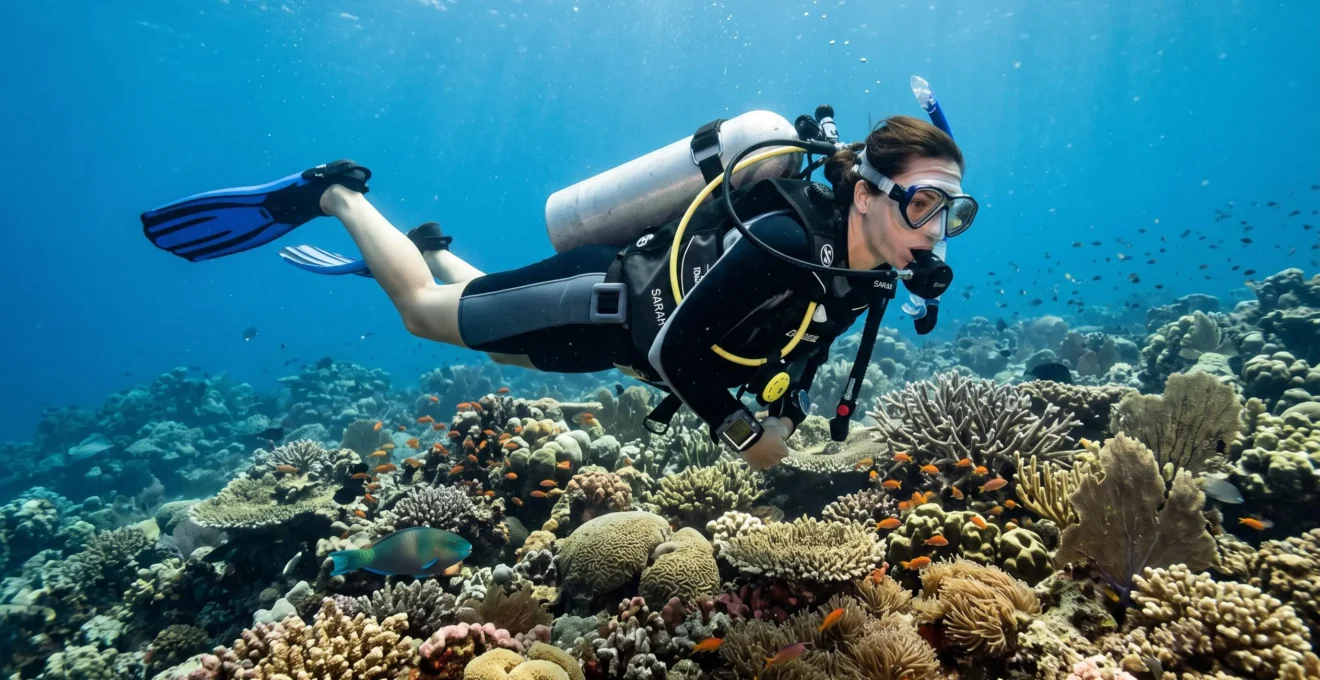
Your first tropical reef dive should be memorable for the coral, marine life, and feeling of weightlessness—not for an unexpected current that makes you question your certification.
Yet being newly certified does not automatically mean you are prepared for every dive advertised as beginner-friendly. Water movement, entry procedures, visibility, and the distance to a safe exit can turn an apparently straightforward reef excursion into a demanding experience.
The safest way to book a beginner reef dive is to match the site and operator to your demonstrated skills, rather than relying on the destination’s reputation or your certification card alone. That means asking about actual conditions, arranging appropriate supervision, and practicing buoyancy before approaching fragile coral.
Whether you are considering a sheltered reef in the Florida Keys, a tropical house reef, or a guided boat excursion, the same principles apply: understand your limits, request a suitable dive plan, and be willing to change that plan when conditions do not cooperate.
Reef diving essentials for newly certified divers
- Choose conditions before scenery: Request a sheltered, shallow site with manageable water movement and an easy exit strategy.
- Verify your operator: Ask about group size, current assessments, emergency procedures, and alternatives when conditions deteriorate.
- Protect the reef through buoyancy: Practice neutral hovering, horizontal trim, and equipment positioning before diving near living coral.
- Why Do Reef Dives Feel Scary for New Divers Even With a “Beginner” Label?
- How to Vet a Dive Operator With 7 Questions Before Your First Reef Day?
- Shore Dive or Boat Dive: Which Is Better if You’re Nervous About Deep Water?
- The Buoyancy Mistake That Breaks Coral and Gets Divers Banned From Sites
- When Is the Best Time to Dive Reefs for Better Visibility and Gentler Currents?
- How to Vet a Water Sports Operator With 6 Questions Before You Pay a Deposit?
- How to Decode a Wilderness Tour Difficulty Rating Using 4 Numbers Before You Book?
- Which Water Sport Should You Choose If You’re a Nervous Beginner Who Still Wants Thrills?
Why Do Reef Dives Feel Scary for New Divers Even With a “Beginner” Label?
Reef dives can feel intimidating because a beginner label usually describes a site’s general suitability, not the exact conditions you will encounter. Even relatively shallow reefs may experience surge, variable visibility, or currents. Newly certified divers can also feel uncomfortable with unfamiliar descents, limited exit options, or the responsibility of avoiding delicate coral.
A dive site considered easy in calm weather may become challenging when wind, swell, or tidal movement changes. Experience matters as much as depth: a diver accustomed to sheltered training water may have little practical experience managing horizontal water movement.
Before deciding that reef diving is too frightening, identify which of three concerns is driving your anxiety:
- Moving water: You worry that a current could carry you away or make swimming back impossible. Prioritize sheltered sites with predictable conditions and a guide experienced in current assessment.
- Open blue water: You dislike descending without a visible bottom or nearby reference. Consider a gradual descent along a sandy slope, reef wall approach, or suitable fixed descent line.
- Damaging coral or making mistakes: You fear losing buoyancy control or slowing down experienced divers. Choose a small, supportive group and begin with practice over sand.
A useful readiness check is whether you can maintain neutral buoyancy without grabbing a surface, clear a flooded mask without panicking, communicate with your buddy, and follow a planned ascent. These skills do not guarantee readiness for currents, but difficulty performing them in calm water is a reason to seek additional supervised practice.
Normal nervousness often becomes manageable after a controlled briefing and descent. Persistent panic, chest tightness, difficulty breathing, or an overwhelming need to escape should not be dismissed as ordinary nerves. Stop, communicate with the instructor, and do not descend until the problem has been addressed. Unexplained physical symptoms warrant medical assessment rather than an attempt to push through the dive.
Certification demonstrates completion of a training standard; it does not erase individual limits. A confined-water refresher can be a better investment than an ambitious reef booking.
Once your main concern is clear, the next decision becomes easier: find an operator willing to adapt the experience to your actual ability rather than the most adventurous itinerary available.
How to Vet a Dive Operator With 7 Questions Before Your First Reef Day?
Vet a reef diving operator by asking seven specific questions about supervision, currents, emergency procedures, and environmental protection. A suitable operator should explain how the dive will change for someone with limited experience, what happens when conditions deteriorate, and how divers can end an excursion safely without being pressured to continue.
The most useful distinction is between an operator who merely guides a group through a predetermined route and one who can provide additional supervision, coaching, or a separate beginner-appropriate dive when needed.
Ask these seven questions before booking:
- How many divers will be assigned to each guide? Request the expected ratio for your specific trip and whether less experienced divers can receive closer supervision.
- What happens if someone becomes separated or needs to end the dive early? Expect a clear lost-buddy procedure, controlled ascent plan, surface support arrangement, and instructions for signaling the boat or shore team.
- What currents are expected at this particular reef, and how are they checked? Ask about site-specific forecasts, local knowledge, tidal-current predictions, and the conditions that would trigger a change of location.
- Is there a sheltered route or alternative shallow site? Find out whether the operator offers an appropriate house reef, guided shore dive, or another suitable location if the original plan becomes demanding.
- What does the safety briefing cover? It should explain hand signals, buddy positioning, gas monitoring, entry and exit procedures, ascent protocols, and emergency responses.
- What happens if conditions become marginal on the morning of the dive? A professional answer should include concrete options such as relocating, rescheduling, or cancelling rather than promising that every scheduled dive will proceed.
- Which reef-conservation rules are actively enforced? Look for clear expectations about avoiding coral contact, maintaining appropriate distance, securing equipment, and respecting protected marine life.
These questions matter because conditions can change during a dive. Divers Alert Network‘s article on current diving explains why site-specific current awareness, suitable training, and the correct equipment are important. It advises against diving in currents greater than 1 knot without appropriate training and experience; that is expert guidance, not a universal legal threshold or a target speed for beginners.
Evaluate the quality of the answers, not merely whether the operator answers every question. Statements such as “currents are never a problem” or “everyone follows the same dive profile” should prompt further scrutiny. By contrast, explaining a specific tide window, conservative route, surface-marker buoy procedure, or suitable alternative site suggests greater attention to conditions.
Verify the operation beyond its promotional material. Check recent reviews from newly certified divers, the qualifications of the professionals who will supervise you, and any claimed affiliation with recognized training organizations such as PADI, SSI, or BSAC. Agency affiliation is useful background information, but it does not independently guarantee operational safety.
Also confirm the availability of emergency oxygen, first-aid equipment, communications, and an emergency action plan appropriate to the site. Ask who is trained to use the equipment and how emergency assistance is accessed.
An operator who welcomes detailed questions and acknowledges that some conditions are unsuitable is usually a more credible candidate than one promising a perfect dive regardless of the weather. The next choice is which entry format best accommodates your concerns.
Shore Dive or Boat Dive: Which Is Better if You’re Nervous About Deep Water?
A sheltered shore dive is often a comfortable starting point for someone nervous about deep water because it may allow a gradual descent along a visible seabed. However, boat diving can be preferable when shore entries involve waves, long surface swims, or difficult exits. Neither format is automatically safer; conditions, supervision, and exit arrangements determine suitability.
Shore diving offers psychological advantages when the entry passes through a shallow, protected lagoon or gently sloping reef. You can often establish breathing and buoyancy control before reaching greater depth.
However, shore access may involve slippery rocks, breaking surf, surge, or channels with concentrated water movement. An accessible beach does not necessarily mean a low-current underwater environment.
Boat diving eliminates some shore-entry difficulties, but it introduces other considerations. A giant-stride entry may place you directly over deeper water, and some sites involve descending through open water without a nearby bottom reference. An experienced crew should explain the descent method and what happens when a diver needs to surface before the rest of the group.
Some boat-operated drift dives allow divers to move with the current and be collected downstream rather than swimming against it. Nevertheless, drift diving requires suitable training, navigation procedures, surface signaling, and dependable boat support. It should never be assumed to be the easier option simply because less finning may be required.
The comparison below focuses on common anxiety triggers rather than assigning an overall safety ranking.
| Primary concern | Potential shore-dive advantage | Potential boat-dive advantage |
|---|---|---|
| Fear of open blue water | Gradual descent along a visible bottom | Guided descent with a suitable line, where available |
| Fear of being left behind | Planned return to an accessible shore exit | Dedicated surface crew and diver-accounting procedures |
| Fear of difficult entries | Gentle beach entry at protected sites | Entry platform and suitable ladder avoiding shore surf |
| Fear of currents | Sheltered lagoon or protected house reef | Carefully selected site with an appropriate recovery plan |
| Seasickness | Less time aboard a moving vessel | Short transfers may be manageable, depending on conditions |
For a first reef excursion, consider a supervised refresher at a sheltered house reef or lagoon. An instructor can assess buoyancy, communication, and comfort before you commit to a more exposed site. A discover-scuba program may be designed for people without certification, so an already certified diver should ask whether a refresher or supervised skills session is more appropriate.
Whatever format you choose, establish your exit procedure before entering the water. Avoid assuming you can surface or swim ashore independently whenever you feel uncomfortable; a safe ascent and exit must follow the site-specific plan.
Your entry method should reduce unnecessary stress, but the ability to maintain control underwater matters just as much. That leads to the skill that protects both your confidence and the reef itself.
The Buoyancy Mistake That Breaks Coral and Gets Divers Banned From Sites
The dangerous buoyancy mistake is using coral as a place to stand, kneel, hold on, or rest a fin while regaining stability. Poor weighting, uncontrolled breathing, and incorrect body position can all contribute to this behavior. Coral is living habitat, not underwater support equipment, and even brief contact can cause damage.
New divers may discover that equipment weighting feels different in saltwater, with another wetsuit, or after changing tank configurations. Inappropriate weighting can cause excessive buoyancy adjustments, while poor trim may leave fins pointing downward toward fragile coral.
Adding more weight is not a reliable solution to every stability problem. Excess weight can require additional buoyancy compensator inflation, potentially increasing drag and complicating buoyancy management.
According to NOAA‘s responsible diving recommendations for the Florida Keys, divers should practice buoyancy control, maintain a horizontal position, secure loose equipment, and avoid touching coral with hands, fins, or diving gear.
Before entering a reef environment, arrange an instructor-supervised buoyancy review over sand or another non-sensitive training area:
- Review your weighting. Perform a weight check using the method appropriate to your equipment, gas supply, exposure protection, and training. Confirm that you can maintain a controlled position and ascent.
- Adjust trim. Work with your instructor to distribute weight appropriately and establish a comfortable, horizontal swimming position.
- Practice hovering. Maintain a stable position above the bottom without touching it, using controlled breathing and small buoyancy corrections.
- Check your fins and accessories. Ensure gauges, hoses, cameras, and other equipment cannot hang below you or strike the reef.
- Rehearse moving away. Practice stopping, maintaining awareness of the bottom, and creating distance from obstacles without grabbing them.
These exercises should be learned and verified with a qualified dive professional rather than improvised above living coral. A buoyancy specialty course or focused refresher can provide additional coaching.
Coral damage is a conservation issue with practical consequences. Individual reefs may be subject to local restrictions, temporary closures, or operator-specific access rules. A diver who disregards conservation instructions may also be refused further participation by an operator. However, neither automatic blacklisting nor mandatory advanced certification following reef damage is a universal policy.
Buoyancy control also supports comfort in moving water. A streamlined, horizontal position can reduce unnecessary effort, while reliable control helps you avoid accidental contact during mild water movement. It does not replace current-diving training or make strong currents safe.
The more reliably you can control your position in sheltered water, the easier it becomes to assess whether a particular reef excursion fits your abilities. The next step is choosing a date when environmental conditions support that decision.
When Is the Best Time to Dive Reefs for Better Visibility and Gentler Currents?
The best time for a nervous beginner to dive a reef is when local forecasts indicate suitable visibility, manageable currents, and calm entry and exit conditions. There is no universal best month or time of day. At tidally influenced sites, a predicted slack-current period may help, but wind, swell, and local underwater geography must also be considered.
Visibility and current strength are separate environmental factors. Water may appear exceptionally clear while a strong current moves across the reef, or visibility may be reduced by suspended sediment even when horizontal water movement is limited.
Recent rainfall, coastal runoff, sediment disturbance, and plankton activity can affect visibility. Currents may be influenced by tides, persistent winds, regional circulation, and the shape of reef channels or slopes.
Understanding tidal predictions is particularly useful. NOAA distinguishes water-level predictions from current predictions: the first describes changes in sea level, while the second provides information about horizontal water movement.
Its frequently asked questions on tides and currents explain the distinction and identify slack water as a period with little or no horizontal tidal current. Importantly, slack current does not always occur at the exact time of high or low tide.
For reefs strongly influenced by tides, the lunar cycle can provide additional context. Spring tides around new and full moons often involve a greater tidal range than neap tides, but local current conditions cannot be established from the moon phase alone.
Use this planning sequence before selecting travel dates:
- Research the destination’s typical storm, monsoon, and seasonal wind patterns.
- Ask local operators which periods usually offer suitable conditions for newly certified divers.
- Check available location-specific tidal-current predictions rather than relying exclusively on high- and low-tide tables.
- Ask how seasonal visibility changes and whether sheltered alternatives remain available.
- Reconfirm the actual forecast shortly before the dive, accepting that the plan may need to change.
Morning trips may provide calmer surface conditions in destinations where afternoon winds regularly strengthen. However, morning departures are not inherently safer, less crowded, or associated with weaker currents everywhere.
Ask whether the operator can select a departure time based on the expected current window, rather than simply offering the earliest available booking.
Even a carefully chosen season cannot guarantee a suitable diving day. That uncertainty makes flexible bookings and transparent cancellation terms essential, especially when safety concerns may require a last-minute change.
How to Vet a Water Sports Operator With 6 Questions Before You Pay a Deposit?
Before paying a deposit, check an operator’s cancellation terms, weather policy, insurance requirements, group arrangements, staff qualifications, and refund procedures. These six questions protect both your finances and your ability to make a conservative safety decision. A reliable provider should explain what happens when conditions become unsuitable without forcing you to guess what you have purchased.
Safety questions establish whether an activity is appropriate. Booking questions establish what happens financially when the planned activity cannot proceed.
Ask for written answers to these six questions:
- What is the cancellation and refund policy? Ask about deadlines, deposit retention, administration charges, and voluntary cancellations.
- What happens if your company cancels because of weather or sea conditions? Establish whether the available outcome is a refund, rebooking, or credit, and which conditions apply.
- What insurance or medical documentation is required? Clarify the operator’s requirements, the scope of any insurance it provides, and whether you need separate diving, medical, or evacuation coverage.
- What group size and supervision have I actually booked? Confirm whether the advertised ratio is guaranteed, subject to change, or dependent on paying for private guiding.
- Who will supervise the activity, and what qualifications do they hold? Request the qualifications relevant to the planned dive, including any additional training needed for particular conditions.
- What happens if the operator changes or cancels the trip? Ask about alternative sites, postponements, equipment rental charges, and circumstances in which extra fees may apply.
Newly certified divers should clarify two additional details within these discussions: whether their certification and logged experience satisfy the requirements of the specific excursion, and whether a voluntary decision to abort or skip a dive affects the price paid.
Do not assume an interrupted dive qualifies for a refund. Equally, do not assume an operator can automatically retain your payment after cancelling. Contract terms and applicable consumer-protection rules differ by jurisdiction and by the type of booking.
Your five-step prepayment verification checklist
- Confirm eligibility: Obtain written confirmation that your certification level and experience are accepted for the specific dive.
- Document the safety plan: Save the operator’s response describing currents, maximum depth, supervision, and alternative sites.
- Verify emergency readiness: Record confirmation of available oxygen, first aid, communications, and emergency procedures.
- Capture the financial terms: Save a copy of the cancellation, weather, refund, and rescheduling policies before payment.
- Preserve booking records: Keep the written itinerary, business contact information, receipt, and any agreed special arrangements.
Where possible, prefer a manageable deposit over unnecessary full prepayment and use a payment method offering suitable dispute protections. Card protections depend on the provider, jurisdiction, and circumstances; they are not an automatic refund guarantee.
Confirm the business’s physical location, relevant local authorization, and contact details. Pressure to pay immediately without receiving written terms is a reason to reconsider the booking.
A flexible booking is valuable, but flexibility cannot compensate for a dive that is fundamentally beyond your experience. To evaluate that risk, translate vague difficulty labels into measurable conditions.
How to Decode a Wilderness Tour Difficulty Rating Using 4 Numbers Before You Book?
Decode a dive tour’s difficulty by requesting four measurable details: maximum planned depth, expected current speed, water temperature, and likely surface swell height. These figures reveal practical demands that labels such as easy, beginner, or intermediate may conceal. Compare them with your actual diving experience and the operator’s contingency plan, not just your certification level.
Unlike standardized training qualifications, promotional difficulty labels do not follow one universal international system. Two providers may describe similar underwater conditions differently because of varying assumptions about experience, supervision, and acceptable risk.
Ask the operator to provide these four numbers, including their units and relevant uncertainty:
| Measurement | What to request | Why it matters |
|---|---|---|
| Maximum depth | Planned depth in metres or feet | Affects gas consumption, no-decompression planning, ascent considerations, and suitability for your training |
| Current speed | Expected speed and plausible stronger conditions, in knots | Helps identify water movement beyond your experience |
| Water temperature | Expected temperature at diving depth, in °C or °F | Determines exposure protection and potential thermal stress |
| Surface swell | Expected wave or swell height in metres or feet, with period and direction where relevant | Helps assess entries, exits, boat movement, and surface recovery |
These numbers are not universal safety thresholds. For example, current speed alone cannot capture turbulence around a reef corner, changing direction, or the difficulty of reaching a sheltered exit.
A current of 0.5 knots is approximately 0.9 km/h, while 2 knots is approximately 3.7 km/h. The diving demands can differ substantially, especially if someone attempts to maintain position by finning against the flow.
The earlier Divers Alert Network guidance emphasizes training and experience for current diving. It does not provide a single maximum current speed that guarantees safety for every newly certified diver.
A useful question is: “What is the strongest current reasonably expected on this site during our planned dive, in knots, and what will you do if it becomes stronger?” Follow it with: “What minimum experience do you require for this exact route, regardless of its advertised difficulty rating?”
Also ask whether the operator measures current directly, relies on forecasts, or estimates it from experience. An inability to provide a reliable numerical estimate should be acknowledged rather than replaced with false precision.
Finally, investigate conditions beyond the typical profile. Ask what a difficult day looks like at the site, whether the route is modified, and which criteria cause the operator to relocate or cancel.
If the answers reveal conditions beyond your experience, choosing a different activity is not a failed diving adventure. It may be the most effective way to build confidence while still enjoying the reef.
Key takeaways before choosing your reef experience
- Feeling in control matters more than choosing the activity with the most dramatic underwater scenery.
- A sheltered first experience gives you useful information about your readiness without requiring exposure to demanding currents.
- Progression should follow demonstrated competence and changing conditions, not pressure to complete a bucket-list dive.
Which Water Sport Should You Choose If You’re a Nervous Beginner Who Still Wants Thrills?
For a nervous beginner who wants to experience a spectacular reef, guided snorkeling or a shallow, sheltered scuba dive may offer the best balance of excitement and control. Snorkeling avoids the demands of breathing underwater, while appropriately supervised scuba provides closer access to marine habitats. Strong-current drift diving is better considered after gaining relevant training and experience.
The important comparison is how much control each activity gives you over your movement, environment, and decision to stop.
Snorkeling generally involves fewer underwater procedures than scuba. You can raise your face above the surface and communicate more directly, although currents, waves, fatigue, and boat traffic still require attention. Exiting the activity may not be immediate if you are far from a safe pickup or shore.
Stand-up paddleboarding and similar surface activities may provide a sense of control in protected water, but offshore winds and currents can carry participants away from their intended route. Supervision and a suitable location remain important.
Freediving courses offer another way to develop underwater comfort under qualified supervision. Breath-hold diving introduces distinct risks, including loss of consciousness, and must not be treated as a casual substitute for scuba or practiced alone.
For certified divers, a shallow reef excursion with a qualified guide may be the most natural progression, provided it remains within personal training limits and follows an appropriate dive plan.
| Activity | Potential benefit for nervous beginners | Main limitation |
|---|---|---|
| Guided snorkeling | View coral while remaining at the surface | Currents and distance from a safe exit still matter |
| Supervised lagoon refresher | Practice scuba skills in controlled conditions | Less extensive reef exploration |
| Sheltered shallow reef dive | Experience scuba among coral with an appropriate route | Requires reliable underwater skills and controlled ascent procedures |
| Guided freediving course | Develop supervised breath-hold and water-comfort skills | Requires specialist instruction and buddy safety procedures |
| Current-affected drift dive | Experience reef scenery while moving with the flow | Requires appropriate current-diving skills and dependable surface support |
Consider a hypothetical traveler who completed an open-water course in a calm lake but has never encountered a tropical reef. Instead of immediately booking a current-affected boat dive, they arrange a sheltered refresher, followed by a shallow guided reef excursion if the instructor confirms they are ready and conditions remain suitable.
That progression creates opportunities to practice buoyancy, observe how the equipment behaves in saltwater, and experience the reef without making strong currents part of the first challenge.
A depth of approximately 5–10 metres can be suitable for some introductory reef excursions, but shallow water does not guarantee weak currents, gentle surge, or a simple exit. Site selection remains essential.
Confidence should develop from comfortable, repeatable experiences. A diver who can follow the dive plan, communicate calmly, maintain buoyancy, and recognize personal limits is better prepared to consider progressively more demanding environments.
Choose one manageable next step: contact a qualified operator, describe your certification and concerns, request a sheltered supervised option, and obtain a clear safety and cancellation plan. Book only when the conditions, supervision, and your personal readiness align. The goal is not simply to reach a dream reef, but to enjoy it while leaving its coral undisturbed.
Do I need additional certification before my first tropical reef dive?
Not necessarily. An entry-level open-water certification may be sufficient for an appropriate reef dive within your training limits. However, a site involving significant currents, specialized procedures, or demanding conditions may require additional experience or training. Confirm the specific requirements with the operator rather than assuming every reef accepts entry-level divers.
Should I tell my dive guide that I am afraid of currents?
Yes. Explain what worries you, describe your relevant diving experience, and ask what measures are available to reduce the demands of the dive. A guide needs accurate information to assess whether the planned route, conditions, and supervision are appropriate. Never conceal serious anxiety to avoid appearing inexperienced.
What should I do if I accidentally touch coral during a dive?
Regain control without making further contact, avoid grabbing coral or kicking the seabed, and calmly create distance using your trained buoyancy techniques. Inform your guide when appropriate and review what caused the contact. Do not attempt to reposition broken coral or handle marine organisms without authorization from qualified local conservation personnel.
Can I request a private instructor instead of joining a regular dive group?
You can ask whether private guiding or an instructor-led refresher is available. Availability, qualifications, supervision arrangements, and prices vary between operators. Private supervision can provide more individualized attention, but it does not make unsuitable environmental conditions safe.
What happens if I decide not to dive after arriving at the boat or reef?
Tell the dive professional immediately and follow the crew’s instructions. You should not feel pressured to enter the water when you believe you cannot dive safely. Whether you receive a refund, credit, or no reimbursement depends on the applicable booking terms and consumer protections. Clarify the policy before paying, particularly if you anticipate needing the option to withdraw.