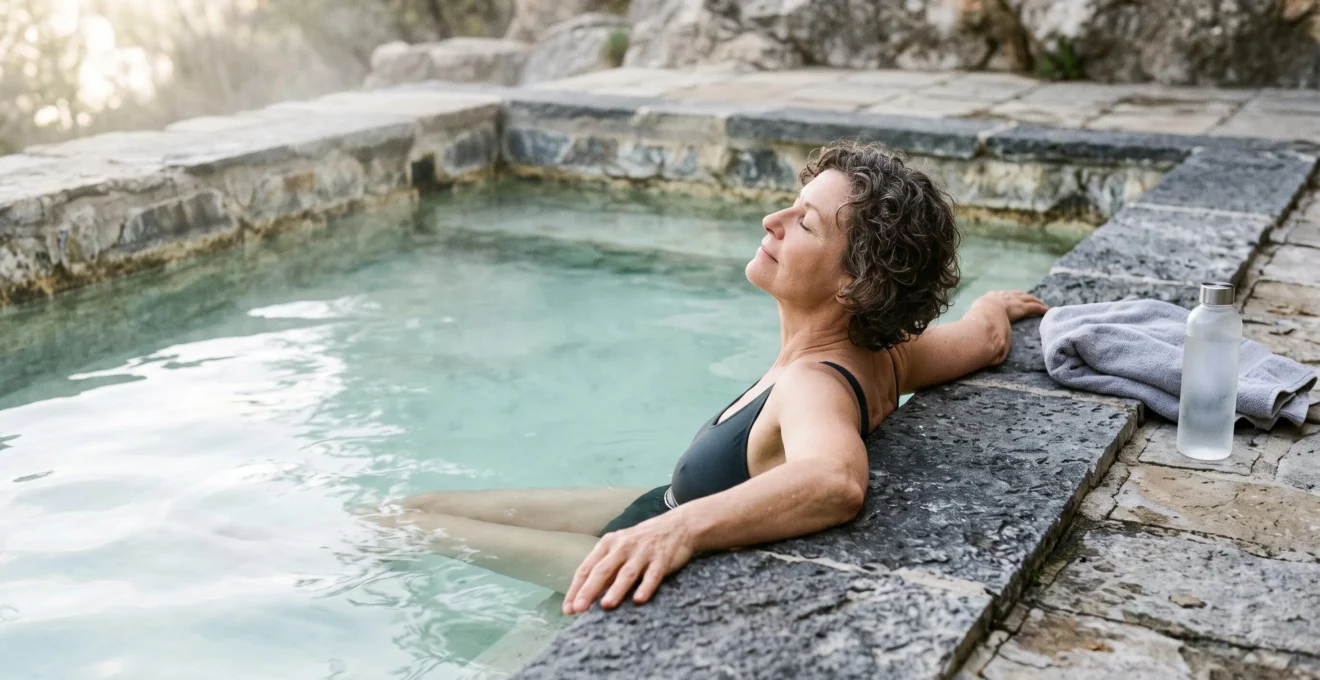
For sore muscles without the discomfort of intense heat, the most sensible starting point is usually a moderately warm mineral pool, with short immersion periods and sufficient rest between them. Water temperature, individual heat tolerance and the opportunity to move comfortably matter more than a spring’s reputation or the strength of its mineral smell.
Mineral bathing can offer temporary relief from everyday stiffness through warmth, buoyancy and relaxation. However, the evidence does not establish that any particular mineral composition consistently outperforms another for travel-related muscle aches. A highly mineralized spring is not automatically more therapeutic, and prolonged exposure can introduce avoidable risks.
Travellers also need to distinguish ordinary muscle soreness from symptoms requiring medical attention. Dizziness, cardiovascular conditions, pregnancy, unexplained leg swelling or recent illness can change whether bathing is appropriate at all.
The practical goal is to choose a pool that feels comfortable, understand what its water analysis actually says, and leave with less stiffness rather than more fatigue.
Mineral pool choices at a glance
- Prioritize tolerable warmth: moderate-temperature immersion can help relax sore muscles without the stronger cardiovascular demands of very hot pools.
- Read the water analysis: mineral concentration, dominant ions and actual bathing temperature are more informative than promotional descriptions.
- Build in recovery time: short bathing rounds, hydration and proper rests are preferable to stacking hot pools, saunas and steam rooms.
- Why Do Mineral Pools Sometimes Feel Like “Just Warm Water” Even at a Famous Site?
- How to Read Mineral Pool Descriptions Without Getting Lost in Chemistry Terms?
- High-Heat Pool or Contrast Circuit: Which Works Better if You Feel Dizzy in Saunas?
- The Heat-Stacking Mistake That Can Ruin Your Mineral Pool Day in Under 2 Hours
- In What Order Should You Use Mineral Pools and Rest Areas to Feel Better by Evening?
- How to Vet a Thermal Spring Sanctuary in 15 Minutes Using Water Notes and Facility Clues?
- Massage or Hydrotherapy: Which Helps More if You’re Stiff After a Long Flight?
- Which Modern Spa Treatment Makes Sense if You Only Have 90 Minutes and Want Visible Results?
Why Do Mineral Pools Sometimes Feel Like “Just Warm Water” Even at a Famous Site?
A famous mineral pool may feel like ordinary warm water because dissolved minerals do not necessarily produce noticeable sensations. Sulfur, magnesium, calcium and bicarbonate can be present without creating an obvious physical effect. Comfortable temperatures, dilution and individual expectations also influence perception. The absence of tingling, odor or intense warmth does not establish that a pool lacks minerals.
Travellers frequently use temperature, smell and skin sensation as informal measures of therapeutic strength. These are unreliable indicators. Sulfur compounds may produce a distinctive smell, but odor intensity does not provide a dependable measurement of mineral concentration or pain-relief potential. Magnesium-rich and bicarbonate-rich waters may feel entirely unremarkable.
Historical reputation creates another expectation problem. An established thermal destination may be celebrated for its architecture, geological setting, bathing traditions or unusually abundant spring water. None of these characteristics demonstrates that its pools will offer stronger muscle relief than a smaller, well-managed facility.
A randomized trial on mineral-water concentration and musculoskeletal pain involving 145 participants compared bathing treatments containing different mineral concentrations. The researchers found no statistically significant difference in pain reduction between the tested mineral-water concentration groups. The intervention lasted two weeks, so the findings cannot establish what a single recreational visit will achieve.
145 participants
In a randomized trial of musculoskeletal pain, higher total mineral concentrations of 20, 40 and 60 grams per liter did not produce statistically significant differences in pain reduction between the mineral-water groups. This does not rule out effects from specific compositions or different treatment protocols.
Rapolienė and colleagues, International Journal of Biometeorology, 2020.
Pool engineering can also change the bathing experience. Naturally hot source water may be cooled before use, while a large communal pool may combine mineral water with other water supplies according to its operating practices. The source temperature therefore tells you something different from the temperature experienced by bathers.
Ask staff whether the posted analysis describes water at the source or water in the actual bathing pool. If water is blended, inquire whether the facility provides information about the final mineral composition.
Most importantly, do not interpret mild sensations as failure. For an initial visit, comfortable movement and temporary muscle relaxation are more realistic goals than dramatic pain elimination. Substantial absorption of therapeutic quantities of dissolved minerals through intact skin has not been established as the main explanation for bathing benefits.
The next step is learning which details on the water description are genuinely useful, rather than treating a long chemical list as proof of effectiveness.
How to Read Mineral Pool Descriptions Without Getting Lost in Chemistry Terms?
Read a mineral pool description by checking three things first: the total dissolved mineral content, the dominant dissolved ions and the actual pool temperature. These details help distinguish water types and bathing conditions. Mineral names alone cannot tell you how much muscle relief to expect, and a complex chemical profile does not automatically indicate a stronger treatment.
Most travellers encounter several recurring water categories. Their chemical characteristics can guide questions about comfort and suitability, but the effects attributed to individual minerals are often less certain than the effects of immersion itself.
| Mineral profile | What the description means | Practical consideration for sore muscles |
|---|---|---|
| Sulfur-rich | Contains sulfur compounds, sometimes associated with a recognizable odor. | Consider a comfortable-temperature pool; strong odor is not proof of stronger relief. Check sensitivities and facility guidance. |
| Magnesium/calcium-rich | Contains substantial amounts of magnesium and calcium ions, often contributing to water hardness. | Suitable for consideration at moderate temperatures, but there is no established guarantee of superior muscle relief from skin absorption. |
| Bicarbonate-rich | Contains bicarbonate as a significant dissolved component. | May feel mild; evaluate temperature and personal comfort rather than assuming an inherently gentler physiological effect. |
| Saline | Contains dissolved salts, sometimes at relatively high concentrations. | May affect buoyancy and can sting irritated skin or open cuts; rinse when recommended. |
Labels also use terminology that sounds more technical than it is useful:
- Thermal: describes a relationship to natural heat or source temperature under a particular classification system; it does not establish the temperature of every bathing pool.
- Hypotonic: describes a solution’s osmotic properties relative to a reference. It does not automatically mean medically safer or better for people with low blood pressure.
- Mineralized: indicates dissolved mineral content, but the word alone does not specify concentration or therapeutic benefit.
- Oligomineral: generally indicates relatively low mineralization within a particular classification system. Exact definitions vary by jurisdiction.
On a laboratory analysis, look for dry residue or total dissolved solids, usually presented in milligrams per liter or grams per liter, and the dominant ions, such as sodium, chloride, calcium, magnesium, sulfate and bicarbonate. Then compare the listed source temperature with the temperature displayed beside the pool.
Dry residue and total dissolved solids are related measurements, but their laboratory methods can differ; they should not always be treated as perfectly interchangeable.
Marketing expressions such as “deeply restorative” or “mineral-powered recovery” do not substitute for chemical measurements or clinical evidence. Likewise, a published analysis verifies composition under stated sampling conditions, not the actual effectiveness of a specific soak.
People with eczema, broken skin, allergies or known sensitivities should ask about irritation risks and treatment additives. Highly saline water may sting damaged skin, while some sulfurous waters can be unpleasant for sensitive visitors. Reactions depend on concentration, exposure and individual circumstances, not simply the presence of a mineral.
Once the chemistry is understood, the more consequential question for heat-sensitive travellers is how the chosen temperature and bathing sequence affect circulation and dizziness.
High-Heat Pool or Contrast Circuit: Which Works Better if You Feel Dizzy in Saunas?
If saunas make you dizzy, a moderately warm mineral pool is usually a more cautious starting choice than a high-heat pool or hot–cold contrast circuit. Sustained warmth can relax tense muscles without requiring repeated temperature extremes. However, even moderate immersion can lower blood pressure, so previous fainting episodes or cardiovascular symptoms deserve medical advice before bathing.
Warm immersion causes peripheral blood vessels to widen. This process, called vasodilation, can support a feeling of muscle relaxation while also reducing blood pressure. Buoyancy decreases the weight borne by joints, making gentle movement more comfortable.
Cold exposure produces a different vascular response, including peripheral vasoconstriction. Alternating between hot and cold conditions therefore creates more abrupt physiological changes than remaining in one moderately warm environment.
Contrast bathing is sometimes marketed as a way to invigorate circulation or accelerate recovery. Such claims should not be interpreted as evidence that rapid temperature changes consistently outperform comfortable immersion for ordinary travel-related stiffness.
A Cleveland Clinic medical overview of hot-tub benefits and risks explains that warm-water immersion can ease mild muscle discomfort while potentially lowering blood pressure. It also warns that prolonged hot-tub exposure may cause dizziness or fainting, especially in susceptible individuals.
The following comparison helps match the experience to the traveller rather than to the spa’s most intense attraction.
| Personal factor | Moderately warm pool | High-heat or contrast circuit |
|---|---|---|
| Low blood pressure or previous fainting | Potentially less intense, but still requires caution and medical advice when relevant. | Temperature extremes may increase symptoms; avoid without appropriate clinical clearance. |
| History of sauna dizziness | Start with a brief, comfortable exposure only if bathing is medically appropriate. | Do not assume a cold plunge will prevent dizziness or make hot exposure safe. |
| General muscle stiffness | Warmth and buoyancy may provide comfortable temporary relief. | Additional temperature extremes have no established necessity for this goal. |
| Desire to feel invigorated | Offers a calmer, lower-intensity experience. | May feel stimulating but carries additional tolerance and safety considerations. |
For someone without contraindications who still wants to explore contrast bathing, a less intense approach is to avoid prolonged hot exposure, use a comfortably cool shower rather than an icy plunge, and allow ample rest. This is a comfort-oriented modification, not a proven method of making contrast circuits safe for people prone to fainting.
Never use cold immersion to push through dizziness. If light-headedness begins, stop exposure, move to a safe resting position and seek assistance. Symptoms that persist, recur or accompany chest pain, breathlessness or loss of consciousness require prompt medical assessment.
A moderately warm pool also permits gentle shoulder, hip and ankle movement without requiring strenuous exercise. The combination of tolerable warmth, buoyancy and movement may be more valuable for ordinary stiffness than simply increasing heat intensity.
Even an individually comfortable station can become problematic when combined with several other heated facilities. Total exposure matters as much as the choice of pool.
The Heat-Stacking Mistake That Can Ruin Your Mineral Pool Day in Under 2 Hours
Heat-stacking happens when visitors move through several heated environments without allowing enough cooling and recovery between them. A hot pool followed by a sauna, steam room and warm shower can create substantial cumulative heat exposure. Each stop may initially feel manageable, yet together they can increase fatigue, dizziness and dehydration risk rather than improve muscle comfort.
Consider a hypothetical traveller who spends time in a hot mineral pool, immediately enters a sauna, continues into a steam room and finishes with another hot bath. None of the transitions includes a meaningful period for body temperature and cardiovascular responses to settle.
The central mistake is treating each heated station as a separate experience instead of considering cumulative heat load. Exposure duration, temperature, humidity, individual physiology and recovery opportunities all influence the result.
A practical way to monitor this is to record the minutes spent in heated environments across the entire visit. There is no universal safe total for all mineral-pool settings, but counting combined exposure helps prevent repeated rounds from becoming an unplanned endurance test.
Stop immediately if you experience light-headedness, unusual weakness, nausea, headache, a pounding heartbeat or concerning changes in sweating. Confusion, collapse or severe symptoms require urgent assistance. Do not wait for several warning signs to appear together.
Dehydration can worsen heat intolerance. Warm and hot bathing may increase sweating, especially where steam or humid air makes evaporation less effective. Mineral water does not inherently draw body fluids through intact skin simply because it contains dissolved salts.
For a half-day visit, begin normally hydrated, bring accessible drinking water, drink during breaks and replace fluid losses without forcing excessive amounts. People who have been advised to restrict fluids should follow their medical guidance. Avoid alcohol before or during heated bathing.
Travellers arriving after a long flight, with poor sleep, after alcohol consumption or following strenuous exercise may be less prepared to tolerate heat. Rather than using an intense circuit to combat travel fatigue, these visitors may benefit from postponing the session or choosing a gentler activity.
The CDC guidance on hot-tub water quality and safe use recommends that hot-tub temperatures should not exceed 104 °F (40 °C). This is a maximum for the hot-tub context, not an ideal therapeutic temperature or a guarantee of safety for everyone.
A restorative spa visit should include a deliberate cooling strategy. Sequencing pools and rest areas intelligently is the next practical step.
In What Order Should You Use Mineral Pools and Rest Areas to Feel Better by Evening?
Start with a short session in a comfortably warm mineral pool, leave the water for a proper rest, and only consider another gentle round if you still feel well. Finish with the mildest bathing option or a comfortable shower rather than renewed intense heat. For heat-sensitive travellers, recovery intervals should take priority over visiting every available pool.
The purpose of this sequence is to benefit from warmth and buoyancy without allowing heat exposure to accumulate. There is no established universal mineral-pool protocol that guarantees better evening recovery, so the schedule should be treated as a flexible starting point.
A reasonable first round is brief enough to assess your response. For hot-tub-style immersion, the Cleveland Clinic guidance discussed earlier cautions against prolonged exposure beyond approximately 15 minutes. This should not be generalized into a fixed limit for every lukewarm pool, but it supports avoiding extended hot soaks.
After leaving the water, sit or recline in a temperate rest area until breathing, comfort and the sensation of heat return toward normal. Stand up slowly, particularly if warm bathing tends to make you light-headed.
Resting is not simply time spent waiting for the next attraction. It provides an opportunity for temperature and cardiovascular responses to settle, allows hydration and helps visitors notice whether the previous immersion has caused discomfort. Evidence does not establish a specific biological moment when mineral-related benefits “consolidate,” but the safety and comfort value of rest is clear.
If another soak still seems appealing, choose a mild pool and avoid automatically increasing either temperature or exposure time. Longer is not necessarily better, particularly when heat sensitivity or blood-pressure changes are concerns.
Consider the remainder of the travel day. A visitor who must immediately drive a long distance should avoid leaving the facility feeling sleepy, dizzy or unsteady. Allow enough time to recover fully before driving or undertaking demanding travel.
Warm bathing followed by cooling may support relaxation before sleep. The Cleveland Clinic article recommends allowing approximately one to one and a half hours between leaving a hot tub and bedtime, although this is expert advice rather than a universally established optimal interval.
Once a suitable sequence is clear, selecting a facility capable of supporting it becomes important. Water documentation, temperature controls and genuine rest space deserve scrutiny before booking.
How to Vet a Thermal Spring Sanctuary in 15 Minutes Using Water Notes and Facility Clues?
You can conduct a useful 15-minute preliminary check by reading the water analysis, confirming actual pool temperatures, asking how the water is treated and inspecting hygiene and rest facilities. A credible thermal sanctuary should be able to explain its mineral-water source and operating practices. No single clue, including natural spring feeding or chlorine odor, proves therapeutic quality.
Begin with the posted water analysis or the facility’s official information. Look for the sampling location, date, dominant mineral ions, total dissolved mineral content and source temperature. An analysis of untreated spring water should not automatically be assumed to describe the composition of a diluted or blended bathing pool.
Then ask staff how the water reaches the pools. Is it supplied directly from a spring, cooled, blended, filtered, recirculated or disinfected? How is water renewal managed? These questions clarify the experience without treating legitimate treatment systems as evidence of an inauthentic spring.
Visible temperature displays are especially helpful for travellers who want to avoid overheating. Clean walking surfaces, clear shower instructions, properly maintained changing areas and genuinely usable rest zones offer additional evidence of thoughtful management.
Water disinfection deserves a nuanced assessment. A strong chemical odor may indicate a water-quality problem, but it does not prove that the facility has diluted its spring water. Recirculation and disinfection may be necessary components of safe pool operation, depending on local requirements.
Ask whether staff routinely check disinfectant levels and pH, whether recent inspection information is available, and who is responsible for water management. Requirements vary between countries and facility types.
A responsible operator should also explain posted contraindications and the distinction between bathing facilities and facilities offering supervised drinking-water treatments. Water marketed for drinking cures is not automatically appropriate for ingestion by every visitor, and its composition alone does not determine bathing comfort.
Your five-step, 15-minute mineral spa screening checklist
- Read the analysis: record the dominant mineral ions, total dissolved mineral content and sampling information. Deliverable: a brief note identifying the actual water profile.
- Verify temperature: compare source temperature with displayed pool temperatures. Deliverable: one candidate pool within your personal comfort range.
- Ask about water handling: confirm whether water is cooled, blended, filtered, recirculated or disinfected. Deliverable: a written or remembered explanation of how the bathing water is maintained.
- Inspect recovery facilities: locate drinking water, hygienic showers, safe walking routes and comfortable rest areas. Deliverable: an identified place to rest between immersions.
- Check health precautions: read posted warnings and ask staff about relevant medical restrictions. Deliverable: a clear decision to proceed, seek medical advice or skip bathing.
For visitors with heart disease, unstable blood pressure, pregnancy-related concerns, a history of fainting or other relevant conditions, a short facility screening cannot replace individualized medical guidance.
Facility quality establishes the conditions for a sensible visit. After a long flight, however, choosing between immersion and massage also requires attention to the nature of the symptoms.
Massage or Hydrotherapy: Which Helps More if You’re Stiff After a Long Flight?
For uncomplicated, widespread stiffness after a long flight, gentle movement and a comfortably warm pool may be a practical starting point. For discomfort concentrated in one shoulder or the neck, a targeted massage may be more appealing. Neither treatment should be used to self-manage unexplained leg swelling, suspected blood clots or concerning circulation-related symptoms.
Air travel often means prolonged sitting, limited movement and sustained postures. This can contribute to general stiffness, particularly around the hips, back, shoulders and neck. Travellers may also experience temporary leg heaviness after extended immobility.
Warm-water immersion offers two potential advantages for uncomplicated muscular discomfort: buoyancy reduces mechanical loading, while comfortable warmth can encourage relaxation and gentle movement. It does not, however, establish a special mineral-driven effect on travel-related circulation.
Massage works differently. A therapist can concentrate manual techniques on a specific muscle group or area of perceived tightness. The pressure and technique should reflect the traveller’s condition and comfort; deep pressure is not automatically more beneficial.
There is insufficient evidence to establish a universal winner between massage and mineral hydrotherapy for post-flight stiffness. Choose according to whether the discomfort is widespread or localized, and whether there are medical warning signs.
Unexplained leg swelling deserves particular caution. Prolonged immobility during journeys lasting more than four hours can increase the risk of travel-associated blood clots.
The CDC advice on blood-clot risks during long-distance travel identifies leg swelling, pain, tenderness, warmth and discoloration among possible deep-vein thrombosis symptoms. New or unexplained symptoms require medical assessment rather than massage or hydrotherapy. Sudden breathlessness, chest pain, fainting or other possible pulmonary embolism symptoms require emergency care.
For otherwise healthy travellers with ordinary stiffness, gentle walking and calf movements are sensible first activities after prolonged sitting. If warm immersion is suitable, a short, comfortable soak may follow. Targeted massage can be considered after resting and confirming that no heat-related symptoms remain.
Avoid scheduling strenuous manual treatment immediately after an exhausting hot-water session. This is a conservative comfort recommendation rather than a clinically established requirement for a specific interval between treatments.
When the symptoms are ordinary muscle tightness and time is limited, a deliberately simple treatment schedule can be more manageable than a full spa circuit.
What to remember before choosing a short spa session
- Set the outcome first: easier movement and reduced discomfort are more realistic immediate goals than curing a musculoskeletal problem.
- Use your recent travel history and heat response to decide whether a warm pool, targeted massage or neither is appropriate.
- Reserve enough time to recover after immersion; treatments that leave you overheated or unsteady undermine the purpose of the visit.
Which Modern Spa Treatment Makes Sense if You Only Have 90 Minutes and Want Visible Results?
For a 90-minute visit focused on sore muscles, a moderately warm mineral pool, dedicated rest time and one optional targeted treatment offer a practical combination. Rather than trying every facility, concentrate on comfort and a clear outcome such as easier shoulder movement or less perceived stiffness. Immediate relief is possible, but visible or lasting therapeutic results are not guaranteed.
A short spa session benefits from restraint. Rapidly switching between several pools, saunas, steam rooms and treatments leaves less time to assess how your body responds and may unnecessarily increase total heat exposure.
The following hypothetical schedule illustrates how a heat-sensitive traveller without relevant contraindications could allocate 90 minutes. It is a planning example, not a clinically validated treatment protocol.
| Time allocation | Activity | Purpose |
|---|---|---|
| 10 minutes | Arrival, shower and temperature check | Confirm suitability and prepare for bathing. |
| 10 minutes | First moderate-temperature mineral soak | Assess comfort while gently moving stiff muscles. |
| 15 minutes | Rest, cooling and hydration | Allow recovery and monitor for unwanted effects. |
| 10 minutes | Optional second mild soak | Continue gentle immersion only if fully comfortable. |
| 15 minutes | Second rest and transition | Avoid proceeding into another treatment while heat-fatigued. |
| 20 minutes | Optional targeted massage or gentle hydro-massage | Address a specific area of ordinary muscle tension. |
| 10 minutes | Final shower, dressing and recovery check | Leave without rushing or feeling overheated. |
This example devotes approximately 20 minutes to immersion, divided into separate rounds, rather than prescribing one continuous 45-minute soak. For someone particularly sensitive to heat, a single shorter round and additional rest may be preferable.
It is also important to distinguish muscle-related improvement from cosmetic changes. A beauty wrap or skincare treatment may be designed around appearance or skin feel, while a targeted massage or comfortable immersion addresses the experience of stiffness more directly. None provides a guaranteed visible change in muscle condition.
Hydro-massage jets can create a pleasant localized sensation, but high-pressure jets may be uncomfortable over tender tissue. Choose gentle settings, avoid painful pressure and do not interpret temporary comfort as proof of tissue repair.
Saunas and contrast circuits are optional rather than essential. Leaving them out of a short visit reduces complexity and avoids additional temperature extremes, although some visitors may miss the stimulating sensation they associate with spa experiences.
Before booking, ask whether the stated treatment duration includes changing, showering and transition time. A nominal 90-minute package may offer much less actual immersion or rest time than expected.
The best result to assess immediately afterward is functional and modest: whether walking feels more comfortable, whether shoulders move more freely, and whether the traveller feels relaxed rather than exhausted. Persistent, severe or worsening pain deserves appropriate medical evaluation.
Choose one comfortable pool, confirm that its water and temperature suit you, allow recovery time, and add a gentle targeted treatment only if it addresses a specific concern. The aim is not to accumulate therapies but to finish the visit feeling safe, comfortable and ready for the rest of your journey.
Can mineral bathing help delayed-onset muscle soreness after exercise?
Comfortable warm-water immersion may temporarily ease the perception of muscle soreness and make gentle movement more pleasant. However, evidence from mineral-water bathing studies does not establish that a particular mineral profile accelerates recovery from exercise-induced muscle damage. Rest, appropriate activity and individual symptoms should guide the decision.
Is a mineral pool safe if you take medication for blood pressure?
Warm immersion can lower blood pressure, and some medications may affect the body’s response to heat or changes in circulation. Ask your prescribing clinician whether heated bathing is appropriate, especially if you experience dizziness or have unstable blood pressure. Do not adjust medication solely to accommodate a spa visit.
Can you use mineral pools with eczema or sensitive skin?
Suitability depends on skin integrity, the composition of the water, additives and individual sensitivity. Saline water may sting broken skin, and heat can aggravate discomfort in some people. Avoid immersion with open wounds when facility or medical guidance advises against it, and consult a healthcare professional if the condition is active or severe.
Does a natural spring-fed pool need filtration or disinfection?
Water-treatment requirements depend on the facility design, bathing-water classification and applicable local regulations. Natural origin does not guarantee microbiological safety. Proper filtration, disinfection, monitoring and water renewal may be part of legitimate mineral-pool management. Check the operator’s water-quality practices rather than assuming untreated spring water is safer.
Should you stop soaking if your muscles still feel sore afterward?
Do not extend immersion simply because the discomfort has not disappeared. Bathing may produce temporary relaxation without eliminating the underlying cause of soreness. Stop if symptoms worsen or heat-related discomfort appears. Seek medical advice for persistent, severe, unexplained or progressively worsening pain, particularly when accompanied by swelling, weakness or other concerning symptoms.