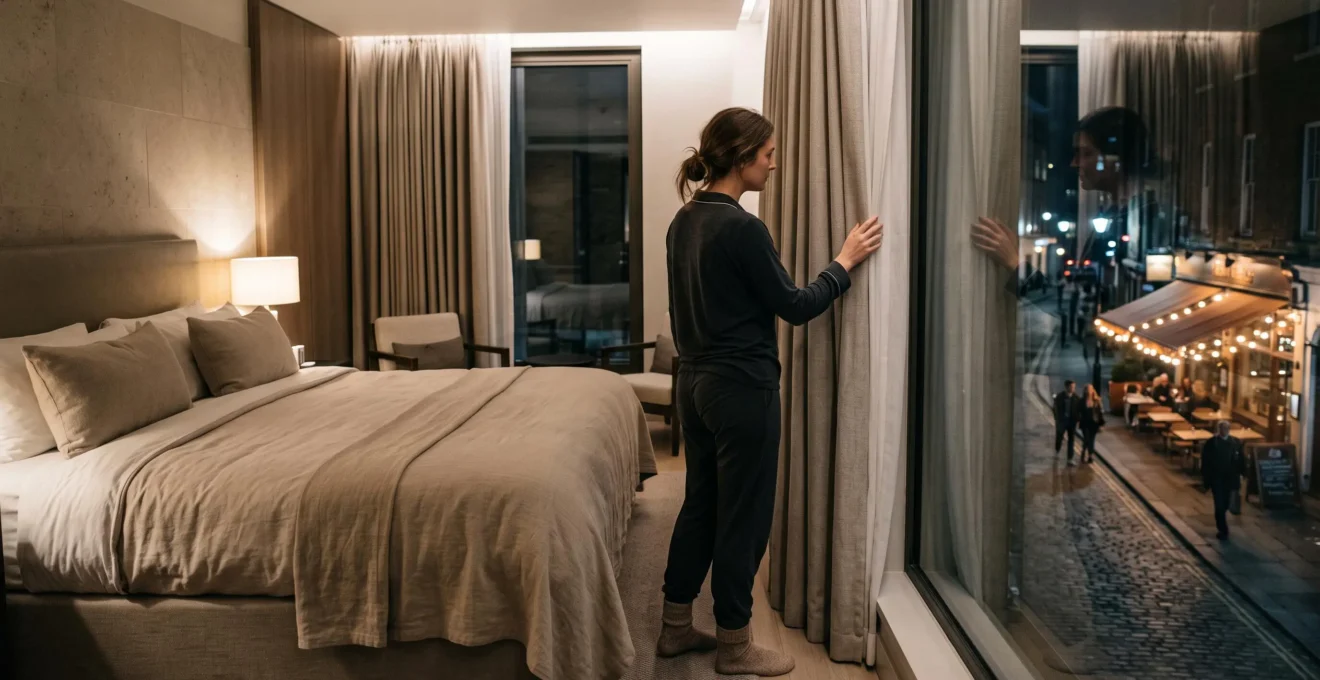
A premium hotel room can have beautiful furnishings, exceptionally comfortable bedding and attentive staff yet still leave a light sleeper awake at 2 a.m. The difference between an expensive stay and a genuinely restful one often lies in details that rarely appear prominently in booking descriptions: window orientation, sound transmission, mechanical equipment and the hotel’s ability to respond when something goes wrong.
For professionals facing early departures and couples seeking an uninterrupted holiday, premium accommodation should mean more than visible luxury. It should combine credible noise protection, a room positioned away from foreseeable disturbances, dependable environmental controls and practical assistance when problems arise.
No hotel can guarantee absolute silence or uninterrupted sleep. However, travelers can reduce uncertainty by identifying their most disruptive noise sources, examining the actual sleeping environment rather than the room category alone, and obtaining meaningful information before committing to a reservation.
What makes a premium stay genuinely sleep-friendly?
- Acoustic protection: Evaluate external noise, sound traveling between rooms and disturbances from ventilation or other equipment separately.
- Room placement: Prioritize the specific sleeping area’s location over hotel star ratings, room size, prestigious views or luxury labels.
- Reliable service: Choose accommodation that can explain its quiet-room options and provide realistic assistance if nighttime disturbances occur.
- Why Do “Premium” Rooms Still End Up Noisy at 1 a.m. in Busy Districts?
- The Booking Filter That Tricks Light Sleepers Into Choosing the Worst Rooms
- The Booking Detail Most People Miss That Leads to 2 a.m. Noise in Old Town Streets
- The Room Category Mistake That Put You Above a Nightclub Even in a Luxury Hotel
- Premium Hotel or Aparthotel: Which Works Better for a 4-Night Trip With Early Starts?
- When Should You Contact a Hotel to Secure a Quiet Room Without Paying Another Upgrade?
- How to Request a Truly Quiet Room Using 3 Specific Messages Before Check-In?
- What Separates True Luxury Accommodation From “Expensive” When Something Goes Wrong?
Why Do “Premium” Rooms Still End Up Noisy at 1 a.m. in Busy Districts?
Premium hotel rooms can become noisy at 1 a.m. because luxury amenities and acoustic protection are different qualities. Nightlife, neighboring guests and building equipment create separate noise risks that expensive bedding or sophisticated interiors cannot eliminate. A genuinely sleep-friendly room needs effective sound control, suitable positioning and attention to disturbances that emerge after normal check-in hours.
Luxury classifications generally communicate a property’s facilities, service standards and overall hospitality offering. They do not automatically establish how effectively a particular bedroom blocks music, conversations, ventilation noise or vibrations.
The WHO guidance on environmental noise identifies sleep disturbance among the health concerns associated with excessive environmental noise. Although this evidence does not assess individual hotels, it establishes why nighttime sound exposure deserves consideration independently of visible comfort.
Three distinct acoustic vulnerabilities matter when evaluating a premium room:
- External sound: Traffic, entertainment venues, outdoor conversations and deliveries entering through windows or other parts of the building envelope.
- Internal transmission: Corridor conversations, neighboring televisions, closing doors, plumbing and sounds passing through walls or connecting doors.
- Mechanical disturbance: Ventilation hum, air-conditioning cycles, equipment vibration and sound carried through service ducts.
A room may perform well against one category while remaining vulnerable to another. The ASHRAE Handbook chapter on hospitality buildings identifies equipment cycling, duct-borne sound and vibration as relevant guest-room engineering concerns. This explains why excellent glazing alone cannot establish acoustic comfort.
Timing creates another complication. A peaceful room at 4 p.m. may sound entirely different after restaurants close, visitors leave nearby bars or early-morning operations begin. Intermittent disturbances can also be particularly noticeable to guests who react strongly to sudden changes in background sound.
Central locations involve a genuine trade-off. A room facing a busy street may benefit from relocation to a protected wing, but widespread sound transmission or persistent building vibration may affect multiple rooms. In that situation, choosing another property could be more effective than requesting a different floor.
The practical starting point is personal sensitivity: identify whether music, voices, sudden impacts or mechanical hum most often interrupt sleep. That priority will make the next stage of accommodation screening more meaningful.
The Booking Filter That Tricks Light Sleepers Into Choosing the Worst Rooms
The most misleading booking filter for light sleepers is treating luxury ratings or high guest scores as substitutes for quiet-room evidence. These measures summarize overall experiences, not the acoustic conditions of every bedroom. A better approach is to screen properties specifically for recurring noise complaints, room orientation, building equipment and the quality of information staff can provide.
A hotel can receive excellent reviews for breakfast, cleanliness, location and hospitality while a small group of sensitive sleepers reports repeated nighttime disturbances. Those experiences are not necessarily contradictory: different guests may occupy different rooms, visit on different nights or tolerate different noise levels.
Rather than considering only an overall review score, examine recent feedback for specific acoustic descriptions. Useful search terms include:
- Street noise, restaurant terrace and late-night conversations.
- Bass, nightclub, music and event noise.
- Thin walls, connecting doors and corridor noise.
- Air conditioning, ventilation, humming and vibration.
- Early deliveries, service entrance and housekeeping noise.
Look for patterns rather than reacting to one dramatic review. Several independent complaints describing the same disturbance in similar locations are more informative than a single unexplained incident. Dates matter too: an older complaint may no longer reflect current conditions, while recent reports may identify an ongoing problem.
Descriptions such as “soundproof rooms,” “quiet location” and “courtyard view” also require interpretation. Soundproof may describe a particular construction feature rather than complete isolation. A courtyard might be protected from traffic but exposed to restaurant seating or mechanical equipment.
The most useful screening sequence is therefore:
- Exclude properties with repeated, relevant and unresolved noise complaints.
- Investigate hotels whose acoustic descriptions lack specific supporting details.
- Shortlist properties that can explain room orientation, equipment locations and quieter alternatives.
Before booking, ask what makes the suggested room quieter. Details about glazing, corridor placement or distance from entertainment spaces are more actionable than a generic assurance that guests usually sleep well.
Once a property passes this initial screening, the next question is geographical: which side of the building will the sleeping area face, particularly in historic districts where daytime appearances can be misleading?
The Booking Detail Most People Miss That Leads to 2 a.m. Noise in Old Town Streets
The overlooked booking detail is the exact orientation of the room’s windows. In historic districts, a bedroom facing a pedestrian street may overlook restaurants, gathering points or late-night pedestrian activity even without passing cars. The hotel’s address alone cannot reveal that exposure; guests need to establish where their specific room sits within the building.
Pedestrian-only streets can appear especially attractive to travelers seeking peace. Yet removing vehicle traffic does not remove conversations, rolling luggage, restaurant closures or early service activities. The relevant question is not simply whether cars are permitted, but what happens directly below the windows during the intended sleeping hours.
Historic architecture adds another variable. Rooms within the same heritage property may have different window configurations, renovation histories and acoustic performance.
Historic England‘s advice on upgrading historic windows explains that traditional windows can be improved, including through secondary glazing that can provide effective noise reduction. Its guidance concerns buildings in England and does not establish the condition of any individual hotel.
Consequently, an older building should not automatically be dismissed, nor should a renovated facade be interpreted as evidence of effective nighttime insulation.
A practical street-level investigation combines satellite maps, street imagery and room-view information. Identify restaurant entrances, outdoor seating, bars and possible service access around the building. Then compare these features with the room orientation the hotel can actually offer.
Check internal courtyards as carefully as public streets. An enclosed courtyard without active hospitality facilities may provide a useful alternative. One containing a bar, dining terrace or ventilation equipment may introduce a different type of disturbance.
Ask whether the proposed room has upgraded glazing, which direction its bedroom windows face and whether those windows overlook an active public or service area. If the property cannot identify a particular room before arrival, request information about the exposure of available room categories or wings instead.
Once the exterior exposure is understood, examine vertical placement as well. A room that avoids street activity can still be poorly positioned relative to entertainment facilities inside the building.
The Room Category Mistake That Put You Above a Nightclub Even in a Luxury Hotel
The mistake is assuming that the most expensive or prestigious room category must also be the quietest. Hotel categories often emphasize size, views, interiors or exclusive amenities rather than acoustic isolation. A luxury suite positioned above an entertainment venue can be less suitable for a light sleeper than a smaller room in a protected part of the same property.
Room hierarchy and sleep suitability follow different criteria. A landmark view might require a street-facing position. A spacious suite might sit near the lift lobby, while a desirable terrace could overlook a lively courtyard.
Vertical placement deserves particular attention when hotels contain bars, nightclubs, function rooms or event spaces. Music and vibration may travel through structural elements as well as through the air. Effective windows cannot necessarily resolve disturbances that reach a bedroom through floors or walls.
Higher floors are not universally quieter either. They may reduce exposure to some street-level sounds while introducing proximity to rooftop venues or mechanical equipment. The relevant factor is the room’s relationship to identifiable noise sources, not its floor number in isolation.
When comparing categories, request location-specific information rather than marketing descriptions.
| Decision factor | Prestige-led choice | Sleep-led choice |
|---|---|---|
| Room outlook | Landmark or entertainment-district view | Exposure assessed against nighttime activity |
| Floor position | Higher floor preferred automatically | Distance from identifiable noise sources verified |
| Room size | Largest available suite | Sleeping area positioned away from disturbances |
| Building services | Equipment location not investigated | Nearby plant rooms and ventilation checked |
| Upgrade decision | Higher category assumed better | Acoustic advantage clarified before paying |
Consider a hypothetical hotel offering a large suite above an event space and a smaller room in a quieter wing. The second option may offer a better sleeping experience if staff can substantiate the difference in exposure. The example illustrates the decision principle, not a verified outcome for any property.
Before paying extra, ask whether the proposed upgrade provides a confirmed improvement in room position, a plausible but unverified advantage, or simply additional space and amenities.
For multi-night travel, this distinction becomes part of a broader operational decision: whether a conventional premium hotel or an aparthotel provides the more predictable environment for repeated early starts.
Premium Hotel or Aparthotel: Which Works Better for a 4-Night Trip With Early Starts?
Neither a premium hotel nor an aparthotel is automatically better for a four-night trip with early departures. A hotel may offer more accessible staff support and convenient services, while an aparthotel may provide greater independence and control over morning routines. The better choice depends on acoustic conditions, room layout, operating arrangements and how quickly problems can be resolved.
Four nights create repeated opportunities for small inconveniences to affect the trip. Unpredictable temperature, a noisy refrigerator, delayed breakfast arrangements or disruptive hallway activity can become more consequential when mornings are tightly scheduled.
A premium hotel may provide staffed reception, established housekeeping arrangements and convenient breakfast services. However, actual nighttime staffing, room-change flexibility and the availability of assistance depend on the individual property.
An aparthotel can be particularly practical for travelers who prefer to prepare meals independently, control their departure routine or separate the sleeping area from shared living space. Yet kitchen equipment, neighboring apartment activity and building management arrangements introduce considerations that may not be obvious from the accommodation format.
The following comparison focuses on the four-night early-start scenario rather than assuming either category offers universal advantages.
| Priority | Premium hotel | Aparthotel |
|---|---|---|
| Nighttime assistance | May offer immediate reception support if staffed overnight | Depends on on-site staffing and after-hours arrangements |
| Breakfast | May provide scheduled dining or takeaway arrangements | Allows self-preparation when kitchen facilities are suitable |
| Sleeping-area layout | Depends on room or suite configuration | May offer a separate bedroom, depending on unit type |
| Equipment noise | HVAC and building services require checking | HVAC, refrigerator and other appliances require checking |
| Problem resolution | Depends on available rooms and staff authority | Depends on alternative units and management accessibility |
Assess temperature control and mechanical noise before committing. ASHRAE’s hospitality engineering guidance highlights the importance of quiet, controllable guest-room conditioning systems, but the performance of individual installations still needs verification.
For an early departure, determine whether breakfast is available at the required time, whether packing and preparation can occur without waking a partner, and whether housekeeping or shared-building operations coincide with the sleeping schedule.
Compare value across the full four-night stay. A lower nightly rate may be less attractive if addressing a disturbance requires repeated communication or relocation. Conversely, paying for hotel services provides little benefit when those services do not address the traveler’s actual requirements.
Whichever format is chosen, advance communication is the next opportunity to reduce uncertainty without automatically purchasing a more expensive room.
When Should You Contact a Hotel to Secure a Quiet Room Without Paying Another Upgrade?
Contact the hotel before booking to establish whether suitable quiet-room locations exist, after confirmation to record your preferences, and again before arrival to check the current allocation position. There is no universally effective contact interval, and an early request does not guarantee priority. The objective is to obtain usable information while preserving flexibility and avoiding unnecessary upgrade costs.
Before paying, ask whether the booked category includes rooms away from the noise sources that concern you. This establishes whether the property can potentially meet your needs without changing the accommodation type.
Once a reservation is confirmed, provide its reference and request that the specific quiet-room preference be attached to it. A recorded preference is useful, but it is not equivalent to a confirmed assignment.
Closer to arrival, contact the property again to ask whether its allocation arrangements can accommodate the request. The precise timing depends on how the hotel assigns rooms, anticipated occupancy and applicable reservation policies.
Special events can make this communication more important. If a wedding, conference or local celebration coincides with the stay, ask whether the property anticipates noise or reduced flexibility in quiet-room allocation.
To avoid paying unnecessarily, distinguish two separate requests:
- Location within the purchased category: A quieter room position that may be available without changing the agreed rate.
- Change of room category: A different accommodation product that may involve extra charges or altered amenities.
Ask the property to explore the first option before discussing the second. Complimentary changes depend on policy, inventory and the circumstances of the reservation.
Reservation flexibility is an essential safeguard. Booking.com‘s reservation and cancellation FAQ explains that cancellation fees depend on property-specific conditions. Travelers using that platform should review their individual booking confirmation; other booking channels may have different procedures.
If the hotel can record the preference but cannot confirm a suitable room, compare the remaining uncertainty with the cancellation deadline. A flexible reservation may provide an opportunity to reconsider the property before financial penalties apply.
The quality of the request matters as much as its timing. Three concise, purpose-specific messages can help the hotel identify a suitable room without creating unrealistic expectations.
How to Request a Truly Quiet Room Using 3 Specific Messages Before Check-In?
Request a quiet hotel room through three focused messages: explain your most disruptive noise sensitivities, verify the proposed room’s exposure to relevant noise sources, and confirm the reservation details before arrival. Each message should seek a different piece of information. This improves communication without implying that a hotel can guarantee silence or allocate a specific room regardless of availability.
The first message establishes the sleep requirement. Avoid combining every imaginable preference into a long list. A concise explanation of the sounds most likely to disturb you gives the hotel a clearer basis for identifying appropriate locations.
Message 1 — Establish the requirement
“Hello, I have a reservation for [dates]. I’m a light sleeper, particularly sensitive to late-night music and corridor noise. Could you please note my preference for a room within my booked category, away from entertainment areas and busy lift lobbies? I’d appreciate knowing whether such locations are available.”
The second message tests the property’s knowledge of its room layout. Rather than repeating that you want peace and quiet, ask about the location being considered and the disturbances that could affect it.
Message 2 — Verify the location
“Thank you for noting my preference. Could you clarify whether the room location being considered is near a bar, event space, connecting room or mechanical equipment? Is there a quieter part of the same room category that would better suit a light sleeper?”
The third message confirms what has been recorded and whether the situation has changed before arrival. It also protects against misunderstandings concerning upgrades or lost amenities.
Message 3 — Confirm before check-in
“Hello, I’m checking my reservation for [arrival date]. Could you confirm that my quiet-room preference is recorded and whether a suitable location has been identified? Please also let me know if any proposed room change would affect my rate or booked amenities. Thank you.”
Interpret the replies carefully. A specific confirmation identifying a suitable location provides more meaningful information than a general promise. A conditional acknowledgment establishes that the preference is recorded but remains subject to allocation. A generic reassurance such as “all our rooms are quiet” leaves the relevant acoustic questions unresolved.
Where details remain unclear, ask a targeted follow-up. If the hotel’s answers still do not address a serious sleep concern, reconsidering the property may be more appropriate than relying on optimism.
Five checks to complete before booking a quiet premium room
- Identify your noise triggers: Write down your two most disruptive sound types and the hours you need to sleep.
- Inspect the surroundings: Save a map or street-view reference showing nearby entertainment areas, terraces or service entrances.
- Verify room orientation: Obtain a written description of the proposed room’s outlook or location within the building.
- Confirm reservation conditions: Save the rate, cancellation deadline and any stated conditions relating to room changes.
- Document the hotel’s response: Keep written confirmation distinguishing recorded preferences, identified room positions and any agreed charges.
Even precise preparation cannot prevent every disturbance. The final measure of premium hospitality is therefore how effectively the property responds when the expected sleeping conditions are not delivered.
What to remember before the first night
- Evaluate acoustic suitability through specific room-location evidence, not luxury descriptions or assurances alone.
- Preserve enough booking flexibility to act when the property cannot clarify a significant sleep-related risk.
- Assess the hotel’s ability to investigate disturbances and provide realistic alternatives before deciding whether its premium price is justified.
What Separates True Luxury Accommodation From “Expensive” When Something Goes Wrong?
True luxury accommodation is distinguished by effective problem resolution, not simply by its price or appearance. When nighttime noise interrupts sleep, a genuinely premium property should offer accessible assistance, investigate the disturbance, explain realistic remedies and act promptly when suitable alternatives exist. Expensive surroundings provide limited comfort if staff cannot address foreseeable problems or communicate clearly about them.
Service quality becomes particularly important during the first night. A guest who discovers recurring music, a faulty ventilation unit or persistent corridor disturbance needs a practical response while there is still an opportunity to restore the sleeping environment.
Begin by checking the room soon after arrival. Listen for continuous mechanical sounds, assess whether the temperature controls work comfortably and observe any obvious exposure to active hotel facilities.
A short daytime inspection cannot reveal every nighttime issue, but it may identify problems that can be addressed before going to bed.
If a disturbance develops, contact the appropriate hotel staff and describe the sound precisely. Explain whether it is continuous or intermittent, where it appears to originate and how it affects the sleeping area. Specific observations help distinguish a maintenance issue from a location-related problem.
For example, an unusually noisy air-conditioning unit may warrant a technical inspection. Persistent music transmitted from a venue below could instead require consideration of another room position. Neither response should be assumed effective until the actual circumstances are assessed.
Possible service remedies include:
- Technical intervention: Inspecting or correcting identifiable equipment problems where practical.
- Operational intervention: Addressing a disturbance within the hotel’s control when appropriate.
- Room relocation: Offering an available room whose position better addresses the reported noise.
- Alternative accommodation: Considering another suitable arrangement when an on-site solution is unavailable.
- Commercial resolution: Discussing an appropriate adjustment or other remedy according to the circumstances and applicable terms.
None of these remedies is automatically guaranteed. Their availability depends on the hotel’s capabilities, the cause of the problem, contractual conditions and any applicable consumer protections.
A refund or gesture of goodwill may address financial dissatisfaction, but it cannot restore the sleep already lost. For guests with important commitments the following morning, speed, clear communication and the suitability of any alternative can matter more than decorative gestures.
The strongest premium-stay standard combines three requirements: credible acoustic protection, suitable room allocation and a workable response plan.
A property does not need to promise absolute silence to demonstrate genuine attention to comfort. It does need to explain the foreseeable risks it manages, acknowledge the limits of its control and respond constructively when prevention proves insufficient.
Before your next reservation, identify the sounds most likely to interrupt your sleep, ask the property about suitable room locations and check how nighttime problems are handled. Choose the accommodation that provides the clearest evidence of a restful environment and a credible plan if that environment cannot be maintained.
Can a five-star hotel guarantee a completely silent room?
No. A luxury classification does not guarantee complete acoustic isolation or uninterrupted sleep. External activity, neighboring rooms, building services and individual sensitivity all affect the sleeping experience. Ask the hotel for specific information about acoustic protection and room placement rather than relying on its classification.
Are rooms with double-glazed windows always quiet?
No. Window performance depends on construction, installation and the nature of the sound. Even effective glazing cannot necessarily prevent noise traveling through doors, walls, floors or ventilation systems. The relevant assessment covers the whole sleeping environment, not a single window feature.
Should light sleepers always request the highest available floor?
Not necessarily. Higher floors may be farther from some street-level disturbances, but they can also be close to rooftop venues, lift equipment or mechanical installations. A better request specifies distance from the noise sources that matter and asks the hotel which available room locations provide that separation.
What should a guest do if the allocated room differs from the quiet location discussed before arrival?
Show the hotel the written correspondence and clarify whether the earlier communication confirmed a particular room position or merely recorded a preference. Ask what suitable alternatives are available, whether any change affects the agreed rate and which booking conditions apply. A preference acknowledgment should not be treated as a guaranteed assignment.
Is it worth paying extra for a quiet-room upgrade?
Potentially, but only when the alternative offers a meaningful and reasonably substantiated improvement in sleeping conditions. Ask what changes acoustically: room orientation, distance from entertainment facilities, exposure to corridors or proximity to equipment. If the upgrade adds only size or decorative amenities, its higher price does not establish a sleep benefit.