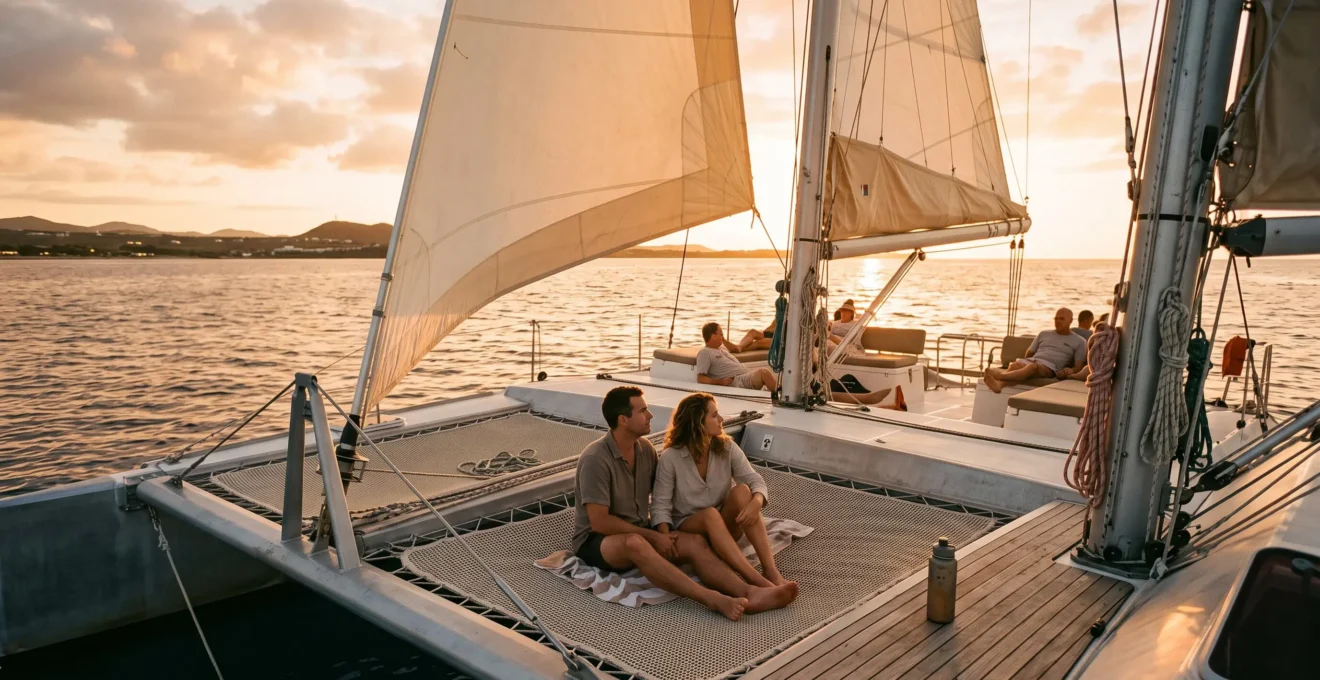
A romantic sunset sailing excursion should offer room to breathe, comfortable seating, uninterrupted views and enough time to enjoy the changing light. Yet a cruise advertised as romantic can still involve crowded decks, loud music, rushed departures or uncomfortable motion.
For most couples seeking a peaceful evening, a small-group catamaran with a clearly stated passenger limit, a sunset-focused itinerary and a sheltered sailing route is a sensible starting point. A private charter offers greater control over the atmosphere and route, provided the operator can accommodate those requests.
The important distinction is not simply between expensive and affordable excursions. It is between experiences designed around scenery and conversation and those organised around entertainment, drinks or maximum passenger capacity.
Before choosing, examine the timing, vessel layout, typical sea conditions and operator’s description of the onboard experience. These details are often more useful than a romantic photograph or an impressive star rating.
How to choose a peaceful sunset sailing experience
- Choose the atmosphere first: Look for a stated passenger limit, relaxed music policy and enough deck space for guests to spread out.
- Check the actual sunset window: Confirm that the excursion stays on the water through sunset rather than returning just as the best light begins.
- Plan for comfort: A suitably sized catamaran, sheltered route, sensible boarding position and preventive seasickness preparation can make the evening more enjoyable.
- Why Do Sunset Cruises Sometimes Miss the Best Light Even When They Leave “On Time”?
- How to Choose a Sunset Sailing Operator Using 6 Listing Clues Without Overresearching?
- Private Charter or Small-Group Catamaran: Which Is Better if You Get Seasick Easily?
- The Motion-Sickness Prep Mistake That Can Ruin a Sunset Sail in the First 10 Minutes
- When Should You Board a Sunset Sail to Get the Best Seat Without Stress and Crowding?
- Jet Ski or Paddleboard: Which Is Better for a 60-Minute Slot With Zero Experience?
- Dune Bashing or Sunset 4×4 Tour: Which Is Better if You Hate Roller-Coaster Feelings?
- Which Desert Safari Style Works if You Get Motion Sick but Still Want the “Dunes” Experience?
Why Do Sunset Cruises Sometimes Miss the Best Light Even When They Leave “On Time”?
A sunset cruise can depart exactly as scheduled and still miss the most attractive light because the published departure time does not necessarily match the actual sunset window. Harbour procedures, seasonal daylight changes and sailing routes all influence when passengers see the sun. The most reliable check is to compare the complete excursion schedule with the sunset time for your travel date.
Scheduled departure and astronomical sunset are different things. A cruise leaving at 5:30 p.m. may be well timed during one part of the year but less suitable during another. Sunset times change with the season, latitude and location, so a departure time alone cannot establish whether the excursion includes golden hour.
The United States Naval Observatory‘s Sun and Moon calculation service provides sunset and civil twilight times for specific dates and locations. Enter your destination and travel date, then check the time zone and daylight-saving-time settings before comparing the result with the operator’s itinerary.
As a practical planning guideline, look for an excursion that includes approximately 30–60 minutes around sunset, ideally with time remaining afterward. This is not a fixed photographic rule: clouds, landscape, atmospheric conditions and the direction of the boat can change when the most attractive colours appear.
Route orientation matters as much as timing. A captain heading toward open water may provide an unobstructed horizon but place the sun directly ahead. A coastal route could create attractive side lighting, silhouettes or reflections, depending on the coastline and direction of travel.
Ask whether the sailing route usually offers views across the sunset or toward a shoreline that could conceal the sun early. Also check whether the boat spends part of the excursion motoring through a harbour before reaching its scenic sailing area.
There is another trade-off: arriving early to secure a good position may mean sitting in direct sunlight while the boat remains docked. If the deck has limited shade, that waiting period can affect comfort before the romantic part of the evening begins.
A well-timed sailing experience leaves room for the light to change naturally rather than treating sunset as a brief photo opportunity. Once the timing works, the next priority is finding an operator whose onboard atmosphere matches the occasion.
How to Choose a Sunset Sailing Operator Using 6 Listing Clues Without Overresearching?
Choose a sunset sailing operator by checking six details: maximum passenger capacity, vessel type, emphasis on alcohol, private versus shared booking arrangements, actual sailing versus motor assistance, and named itinerary stops. These clues help distinguish a quiet scenic excursion from a party-oriented cruise without requiring hours of research. Recent guest photographs and one direct message can resolve the remaining uncertainty.
Start with the listing itself. Romantic marketing language is easy to write; specific operational information is more useful.
| Listing clue | Signs of a calmer experience | What deserves a closer look |
|---|---|---|
| 1. Passenger capacity | A clear maximum headcount and enough usable deck space | “Small-group” or “intimate” without a number |
| 2. Vessel type | A boat layout with accessible outdoor seating and room to move | No identifiable vessel or deck photographs |
| 3. Alcohol emphasis | Scenery, sailing and conversation lead the description | Unlimited drinks, bar packages or party entertainment dominate |
| 4. Booking arrangement | Private charter or clearly defined shared group capacity | Unclear whether other passengers will join |
| 5. Sailing versus motoring | An honest explanation of sail use and motor assistance | “Sailing experience” without explaining how the trip operates |
| 6. Route and stops | Named scenic areas, sheltered waters or planned viewing stops | A vague itinerary with no indication of where the boat goes |
A catamaran is not automatically peaceful, and a traditional sailboat is not automatically romantic. A spacious boat carrying a lively group may feel less intimate than a smaller vessel with attentive crew and a quiet atmosphere.
Passenger count needs context. Twenty guests spread across a generously sized deck can feel more comfortable than a much smaller group confined to limited seating. However, listings that omit the maximum number of guests leave a major comfort question unanswered.
Recent passenger photographs are particularly valuable. Look for the actual amount of usable deck space, how closely people sit, and whether railings or viewing areas become crowded. Reviews mentioning “packed”, “loud music”, “party” or “crowded” may reveal more about the atmosphere than the overall star rating.
Before booking, send one concise question: “What is the maximum number of guests on this departure, and do you normally play music during the sunset portion?”
A specific, helpful reply reduces uncertainty. A vague answer is a reason to investigate further, although response speed alone does not prove how an excursion will operate.
Five checks to complete before booking a sunset sail
- Record the maximum guest count. Save the stated capacity or obtain written confirmation from the operator.
- Identify the actual vessel. Find a photograph or description showing the boat type, deck layout and outdoor seating.
- Verify the atmosphere. Save the operator’s answer about music, drinks and whether other groups will be onboard.
- Check sunset coverage. Compare the local sunset time with the advertised departure and return times, recording whether sunset is included.
- Confirm the route and comfort options. Obtain a reply identifying the typical sailing area and whether sheltered-water alternatives are possible.
When two excursions look equally romantic, prioritise transparent capacity information and a route suited to the expected conditions. Those details also provide the foundation for deciding between a private charter and a shared catamaran.
Private Charter or Small-Group Catamaran: Which Is Better if You Get Seasick Easily?
A small-group catamaran is often a practical starting point for motion-sensitive travellers because its deck layout can provide space to move and maintain a clear horizon view. A private charter may be preferable when it offers genuine control over the route, timing and passenger environment. Neither option guarantees a smoother ride: sea conditions, vessel design and the route remain essential.
The distinction is between two different comfort advantages. A catamaran may offer a relatively wide platform, while a private charter can offer greater flexibility if the operator agrees to adapt the excursion.
| Consideration | Private charter | Small-group catamaran |
|---|---|---|
| Route flexibility | May allow sheltered routes or shorter exposed sections | Usually follows a shared itinerary |
| Vessel motion | Depends on the specific vessel and conditions | Twin-hull design influences rolling, but comfort varies |
| Passenger environment | Only the booked party and crew | Shared with other guests |
| Freedom to move | Depends on vessel size and layout | Wide decks may provide several outdoor positions |
| Cost structure | Typically a premium for exclusive use | Cost shared across individual bookings |
| Main advantage | Privacy and potential itinerary control | Access to a spacious vessel without exclusive charter cost |
Catamaran stability is not a universal seasickness guarantee. Twin-hull geometry affects rolling behaviour, but wave direction, vessel size, speed and individual sensitivity can change how comfortable the boat feels.
The University of Strathclyde research record on catamaran roll motion describes experimental work examining how catamaran characteristics influence rolling and stability. It supports the importance of vessel design, not a blanket claim that every catamaran is more comfortable than every monohull.
For a private charter, ask whether the captain can remain in sheltered waters if the wind or swell becomes uncomfortable. Exclusivity alone does not provide this benefit. A small private sailboat following an exposed route could feel less comfortable than a larger shared vessel travelling through calmer conditions.
Budget also matters. Travellers considering a private charter should decide whether the extra cost buys useful route flexibility or mainly privacy. For someone highly sensitive to motion, a suitable vessel and calmer route deserve priority over exclusivity.
There is a social comfort difference, too. On a shared catamaran with sufficient space, moving from one seat to another or stepping toward a sheltered rail may feel natural. On an intimate private boat, passengers sometimes hesitate to interrupt the atmosphere when they feel unwell, even though they should always tell the crew.
Ask which onboard positions remain accessible during sailing and whether the crew can suggest a comfortable place with a clear view of the horizon. Safety instructions always take precedence over preferred seating.
The better choice is the excursion that provides the most predictable combination of tolerable motion, available deck space and route flexibility. Once selected, preparation before boarding becomes the next important safeguard.
The Motion-Sickness Prep Mistake That Can Ruin a Sunset Sail in the First 10 Minutes
The biggest preventable motion-sickness mistake is waiting until boarding to consider medication. Many treatments work better when taken before motion begins, and oral products need time for absorption. Passengers who delay preparation may feel uncomfortable early in the trip, although symptoms do not follow a universal ten-minute pattern. Check medication-specific instructions before travelling and combine prevention with sensible onboard positioning.
Motion sickness occurs when the brain receives conflicting information about movement from the eyes, inner ear and other sensory systems. This explains why reading a phone on a moving boat can feel unpleasant even when the surrounding sea appears relatively calm.
The CDC Yellow Book chapter on motion sickness recommends preventive measures before exposure and explains that oral medication requires sufficient time to work. Timing varies by product, and effective medications can cause drowsiness or have other precautions.
Ask a pharmacist or healthcare professional which option is suitable for you, especially if you take other medicines, have underlying conditions or need to avoid sedation. Follow the product’s instructions rather than assuming every remedy uses the same lead time.
Preventive preparation is more dependable than improvising after nausea starts. Consider a light, familiar meal before departure instead of arriving hungry or eating a heavy meal immediately beforehand. Drink water normally, avoid alcohol before boarding and carry an extra layer for cooler conditions on deck.
Ginger products and acupressure bands are sometimes marketed as easy alternatives, but the CDC describes supporting evidence as weak or inconsistent. They should not be treated as reliably equivalent to established preventive approaches.
Once aboard, choose a position with relatively little movement, often near the vessel’s centre, and maintain a clear view of the horizon. The exact location depends on the boat, so ask the crew where passengers usually experience the least motion.
During the first few minutes, avoid looking down at photographs, messages or camera settings. Watching the horizon provides a useful visual reference while your body adjusts. If you begin feeling unwell, tell the crew promptly rather than silently enduring the symptoms.
An enclosed cabin can sometimes feel less comfortable when it removes the horizon from view. A sheltered outdoor position may be preferable when conditions and crew instructions allow. A light jacket can make staying outside more pleasant, but cool wind itself should not be assumed to cause dehydration or nausea.
The first few minutes should be spent settling into the motion, not troubleshooting preventable discomfort. That makes choosing the right boarding position and arrival strategy especially valuable.
When Should You Board a Sunset Sail to Get the Best Seat Without Stress and Crowding?
Arrive by the operator’s required check-in time rather than aiming for the advertised departure time. Earlier check-in may improve your seating options when boarding is first-come, first-served, but not every excursion uses that system. Ask when boarding begins, whether seats are assigned and which outdoor areas remain available during sailing before planning your arrival.
Departure time is when the vessel is expected to leave, not necessarily when passengers start gathering. Operators may need time for identification checks, boarding procedures, safety briefings and harbour clearance. Arriving at departure time can therefore mean missing the boat altogether.
The best seat depends on the boat’s layout and your priorities. On some catamarans, forward netting or trampoline areas offer open views and an appealing atmosphere. However, these areas may be restricted during certain sailing conditions, can be exposed to spray and may experience more noticeable motion than positions nearer the vessel’s centre.
Stern seating can be convenient and sheltered, but places close to the boarding ladder, engine or service area may have more passenger movement and noise. A side rail can provide a clear sunset view, provided standing or sitting there is permitted by the crew.
For couples who prioritise scenery, ask which seating areas offer unobstructed views without requiring frequent movement. Motion-sensitive passengers should give comfort and stability priority over a dramatic photograph.
One detail is easy to overlook: the sunset-facing side can change with the season and route. The sun sets in different directions throughout the year, while the boat’s heading may also change during the excursion.
Rather than guessing which side will be best, ask the crew at boarding. They can explain the expected route, viewing opportunities and whether passengers are allowed to move around during the trip.
There is also a limit to the advantages of boarding first. Extra time at the dock can involve direct sunshine, heat or prolonged waiting before the scenery improves. If drinks are served before departure, passengers prone to nausea should not confuse early boarding with a reason to begin drinking early.
A more comfortable approach is to arrive at the required check-in time, board when invited, identify a suitable seat and settle in with water, a light layer and any permitted personal belongings.
Once boarding is organised, avoid filling the hours before departure with activities that leave you tired, wet or rushed. The same preference for a calm experience should guide any additional water activities you book.
Jet Ski or Paddleboard: Which Is Better for a 60-Minute Slot With Zero Experience?
For beginners with a free 60-minute activity slot before a romantic sunset sail, paddleboarding is generally the quieter option, while jet skiing offers more speed and excitement. Neither activity is automatically easier or more comfortable. Beginners need instruction for both, and travellers prone to motion sickness should consider wave conditions, physical effort and the time needed to change before boarding their evening cruise.
A jet ski can feel straightforward because it does not require the same standing balance as a paddleboard. However, operating one safely involves understanding throttle control, steering, stopping behaviour, local rules and instructions from the activity provider.
Guided jet ski outings may also impose speed restrictions, operating zones and minimum distances between participants. The advertised session length does not necessarily represent continuous high-speed riding.
Paddleboarding has a different learning curve. Beginners may spend the first part of the session learning to kneel, stand, balance and steer. Calm, sheltered water makes this process more manageable, while wind and waves can increase the challenge.
Falling into the water is a practical possibility. A beginner who needs to remain dry for an evening sailing excursion may prefer a guided seated activity or a paddleboarding session with enough time afterward to shower and change.
For motion-sensitive travellers, avoid assuming that either activity is risk-free. Jet skiing can involve repeated impacts and rapid movement in choppy water. Paddleboarding is slower but requires balance and can become uncomfortable in waves.
A calm-water paddleboarding session may better suit someone seeking a peaceful afternoon, particularly if kneeling is permitted and the operator offers beginner instruction. However, individual responses to motion vary, and slower movement is not a guarantee against nausea.
Scheduling is often the deciding factor. A one-hour slot finishing shortly before sunset-sail check-in leaves little room for equipment returns, transport, changing clothes or recovering from physical effort.
If the sailing excursion is the main event, choose an add-on that leaves a comfortable buffer before boarding. Travellers who want to feel relaxed and present during golden hour may find a quiet beach visit more suitable than either activity.
The principle extends beyond water sports: an activity designed around thrills may be less suitable for someone whose real priority is enjoying the sunset without physical discomfort. This becomes particularly relevant when comparing desert excursions.
Dune Bashing or Sunset 4×4 Tour: Which Is Better if You Hate Roller-Coaster Feelings?
A scenic sunset 4×4 tour is usually the more suitable choice for travellers who dislike sudden drops, swerves and repeated acceleration. Dune bashing is designed around challenging off-road movement, while a sightseeing-focused 4×4 excursion can prioritise scenic stops and gentler travel. The critical detail is the actual itinerary: some tours marketed as sunset desert experiences include dune bashing automatically.
These excursions can feature similar vehicles and destinations while delivering substantially different sensations.
Dune bashing emphasises dynamic driving. Depending on the route and conditions, passengers may experience climbs, descents, sharp changes in direction and movement across uneven sand. Those sensations can be enjoyable for adventure seekers but uncomfortable for people sensitive to motion.
A scenic sunset 4×4 experience ideally emphasises landscape, photography and time at a viewpoint. The driving may still involve sand tracks and uneven terrain, but the excursion need not revolve around aggressive manoeuvres.
Do not assume that the word “sunset” means the driving will be gentle. The listing might describe a scenic viewpoint while treating an energetic dune-driving segment as an essential part of the journey.
A hypothetical example illustrates the difference: one tour could spend much of its available time driving steep dunes before making a brief sunset stop, while another could travel along a relatively gentle access route and allocate more time to watching the light change. Both could be advertised as sunset desert tours, yet they would suit very different travellers.
Motion sickness can occur during road travel as well as sailing. The sensory conflict associated with repeated vehicle movement means travellers prone to queasiness on boats may also find energetic off-road driving uncomfortable. Individual reactions are not identical, however, and a person’s seasickness history does not predict precisely how they will respond to every desert excursion.
Before booking, ask whether the tour includes dune bashing or only scenic driving. If it does include dune bashing, request the approximate duration and whether the driver can slow down or use a gentler route.
Some operators may accommodate preferences, but this should never be assumed. Terrain restrictions, group arrangements and safety requirements can limit route changes.
For travellers seeking a romantic sunset instead of an adrenaline experience, the safest booking strategy is to confirm the route and intensity before paying. That matters even more when selecting a desert safari package containing several activities.
Key takeaways before choosing your final excursion
- Ask what is compulsory: A scenic sunset stop does not mean intense dune driving is optional.
- Look beyond the vehicle: A private booking is useful only when it provides meaningful flexibility over the itinerary and pace.
- Protect the sunset experience: Confirm that a comfortable route still reaches a suitable viewpoint while the light is worth seeing.
Which Desert Safari Style Works if You Get Motion Sick but Still Want the “Dunes” Experience?
A scenic desert safari with limited dune driving is a sensible starting point for motion-sensitive travellers who still want sunset views and a desert landscape. Look for an excursion that allows gentle access to a viewpoint, with energetic dune bashing removed or reduced if necessary. Shared safaris and private options differ, but only explicit operator confirmation can establish how flexible the itinerary really is.
The desert equivalent of a quiet sunset sail is an experience where the landscape and changing light provide the main attraction. The journey should support the occasion rather than overwhelm it.
There are several ways to experience a desert sunset, each with different comfort considerations.
- Scenic sunset 4×4: A suitable first option when the operator confirms that the viewpoint can be reached through relatively gentle driving.
- Private or customised safari: Potentially useful for adjusting departure time, passenger arrangements or route intensity, but only when changes are explicitly available.
- Safari with a short camel ride: Provides a different way to experience the landscape, although a camel’s movement may still feel uncomfortable to some travellers.
- Safari with sandboarding: Offers an optional activity for those who want variety, but balance demands, falls and movement mean it is not inherently suitable for everyone.
- Dune-bashing-focused safari: Better reserved for travellers who actively enjoy pronounced vehicle motion and are comfortable with the stated activity intensity.
A real itinerary illustrates why package descriptions deserve close attention. Visit Dubai’s Evening Desert Safari excursion listing, supplied by Arabian Adventures, describes dune driving, a sunset stop, a short camel ride and sandboarding subject to weather conditions.
The listing distinguishes shared and private vehicle arrangements. For the shared option, it specifies seating for six guests and one safari guide, with seats not preallocated and a rotation policy in place. However, the description does not confirm that private customers can skip dune driving or request a gentler route.
This example demonstrates an important distinction: private transport does not automatically mean a customisable activity. A traveller booking privately may gain exclusive vehicle use without changing the excursion’s main driving segment.
Before committing to any desert safari, ask the operator three questions:
- How many minutes of the itinerary involve actual dune driving rather than ordinary transport?
- Can the driver skip or soften the dune-driving section if a passenger feels uncomfortable?
- Can the sunset viewpoint be reached without aggressive driving, and is enough time allocated to enjoy the view?
If the answers are unclear, look for a tour explicitly designed around sightseeing rather than adventure driving. Travellers with significant motion sensitivity should also consider participation restrictions and discuss relevant medical concerns with a healthcare professional.
The choice between sailing and desert touring follows the same principle. Both experiences can be romantic, but the quality of the evening depends on the relationship between capacity, route intensity and sunset timing.
A quiet catamaran should have manageable passenger numbers, appropriate sailing conditions and time on the water around sunset. A gentle desert safari should offer comfortable transport, a suitable viewing location and enough time to appreciate the changing light.
Neither experience needs loud entertainment or intense movement to feel memorable. The priority is choosing an excursion that matches the passengers rather than expecting passengers to tolerate an itinerary designed for someone else.
For your next booking, shortlist two or three excursions, verify their passenger arrangements, route flexibility and sunset coverage, then choose the one that gives you the clearest answers. A comfortable, unhurried evening with someone special is a better objective than booking the most elaborate package.
Can you enjoy a romantic sunset cruise without drinking alcohol?
Yes. Look for sailing excursions marketed around scenery, photography, conversation or quiet cruising rather than drinks packages. Ask whether non-alcoholic refreshments are available and whether alcohol service is central to the onboard atmosphere. Avoiding alcohol may also help passengers susceptible to motion sickness.
Is a sunset cruise still worth booking if the weather is cloudy?
It can be, particularly if the appeal includes peaceful sailing, coastal scenery and time together rather than photographs of the sun itself. Cloud cover may obscure sunset or create changing colours, but neither outcome is guaranteed. Check the weather forecast and the operator’s cancellation or rescheduling terms before departure.
Should you choose a shorter sunset sailing excursion if you are prone to seasickness?
A shorter excursion may reduce total exposure to uncomfortable movement, but duration alone does not determine seasickness risk. A longer trip through sheltered water may feel more comfortable than a short outing in rough conditions. Prioritise expected sea state, vessel characteristics, route and access to a stable position with a horizon view.
What should you ask if the operator does not publish the exact boat or route?
Request the vessel name or type, maximum guest capacity, a recent deck photograph, the typical sailing area and the approximate time spent under sail versus motor power. Ask whether the excursion normally remains on the water through sunset. If these details cannot be confirmed, comparing alternatives with clearer descriptions is reasonable.
Can a small group book a peaceful sunset trip without paying for a private charter?
Yes. A shared sailing excursion with a transparent passenger limit, suitable deck layout and relaxed onboard atmosphere can offer a pleasant experience without chartering the entire boat. The important checks are how many guests may attend, whether music and alcohol dominate the trip, and whether everyone has reasonable access to outdoor views.