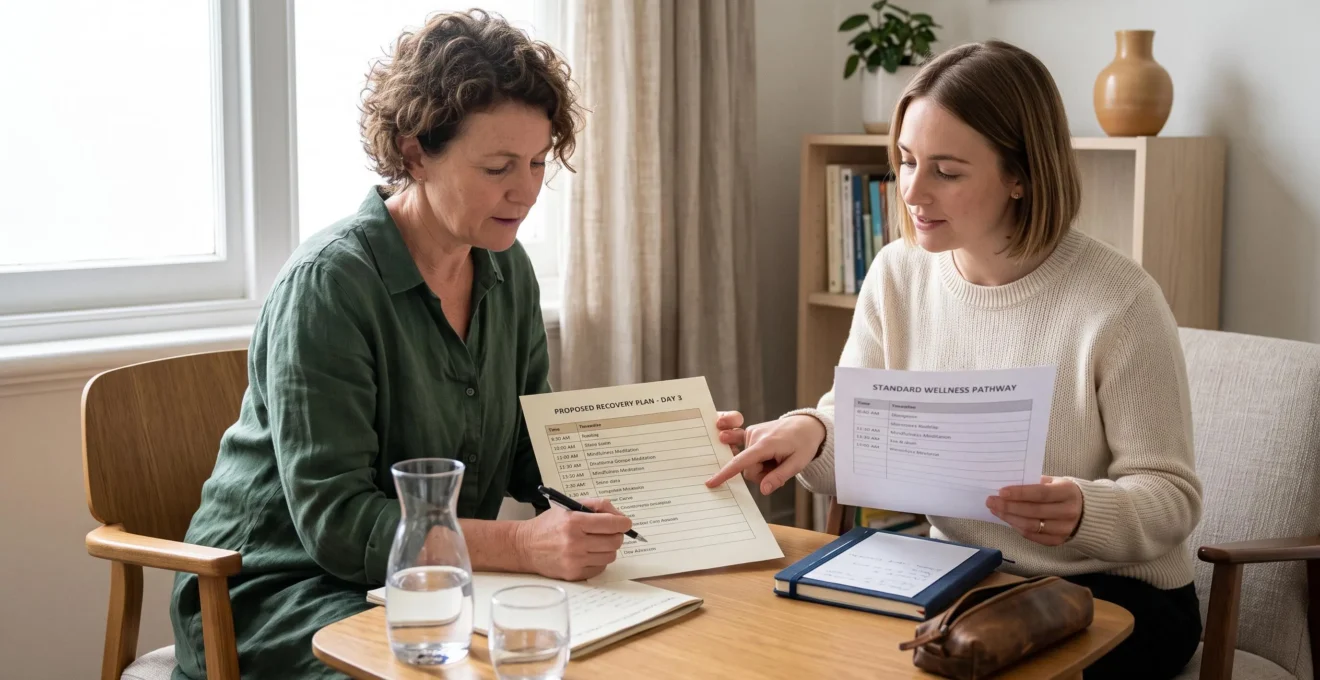
A specialised wellness centre should offer more than an attractive destination, a long treatment menu and assurances of personalised care. The programme should connect your individual goals to appropriate treatments, qualified practitioners, a coherent schedule and a realistic plan for maintaining progress after departure.
That distinction matters when you are considering a substantial investment in pain management, physical recovery, stress reduction or improved mobility. A package can look comprehensive while offering little more than standard classes, interchangeable therapies and amenities available to every guest.
The most reliable way to choose is to examine how a centre makes decisions. Does it assess your health before prescribing sessions? Can it explain why each modality suits your circumstances? Does the itinerary change when your needs change? And will you leave with something practical rather than simply memories of a comfortable stay?
These questions help separate credible, goal-led programmes from expensive packages whose personalisation exists mainly in the brochure.
Choosing a specialised wellness centre: essential checks
- Verify individualisation: request a goal-specific itinerary and establish whether treatment intensity and sequencing can change after assessment.
- Check safety and expertise: verify relevant practitioner credentials, disclose medical information and ask how contraindications are managed.
- Evaluate lasting value: compare meaningful treatment time, programme progression and the practical aftercare included in the price.
- Why Do “Personalised” Wellness Centres Still Put Everyone on the Same Daily Schedule?
- How to Check Practitioner Credentials and Intake Depth Before You Pay a Wellness Deposit?
- Medical Spa or Holistic Centre: Which Fits Better if Your Goal Is Pain Relief, Not Pampering?
- The Disclosure Mistake That Can Make a Wellness Treatment Unsafe Within 1 Session
- How Long Should You Stay at a Wellness Centre to Get Results Without Paying for Dead Days?
- How to Audit a Holistic Program’s Integration in 20 Minutes Before You Pay a Deposit?
- How to Evaluate a Program’s “Aftercare” in 15 Minutes Before You Book?
- How to Choose a Wellness Program That You Can Actually Continue After You Fly Home
Why Do “Personalised” Wellness Centres Still Put Everyone on the Same Daily Schedule?
Many wellness centres use shared daily schedules because group activities and fixed practitioner appointments make staffing and facility management easier. Personalisation may therefore mean selecting treatments within an existing timetable rather than designing a programme around your needs. The decisive question is whether your assessment can change not only which treatments you receive, but also their intensity, timing and sequence.
A centre might advertise individualised recovery while placing every guest in the same morning movement class, afternoon therapy appointment and evening relaxation session. This arrangement is not automatically inappropriate: group activities can be useful, and predictable scheduling helps coordinate practitioners. Problems arise when the advertised personalisation cannot override the timetable.
There are three distinct levels of customisation worth identifying:
- Treatment selection: the centre substitutes one available treatment for another, such as replacing a facial with a massage.
- Intensity and dosage: session duration, physical effort, frequency or treatment intensity are adjusted to the individual’s condition and tolerance.
- Modality sequencing: the programme changes the order and progression of therapies according to assessment findings, recovery and response.
The first level is relatively easy to deliver within a standard package. The second and third require greater coordination and are particularly relevant when managing pain, physical limitations or recovery-related goals.
Before booking, ask the centre to prepare a sample daily plan based on one clearly defined objective. Compare it with the public itinerary, examining session order, rest periods, treatment intensity and opportunities for reassessment.
If the two schedules are almost identical, request a written explanation of what would actually change after your intake. Similarity alone does not prove that care is inadequate, but unexplained uniformity weakens the personalisation claim.
Fixed classes also deserve a safety check. Someone with an inflammatory condition or significant movement restrictions may need modifications, a different session time or permission to skip an activity without losing access to appropriate care.
The goal is not to eliminate shared activities. It is to ensure that clinical needs and personal objectives take precedence over scheduling convenience. That requires knowing who makes treatment decisions.
How to Check Practitioner Credentials and Intake Depth Before You Pay a Wellness Deposit?
Verify practitioner credentials through the relevant professional regulator, then examine the centre’s intake process before paying a deposit. A credible provider should identify who will deliver each treatment, ask about relevant medical conditions and medications, screen for contraindications and explain how your goals inform the proposed programme. Qualifications, assessment quality and professional accountability must be checked separately.
Start by distinguishing regulated healthcare professions from broad wellness titles. Doctors, physiotherapists and psychologists may hold legally protected professional titles, but the applicable rules and registers depend on the country and profession. Terms such as wellness coach, holistic therapist or bodyworker do not, by themselves, establish regulated clinical qualifications.
In the United Kingdom, physiotherapists and several other healthcare professionals can be checked through the HCPC’s professional registration verification page. Doctors, nurses and dentists have separate UK regulators. For practitioners based elsewhere, identify the licensing authority in the jurisdiction where they practise rather than assuming a UK credential system applies.
Registration confirms a particular professional status. It does not automatically establish specialist competence in every treatment, nor does it guarantee results.
Next, ask for the intake form before committing financially. A meaningful assessment should cover relevant diagnoses, symptoms, medications, allergies, previous procedures, current limitations, treatment goals and factors that could make particular interventions unsuitable.
The depth of assessment should match the proposed intervention. A physiotherapy-led pain programme reasonably requires more detailed clinical evaluation than a general relaxation class.
Watch for these warning signs:
- No meaningful health screening before treatments are allocated.
- A sales representative makes clinical suitability decisions without practitioner review.
- The intake never asks about medications or relevant medical conditions.
- The provider will not identify the qualifications of the people delivering sessions.
- The centre cannot explain when it would modify treatment, decline participation or refer someone for outside medical assessment.
Also establish whether the senior professional featured in promotional material will actually treat you. Request a session-by-session practitioner list and a substitution policy in writing. Staff changes are not inherently problematic, but replacement practitioners should have appropriate qualifications and access to relevant assessment information.
A trustworthy centre should also define its limits. Acute injuries, poorly controlled medical conditions and mental health crises may require assessment or treatment outside the wellness setting. A programme that claims to manage virtually every condition warrants particular scrutiny.
Five Checks to Complete Before Paying a Deposit
- Request the names, professional titles and registration details of relevant practitioners; save the verification results.
- Obtain the complete pre-arrival intake questionnaire; retain a copy showing the health topics covered.
- Submit one specific goal and ask for an individually proposed treatment outline; keep the written response.
- Request confirmation of who delivers each treatment and what substitutions are permitted; save the staffing policy.
- Ask which health conditions trigger treatment modifications, exclusions or referrals; obtain a written explanation.
Once professional competence and screening are established, evaluate whether the centre’s actual treatment model suits the problem you want addressed.
Medical Spa or Holistic Centre: Which Fits Better if Your Goal Is Pain Relief, Not Pampering?
For pain relief, choose according to the cause of your symptoms, the qualifications of the treating practitioners and the programme’s ability to assess and measure progress. A medically supervised service may be preferable when diagnosis or complex health risks are involved, while a well-qualified holistic centre may support appropriate movement and self-management. Neither venue label independently establishes clinical quality.
The term medical spa covers different operating models. Some facilities provide physician-led clinical services, others focus primarily on aesthetic procedures, and some hotel-based spas simply have access to a doctor when required.
Holistic centres are similarly varied. They may offer predominantly relaxation-oriented therapies, or employ qualified physiotherapists and other healthcare professionals within a multidisciplinary programme.
The distinction matters because the intervention and practitioner, not the venue category, determine whether an approach is appropriate.
Evidence also varies between pain conditions. The NIH clinical evidence digest on complementary therapies for chronic pain examines interventions such as exercise, acupuncture, massage and mind-body approaches. Its findings differ by condition, intervention and outcome; evidence for one type of pain should not be treated as proof of effectiveness for another.
Use the following comparison as a decision framework rather than a ranking of all facilities within either category.
| Assessment criterion | Medical spa | Holistic centre |
|---|---|---|
| Diagnostic capability | May offer clinical assessment, depending on licensed staff and services. | Varies; some employ regulated clinicians, while others provide non-clinical wellbeing services. |
| Practitioner qualifications | Check the treating professional, not merely the medical director. | Verify each practitioner independently, including any claimed clinical specialisation. |
| Evidence for treatment | Assess the actual intervention and the pain condition it addresses. | Apply the same condition-specific evidence standard. |
| Coordination with existing care | Ask whether appropriate clinical information can be shared with your clinician, with consent. | Check whether staff can coordinate care and recognise when external referral is needed. |
| Progress measurement | Look for relevant baseline and follow-up assessments. | Expect comparable measurement when meaningful pain-related outcomes are claimed. |
| Home programme | Confirm whether ongoing self-management is taught. | Check whether exercises or routines are personalised and supervised appropriately. |
For example, someone seeking support for persistent back pain may benefit more from a programme that assesses functional limitations and develops graded activity than from one built primarily around repeated passive treatments. This is a hypothetical comparison, not a prediction for an individual patient.
Ask what the programme measures at arrival and departure. Depending on the condition, relevant outcomes might include movement range, functional ability or a consistently recorded pain rating.
A beautiful setting can make a stay enjoyable, but amenities should not be confused with active clinical care. Examine the proportion of time devoted to assessment, appropriate treatment, rehabilitation and learning exercises compared with passive relaxation facilities.
The NHS describes physiotherapy as involving assessment, treatment discussion, exercise, manual techniques where appropriate and self-management advice. Its information on physiotherapy assessment and treatment also explains the role of exercises performed at home.
Neither model is automatically more likely to provide effective follow-up. The stronger choice is the individual programme that connects appropriate assessment with progressive self-management, while recognising that pain outcomes cannot be guaranteed.
The Disclosure Mistake That Can Make a Wellness Treatment Unsafe Within 1 Session
The critical mistake is withholding relevant health information because a wellness stay feels like a holiday rather than a healthcare encounter. Medications, recent surgery, pregnancy, allergies and existing medical conditions can change whether a treatment is appropriate. Even one session may introduce avoidable risk when practitioners lack information needed to modify or decline an intervention.
Before travelling, disclose the medications you take, including prescription drugs, over-the-counter products and supplements. Particular attention may be needed for anticoagulants, antidepressants, corticosteroids and substances that could interact with a proposed treatment. Their relevance depends on the specific therapy, dose and individual circumstances.
Also report recent operations, implants, pregnancy, skin problems, bleeding disorders, significant allergies and any symptoms currently under medical investigation.
This information matters across several wellness activities. Forceful massage can be inappropriate for people with certain bleeding risks. Heat exposure may require additional precautions for some medical conditions or medications. Herbal preparations can interact with prescribed drugs, while fasting programmes may create concerns for people with specific illnesses or treatment requirements.
The NIH’s chronic pain evidence review specifically identifies precautions involving deep-tissue massage and anticoagulant use. It also discusses safety considerations for complementary treatments. These findings do not mean that all massage or complementary care is unsafe.
A useful pre-arrival disclosure should therefore include your current conditions, relevant medical history, medication names and doses, allergies, recent procedures, mobility restrictions and the treatments you intend to receive. Send it through an appropriate confidential channel and ask a qualified practitioner to review it.
The centre must actively screen rather than expect guests to identify every possible interaction themselves. Appropriate screening may lead to modified session intensity, alternative activities, additional medical clearance or refusal of a treatment.
Travel adds another consideration. Long journeys can involve prolonged immobility, disrupted sleep and changes to normal routines. The CDC Yellow Book chapter on travel-related blood clots identifies prolonged immobility and certain individual medical histories as relevant to venous thromboembolism risk.
That evidence does not establish that a flight makes massage or sauna use universally unsafe, nor does it establish a standard waiting period before treatment. Someone with recent surgery, previous thrombosis, new leg swelling or other concerning symptoms may need individual medical assessment rather than an ordinary arrival-day wellness session.
After long-distance travel, it is sensible to discuss fatigue, alcohol consumption, hydration concerns and changes in how you feel before undertaking demanding treatments. Avoid assuming that a scheduled intensive session must proceed simply because it is included in the package.
Professional responsibilities and legal duties vary by country, provider and treatment. An unregulated title does not necessarily mean that no duty of care exists, just as a medical-sounding business name does not establish adequate oversight. Written records help document disclosure and communication, but do not guarantee legal recourse.
Safety screening should be integrated into programme design, not treated as a last-minute formality. Once unsuitable treatments are excluded, the next question is how much time the remaining programme genuinely requires.
How Long Should You Stay at a Wellness Centre to Get Results Without Paying for Dead Days?
There is no universal ideal length for a specialised wellness stay. Appropriate duration depends on your objective, the treatments involved, your starting condition and whether the programme includes meaningful progression or assessment. Instead of choosing a package by the number of nights, compare what each additional day contributes and whether that contribution supports your actual goal.
A movement-focused retreat, a structured pain-management programme and a relaxation stay require different schedules. None has a universally validated minimum duration simply because it is marketed under a particular category.
Ask the centre to explain why its proposed length suits your circumstances. The explanation should account for assessment, treatment progression, rest, reassessment and the time needed to learn practices you will continue independently.
Then audit the itinerary day by day. Separate its activities into three categories:
- Goal-related professional time: assessment, appropriate therapy, supervised movement, education and progress reviews.
- Supportive time: recovery periods, meals and rest that may contribute to the overall experience or treatment tolerance.
- Optional experience time: amenities, social activities and general leisure that may be enjoyable but are not central to the intended outcome.
This distinction is not an argument against relaxation. Rest may be a legitimate programme component. The issue is whether the centre explains its purpose rather than presenting every activity as equally therapeutic.
Request the scheduled hours in each category and calculate the approximate cost per day containing meaningful goal-related activity. Keep accommodation, transfers and optional purchases visible in the comparison.
Hypothetical Example: Comparing Two Package Lengths
Imagine a guest comparing a five-night movement programme with a seven-night version. Both include an initial assessment, supervised exercises and a final review. The longer option adds two nights, but its proposed itinerary lists only repeated introductory classes and general spa access.
In this hypothetical situation, the guest should ask whether those classes are deliberately reinforcing skills, whether exercise difficulty will progress and whether additional professional reassessment is included. Without a clear purpose, the extra nights may deliver comfort rather than meaningful programme development.
Some programmes also involve adjustment periods. Changes in activity levels, climate, sleep patterns or food intake can temporarily affect how a guest feels. The timing and significance of these responses vary, and early impressions are not necessarily reliable evidence of long-term benefit.
Restrictive diets, demanding bodywork or other intensive interventions should not be treated as necessary adaptation challenges without appropriate justification and safety review. Claims that uncomfortable symptoms prove a detoxification process deserve particular scepticism.
The most revealing question is the marginal-day test: what specifically happens on each additional day that would not happen if you left earlier?
An answer involving progressive exercises, an important reassessment or supported practice may indicate genuine value. Merely repeating the same menu of treatments does not establish additional benefit, although repetition can be appropriate when it serves a clear, individually justified purpose.
Duration becomes meaningful only when the activities form a coherent process. That coherence can be evaluated before booking, even when a centre markets its approach as holistic.
How to Audit a Holistic Program’s Integration in 20 Minutes Before You Pay a Deposit?
A 20-minute integration audit can reveal whether a holistic wellness programme coordinates its therapies around one clearly assessed goal or simply combines unrelated treatments. Request a sample schedule, the intake form and an explanation of how two proposed modalities work together. Then establish who coordinates care, how practitioners communicate and what happens when treatments conflict.
Integration should have an operational meaning. A centre offering massage, movement therapy, nutrition consultations and mindfulness sessions is not necessarily delivering integrated care merely because all four services appear in one package.
Meaningful integration requires a rationale for choosing and sequencing interventions, a responsible coordinator and a process for reviewing suitability and progress. Different practitioners may contribute complementary skills without claiming that every modality produces an additional clinical benefit.
Use the following 20-minute screening exercise as a practical purchasing tool, not a validated clinical audit.
- Minutes 0–5 — Review the schedule. Look for a clear initial assessment, individual goals, changes in activity across the stay and planned opportunities to review progress.
- Minutes 5–10 — Examine the intake form. Check whether its questions are sufficiently detailed to influence treatment selection and identify contraindications.
- Minutes 10–15 — Test the treatment rationale. Ask the centre to explain how two modalities support your stated goal, why they are sequenced as proposed and whether either could be omitted without compromising the programme.
- Minutes 15–20 — Confirm coordination. Ask who oversees the programme, what information practitioners share with appropriate consent and who resolves conflicting recommendations.
For example, a hypothetical mobility programme might combine an initial functional assessment with supervised exercises and later relaxation sessions. A coherent explanation would specify the role of each component, how exercise difficulty is adjusted and what information informs the next appointment.
A weaker explanation might describe every treatment as beneficial without connecting it to the assessed limitation or identifying any method of evaluating progress.
Also examine the schedule’s structure. Look for shared objectives, progressive work, practitioner handovers and debrief periods. A uniform grid of unrelated appointments may indicate limited coordination, although the appearance of the timetable alone cannot establish whether care is integrated.
Ask what happens if one practitioner recommends an intensive session while another identifies a reason to reduce activity. A credible process should provide a responsible decision-maker and a means of documenting changes.
There are important limits to this test. A polished explanation can conceal weak execution, while a simple schedule can support excellent care. The audit cannot verify clinical competence, prove that combined treatments work or establish how effectively staff collaborate in practice.
Those questions require the practitioner checks, evidence review and individual safety assessment discussed earlier.
A coordinated stay is more credible than an unexplained collection of therapies, but it is still incomplete if the programme ends without helping the guest maintain appropriate progress.
How to Evaluate a Program’s “Aftercare” in 15 Minutes Before You Book?
Evaluate aftercare by asking what practical support is included after departure, who provides it and whether any additional fees apply. A meaningful arrangement should transfer relevant skills and instructions into everyday life, not merely offer access to newsletters or paid services. A short pre-booking conversation can establish whether follow-up is structured, personalised and financially transparent.
Retreat environments simplify routines in ways that ordinary life rarely does. Meals may be prepared, appointments arranged and distractions reduced. A guest can follow an ambitious schedule during the stay without having the time, equipment or professional support to reproduce it at home.
For this reason, aftercare should be assessed as a transfer process. It should identify which activities remain useful, how frequently they should be performed and how to modify them when circumstances change.
Use a 15-minute call to ask these questions:
- What individual written instructions will I receive before leaving?
- Will a follow-up appointment or call be scheduled, and when?
- Who conducts the follow-up: my treating practitioner, another qualified professional or a customer-service representative?
- How long does the included support remain available?
- What additional charges apply, and which services require a subscription?
The answers should be specific enough to appear in a booking confirmation or programme description. Statements such as ongoing support or lifelong guidance are too vague to establish what is actually included.
Depending on the programme, useful take-home materials may include a personalised exercise or activity schedule, written or video instructions, appropriate frequency and progression guidance, precautions, signs that require stopping an activity and a named professional contact.
For clinical programmes, safety instructions should identify circumstances requiring medical assessment rather than suggesting that every problem can be resolved remotely through the centre.
A scheduled follow-up can be valuable, but it should have a purpose. Reviewing adherence, adjusting an exercise progression or identifying obstacles to implementation is different from arranging a sales call to promote another retreat.
Be particularly attentive to paid-aftercare upsells. An optional subscription is not inherently inappropriate if its services and fees are disclosed clearly. The concern is discovering at checkout that essential instructions or expected follow-up were never included in the original package.
Ask for separate written descriptions of included aftercare and optional paid support before paying a deposit.
Finally, ask whether the practitioner will teach and check your ability to perform the recommended home activities before departure. Written guidance is more useful when you understand it and can apply it safely.
Effective aftercare cannot compensate for an unsuitable programme, but it reveals whether the centre has considered the conditions in which its recommendations must eventually work: your everyday life.
Key Takeaways Before Making Your Final Choice
- Prefer adaptable programmes: the itinerary should respond to assessment findings rather than require you to fit a standard timetable.
- Demand accountable care: identifiable practitioners, clear treatment boundaries and documented safety decisions matter more than the number of advertised therapies.
- Choose usable outcomes: value depends partly on what you learn and can maintain, not simply how many sessions you attend.
How to Choose a Wellness Program That You Can Actually Continue After You Fly Home
Choose a wellness programme by testing whether its central practices fit your ordinary life before comparing destinations or package features. The best match is not necessarily the retreat offering the most treatments, but one that addresses your goal through appropriate interventions and teaches realistic routines you can sustain. Time, cost, equipment, access to practitioners and existing responsibilities all affect that decision.
Begin with your main objective. It might be improving movement confidence, learning appropriate pain-management strategies, building a more consistent sleep routine or establishing sustainable physical activity.
Then identify the programme’s three central practices. Do not rely on an extensive treatment menu: ask the centre which activities it considers essential to achieving your stated objective and why.
For each practice, apply a simple home feasibility test:
- Time: Can the practice fit into a typical working week, including family responsibilities and recovery needs?
- Access: Does it require specialist equipment, particular facilities or professionals unavailable near home?
- Cost: Can you reasonably maintain any required appointments, supplies or memberships?
- Environment: Does it depend on a particular climate, destination or level of daily assistance?
- Independence: Can you perform it appropriately without continuous supervision, or is local clinical follow-up necessary?
Some destination-specific treatments may provide a worthwhile experience without being transferable. Mud applications, specialist equipment sessions and carefully prepared retreat meals may not be easy to reproduce once you leave.
Other approaches can be more portable. Individualised movement routines, appropriate breathing practices, sleep habits and practical dietary frameworks may be adaptable to home life, provided they are suitable for your needs.
Portability is not proof of effectiveness. A convenient practice still needs an appropriate rationale, and some specialist treatments legitimately require professional supervision. The goal is to distinguish any benefit received during the stay from the activities needed to support continued progress.
Consider a hypothetical guest who follows a demanding schedule of supervised classes, extensive daily exercise and carefully structured meals during a retreat. On returning home, work obligations make the same routine impractical.
The problem is not necessarily a lack of motivation. The proposed routine may have been designed around the retreat environment rather than the guest’s normal constraints.
Before booking, ask the centre to prepare a realistic-week version of its programme. This should specify which practices take priority, their achievable frequency, necessary equipment, relevant precautions and suitable alternatives when time is limited.
A practitioner should be able to discuss how the programme might be simplified without making unsupported promises that a smaller routine will produce identical outcomes.
For pain-related or rehabilitation goals, the home plan may also need coordination with a local healthcare professional. Ask whether the centre can provide a suitable treatment summary, exercise instructions and relevant progress measurements for continuity of care, subject to your consent and applicable privacy rules.
Compare prospective centres using these written home plans alongside their practitioner credentials, intake procedures, treatment schedules and full costs. A cheaper package may still be poor value if its benefits rely entirely on facilities you cannot access afterwards. Equally, a higher price is justified only by services and expertise that genuinely matter to your objectives.
Before paying a deposit, ask each shortlisted centre for one goal-specific itinerary and its accompanying realistic home plan. Choose the provider that can explain both, document relevant safeguards and show how the proposed activities fit your circumstances. The most meaningful distinction between personalised care and a generic package is whether the programme remains useful after you have flown home.
Does a wellness centre need medical accreditation to offer personalised programmes?
Not every wellness activity requires a medically accredited facility. Requirements depend on the country, the services offered and whether regulated healthcare is being provided. For clinical treatments, verify the relevant practitioner’s licence or registration and the facility’s applicable authorisations. An accreditation or certification should be assessed for its actual scope rather than treated as a universal guarantee of clinical quality.
Should you consult your own doctor before booking a wellness retreat?
Medical advice is especially relevant when you have significant existing conditions, take medications that may interact with proposed treatments, have recently undergone surgery or are considering intensive interventions. Your clinician can help evaluate specific risks and whether a destination programme is appropriate. A routine relaxation stay does not automatically require medical clearance for every traveller.
Can a wellness centre guarantee lasting pain relief or recovery?
No credible provider should promise a particular lasting result for every individual. Outcomes depend on the underlying condition, treatment suitability, personal circumstances and follow-up. Ask how progress will be assessed, what limitations the centre recognises and how the proposed approach fits with any existing medical care.
What should you request in writing before paying a non-refundable deposit?
Request the personalised programme outline, practitioner details, proposed session schedule, health-screening arrangements, treatment substitution rules, included aftercare and full payment and cancellation terms. Confirm which elements may change after assessment and how those changes affect charges or refunds. Written documentation helps you compare providers and understand the contractual commitments before paying.
Is a centre offering fewer treatments necessarily worse value?
No. Treatment quantity is a poor substitute for suitability, quality and coherence. A focused programme with qualified practitioners, appropriate progression and transferable home practices may align better with a specific goal than a longer menu of unrelated services. Compare the purpose and delivery of each treatment, not simply the number advertised.