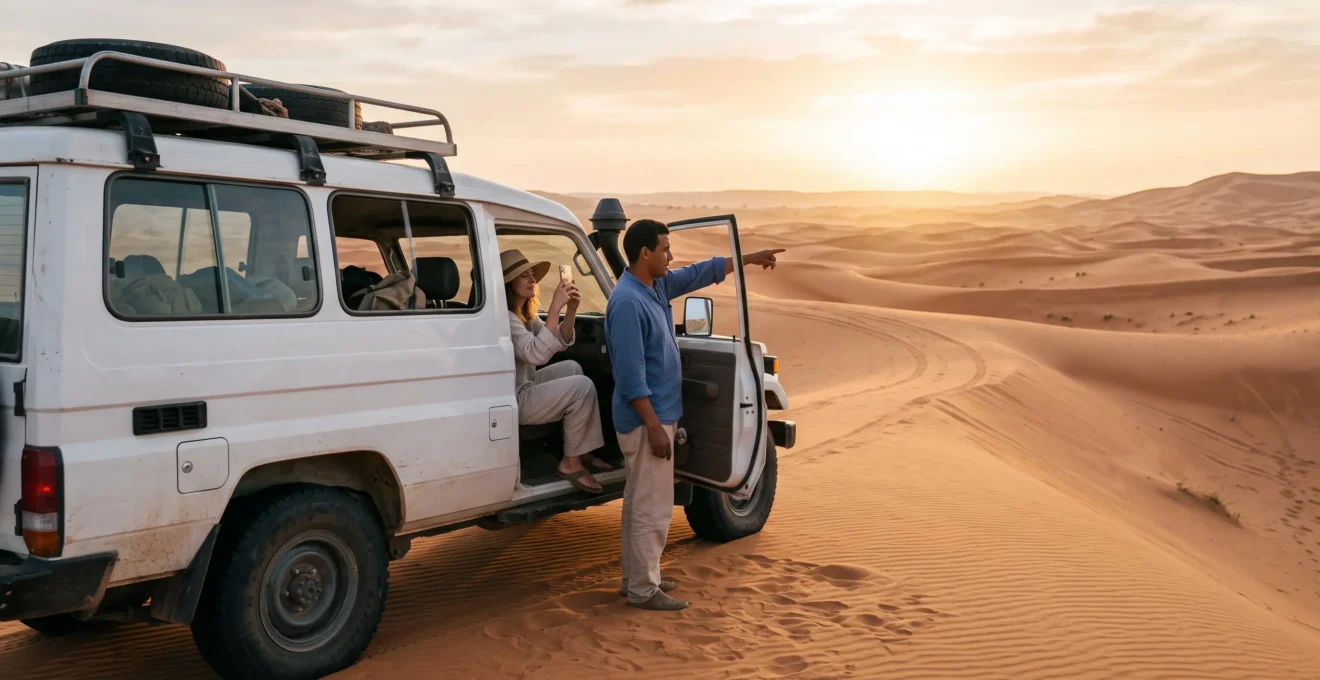
You can experience spectacular desert dunes without enduring steep vehicle drops, repeated jolts or the nausea associated with aggressive dune bashing. For travellers prone to motion sickness, a gentle sunset 4×4 tour with scenic stops is usually the most practical starting point, provided the operator confirms a smooth route and allows passengers to request breaks.
The challenge is choosing an excursion that delivers real dune scenery without turning an enjoyable trip into an exhausting test of endurance. Heat, glare, uneven terrain, vehicle seating and driving style all influence comfort. Even a relatively short outing can become difficult when several uncomfortable conditions occur together.
There is also more to a responsible safari than avoiding nausea. Driver qualifications, vehicle safety, drinking water, cancellation flexibility and animal welfare deserve attention before booking. Whether you prefer an easy scenic drive, a sheltered desert camp or a carefully managed alternative activity, the right choice depends on your personal tolerance rather than the most adventurous package advertised.
Desert safari choices at a glance
- Best starting option: Choose a gentle sunset or early-morning 4×4 tour with predictable driving, an air-conditioned vehicle and frequent stops.
- Before booking: Confirm seatbelts, driver credentials, your seating arrangement and the option to skip dune bashing in writing.
- For maximum comfort: Avoid peak heat, wear breathable sun-protective clothing and choose a sheltered camp or stationary dune viewpoint if vehicle movement becomes uncomfortable.
- Why Do Desert Safaris Feel Twice as Exhausting as You Expect After Only 90 Minutes?
- How to Vet a Desert Safari Operator With 8 Safety Questions Before You Book?
- Dune Bashing or Sunset 4×4 Tour: Which Is Better if You Hate Roller-Coaster Feelings?
- The Clothing Mistake That Makes Desert Heat Feel Unbearable Within 20 Minutes
- When Should You Schedule a Desert Safari to Avoid Peak Heat and Get Better Light for Photos?
- How to Vet a Desert Safari Operator’s Vehicle and Seating Before You Pay a Deposit?
- Dunes or Desert Camp: Which Is Better if You Need Quiet Nights and Minimal Wind?
- Which Desert Safari Style Should You Choose If You’re a Nervous Traveller Who Still Wants the ‘Dunes’ Experience?
Why Do Desert Safaris Feel Twice as Exhausting as You Expect After Only 90 Minutes?
Desert safaris can feel unexpectedly exhausting because heat exposure, dehydration, glare and continuous vehicle movement place different demands on your body. People susceptible to motion sickness may also experience nausea, dizziness and fatigue. Ninety minutes is not a medically established exhaustion threshold: how quickly discomfort develops depends on the conditions, activity and individual traveller.
Consider what happens during a typical dune excursion. The vehicle climbs and descends uneven ground, requiring your body to make repeated small postural adjustments. Meanwhile, bright sunlight, warm air and limited shade can add to the physical demands of the trip. These exposures may occur simultaneously, making it difficult to identify why you suddenly feel unwell.
Two forms of discomfort deserve separate attention:
- Heat-related fatigue: Overheating and dehydration can produce weakness, headache, dizziness, nausea and heavy sweating. Cooling, hydration and reducing heat exposure are essential responses.
- Motion-induced fatigue: Repeated movement can produce nausea, drowsiness, dizziness, sweating and tiredness, even when the cabin temperature is comfortable. Reducing the movement stimulus and maintaining a stable visual reference may help.
These conditions have overlapping symptoms, but they are not interchangeable. Feeling nauseated during a hot safari does not establish whether motion sickness, overheating or both are responsible. The CDC Yellow Book chapter on motion sickness explains that symptoms develop according to the movement experienced and a person’s susceptibility, rather than according to a fixed journey duration.
To estimate your tolerance before booking, think about recent experiences in winding-road vehicles. Could you comfortably handle 20–30 minutes of repeated turns? Did you feel worse when looking at your phone, sitting in the back or travelling without a clear horizon? These observations are more useful than assuming that a 90-minute safari will be manageable.
A useful hypothetical comparison is a traveller who becomes nauseated after a short mountain-road journey. That person may prefer a brief dune-viewing excursion with several stops over a longer route involving repeated climbs and descents. Someone comfortable with winding roads but particularly sensitive to heat may instead benefit most from a shorter, cooler departure window.
Before choosing an excursion, ask how much time is spent driving continuously, how much takes place outside an air-conditioned vehicle and where shaded rest stops are available.
Fatigue is not necessarily a challenge to push through. If you become dizzy, unusually weak or nauseated, tell the guide immediately and stop the activity. Persistent or severe symptoms, especially confusion or fainting, require urgent medical assessment rather than simply continuing the tour.
How to Vet a Desert Safari Operator With 8 Safety Questions Before You Book?
Vet a desert safari operator by asking eight specific questions about driver qualifications, vehicle condition, passenger restraints, emergency preparation, driving style, itinerary flexibility and booking terms. Reliable operators should provide clear answers before payment, preferably in writing. A licence or registration requirement matters, but it cannot replace checking how the actual excursion will be conducted.
Use these eight questions when comparing operators:
- Are your safari drivers appropriately registered, licensed or qualified? Ask which requirements apply at the destination and how the company complies.
- How are the safari vehicles inspected and maintained? Ask about servicing, tyre checks and the condition of the vehicle assigned to your trip.
- Does every passenger seat have a working seatbelt? Confirm that restraints are available and used throughout vehicle travel.
- What first-aid training and emergency arrangements do your guides have? Ask how the team handles a passenger who becomes unwell far from the pickup point.
- Can the driver use a gentle route without steep drops or aggressive dune bashing? Request a specific description of the driving style rather than accepting labels such as mild or family-friendly.
- Can the vehicle stop immediately when it is safe to do so? Find out whether the guide will modify the itinerary if motion sickness develops.
- Are water, shade and cooling facilities available? Ask where breaks occur and how unexpected heat or weather conditions affect the programme.
- What happens if I need to skip an activity, change the route or cancel? Request the refund, modification and deposit conditions in writing.
Local rules differ. For example, the Dubai Department of Economy and Tourism states in Dubai’s official safari driver and vehicle registration requirements that businesses organising safari trips in Dubai must have registered drivers and vehicles. This is a Dubai-specific requirement, not a universal standard for every desert destination.
Registration alone does not confirm that a particular journey will be comfortable or that a specific vehicle has been maintained properly. Practical answers about driving behaviour and emergency readiness are therefore equally important.
Be cautious when an operator responds with phrases such as “all our trips are completely safe” without explaining the actual safeguards. There is no risk-free off-road activity. Similarly, an operator that promises a gentle trip but refuses to explain whether dune bashing can be excluded may not be suitable for a motion-sensitive guest.
Check recent reviews for concrete accounts of seatbelt use, driver behaviour, how staff responded to discomfort and whether promised itinerary adjustments were honoured. Reviews provide supporting context, not independent verification of safety compliance.
Five booking checks to complete before paying
- Request the operator’s legal business name and applicable driver or vehicle registration details. Save the written response.
- Ask for confirmation of working seatbelts, air conditioning and your assigned seating arrangement. Keep the operator’s reply.
- Request a written description of the route, including whether steep dune descents and aggressive manoeuvres are excluded.
- Confirm the rest-stop arrangements, drinking-water availability and procedure if you need the vehicle to stop. Save these details with your booking.
- Obtain the cancellation, refund and activity opt-out terms in writing before paying the deposit. Keep a copy of the conditions.
The most reassuring response is not a blanket guarantee. It is a specific explanation of what the operator can do, what it cannot promise and how it will respond if you need a gentler experience. Those answers make the next decision—whether to choose dune bashing at all—much easier.
Dune Bashing or Sunset 4×4 Tour: Which Is Better if You Hate Roller-Coaster Feelings?
A gentle sunset 4×4 tour is generally a better starting choice than dune bashing if you dislike roller-coaster sensations. Dune bashing typically involves repeated steep climbs, descents and directional changes, while scenic tours can prioritise viewpoints and gentler routes. However, the advertised tour name does not guarantee smooth driving, so confirm the itinerary before booking.
Dune bashing creates the dramatic movement many adventure travellers seek. The vehicle may change direction sharply or descend sandy slopes, generating movement that passengers cannot easily predict. This makes it potentially uncomfortable for people who become nauseated on amusement rides or winding roads.
A scenic sunset 4×4 excursion, by contrast, can focus on accessible dune viewpoints, photography stops and slower driving. Some packages still include off-road sections, so a sunset label should not be interpreted as a promise to avoid steep dunes.
The following comparison can help you distinguish what matters most:
| Decision factor | Dune bashing | Gentle sunset 4×4 |
|---|---|---|
| Movement intensity | Repeated steep slopes, jolts and direction changes | Potentially smoother routes with scenic pauses |
| If roller coasters make you nauseated | Generally a poor match | More suitable if aggressive driving is excluded |
| If brief motion is tolerable but prolonged motion is not | Repeated intense movement may be difficult | Short driving segments with breaks may be easier |
| Control over the journey | May be limited by group itinerary | Can be greater with a private or flexible tour |
| Dune scenery and photographs | Available, depending on stops | Usually a central feature of the itinerary |
| Best booking condition | Clear understanding of the driving intensity | Written confirmation of the gentle route and stopping policy |
A useful compromise is a hybrid desert safari. On some itineraries, passengers can skip the more intense driving section, remain at an appropriate shaded viewpoint and rejoin their group for scenic stops or the sunset portion.
Do not assume this arrangement is available on every group excursion. Ask whether the viewpoint has shade, water, staff supervision and safe transport arrangements. You should not be left alone in an exposed desert location while the rest of the group continues.
One frequently overlooked issue is that “mild dune bashing” has no universally standardised meaning. It might describe slower driving, less challenging terrain or simply a shorter version of the usual activity. Individual drivers may also interpret the description differently.
If movement is a serious concern, request confirmation that the route avoids aggressive manoeuvres altogether. A specific driver experienced with gentle excursions may be useful, but this is not a substitute for clearly agreed driving conditions.
You do not need a dramatic descent to experience the scale, colour and silence of a desert landscape. A stationary viewpoint with an uninterrupted dune panorama can be more memorable than an uncomfortable drive, particularly when the sunset is the main attraction.
The Clothing Mistake That Makes Desert Heat Feel Unbearable Within 20 Minutes
One common desert clothing mistake is choosing tight, poorly ventilated or dark clothing that makes it harder to stay comfortable under strong sunlight. Loose, lightweight, breathable garments are usually a better option. The idea that unsuitable clothing makes desert heat unbearable within exactly 20 minutes is not established; discomfort depends on temperature, exposure, activity and personal tolerance.
Desert weather can be deceptively demanding. Dry air may allow sweat to evaporate quickly, but clothing that restricts ventilation can interfere with effective cooling. Strong sunlight also heats exposed surfaces, while wind and blowing sand create additional discomfort.
Light-coloured clothing generally absorbs less solar radiation than dark alternatives under comparable conditions. A loose long-sleeved shirt and lightweight trousers can provide sun protection while allowing air movement around the body.
Cotton and linen are familiar breathable choices, but not every synthetic fabric is unsuitable. Technical materials specifically designed for moisture management and ventilation can also work well. Consider fabric weight, fit, breathability and sun protection rather than fibre type alone.
The National Park Service heat-safety recommendations support lightweight, loose-fitting, light-coloured clothing, adequate drinking water and protection from direct sun exposure.
Pack these practical accessories:
- A wide-brimmed hat: Protects the face, ears and neck from direct sunlight.
- Closed-toe shoes: Provide practical protection when walking over hot sand, stones and uneven ground.
- UV-protective sunglasses: Reduce glare from bright sand and improve visual comfort.
- A lightweight extra layer: Can help when temperatures drop after sunset or wind increases.
- Sunscreen and drinking water: Support skin protection and hydration during outdoor stops.
For motion-sensitive travellers, comfortable clothing addresses an important practical problem: heat-related symptoms and motion sickness can both involve nausea and dizziness. Reducing heat exposure may remove an additional source of discomfort, although clothing changes have not been shown to prevent vestibular motion sickness itself.
Avoid overdressing for the temperature inside the vehicle while forgetting about the conditions during outdoor stops. Choose layers that can be adjusted easily without exposing yourself unnecessarily to strong sun or wind.
Appropriate clothing helps you tolerate the environment, but it does not make extreme temperatures safe. Choosing the right departure time remains one of the most important ways to reduce unnecessary heat exposure.
When Should You Schedule a Desert Safari to Avoid Peak Heat and Get Better Light for Photos?
Schedule a desert safari around early morning or late afternoon whenever local weather and operating conditions make those periods suitable. Both typically offer lower sun angles and more comfortable conditions than peak daytime heat. Sunrise and sunset also create attractive dune shadows, but the ideal departure time varies by season, destination and the length of the itinerary.
Midday tours can combine strong sunlight, high temperatures and limited shade. For travellers already concerned about nausea or fatigue, avoiding unnecessarily hot conditions reduces one preventable source of physical strain.
General National Park Service outdoor guidance recommends planning hot-weather activities before 10 a.m. or after 4 p.m. where appropriate. These are broad heat-avoidance guidelines, not fixed safe operating hours for desert safaris in every country.
Consider the differences between the most common departure windows:
| Departure period | Main advantages | Important considerations |
|---|---|---|
| Early morning | Potentially cooler weather, fresh dune textures and low-angle light | Early pickup, seasonal temperature variation and possible morning wind |
| Midday | Daylight availability and potentially quieter schedules | Stronger sun exposure and potentially greater heat-related risk |
| Late afternoon and sunset | Warm photography light, long shadows and a natural scenic finish | Residual daytime heat, changing sunset times and possible darkness during the return |
From a photography perspective, the low sun produces long shadows across rippled sand. These shadows reveal the curves and ridges of dunes more clearly than the relatively flat lighting often found near midday. The result can be especially striking when photographed from a stationary viewpoint.
For motion-sensitive passengers, cooler conditions may improve overall comfort, but they do not eliminate movement-related nausea. A rough vehicle ride can still cause motion sickness on a cool morning.
When planning your departure, work backwards from the experience you want. If sunset photographs are the priority, ask how long the drive takes and whether the tour reaches its viewpoint before the light changes. For sunrise trips, check how much driving occurs before daylight and whether the route is suitable for the planned conditions.
Seasonal variation matters. A departure time that works comfortably during a cooler month may become unsuitable during a hotter period. Check the actual forecast, sunrise or sunset time and any local weather warnings rather than relying only on the schedule printed in a tour advertisement.
Ask the operator whether departure times change seasonally and whether excessive heat, strong wind or reduced visibility can trigger a route change or postponement.
Once the departure window is settled, the next important variable is inside the vehicle itself: where you sit, how well you can see ahead and whether the journey can be adjusted when discomfort begins.
How to Vet a Desert Safari Operator’s Vehicle and Seating Before You Pay a Deposit?
Before paying a desert safari deposit, confirm the vehicle type, air conditioning, seatbelt availability, actual seating arrangement and whether the driver can reduce or stop the movement when safe. For motion sickness, a forward-facing seat with a clear view ahead is often helpful. However, no single seat position guarantees comfort in every 4×4.
The vehicle is more than a means of reaching the dunes. Its suspension, seating layout, visibility and ventilation influence the way passengers experience the route. Even a relatively gentle itinerary can feel uncomfortable if you are sitting where movement is pronounced or cannot see the direction of travel.
Ask about the vehicle’s age and maintenance history, but avoid treating age alone as proof of safety. A vehicle’s actual condition, servicing and suitability for the terrain matter more than a simple model-year comparison.
Seating deserves particular attention. The front passenger seat, when available and appropriate, often provides a clearer forward view, helping the brain anticipate turns and changes in direction. Seats closer to the vehicle’s centre may experience less pitching than seats at the extreme ends, although this depends on the vehicle’s geometry and movement.
There is no universal rule that a middle-row seat above the rear axle is always the smoothest. In some vehicles, positions farther from the centre of pitching motion experience stronger vertical movement. The best practical choice combines visibility, secure forward-facing seating and the specific vehicle’s ride characteristics.
When discussing seating with the operator, check:
- Whether the requested front or middle-row seat can actually be reserved.
- Whether every occupied seat has an appropriate, working seatbelt.
- Whether the air conditioning functions throughout the journey.
- Whether the windows provide a useful view toward the road or horizon.
- Whether you can request a safe stop without having to persuade other passengers.
Open-sided vehicles can seem appealing because passengers feel closer to the landscape. However, exposed seating also introduces wind, blowing sand, strong sunlight and reduced control over cabin conditions. These factors may create additional discomfort, especially during longer excursions.
Never choose an exposed or unconventional seat simply because it appears to offer better visibility. Suitable occupant restraints and safe seating arrangements take priority over photographic opportunities.
If you are considering motion-sickness medication, seek advice from a pharmacist or healthcare professional before travelling. Some medicines cause drowsiness or have contraindications, making them unsuitable for certain people or activities. Do not take sedating medication and then operate an off-road vehicle.
Practical measures such as looking toward the horizon, avoiding reading and limiting unnecessary head movement may reduce symptoms, but they are not guaranteed solutions.
For travellers who remain uncomfortable with repeated off-road movement, reducing driving time may matter more than finding the perfect seat. A camp-based stay with brief dune access can provide a different solution altogether.
Dunes or Desert Camp: Which Is Better if You Need Quiet Nights and Minimal Wind?
A sheltered desert camp or lodge is generally the more practical choice if quiet nights, reduced wind exposure and reliable sleep matter most. A camp directly on exposed dunes may offer more immersive scenery, but it can also be vulnerable to wind and sand. Neither setting guarantees silence, so ask about shelter, neighbouring activities and overnight facilities.
Overnight desert experiences vary considerably. Some camps consist of exposed tents close to open dunes, while others use more sheltered ground, enclosed accommodation or permanent structures. The actual layout can matter more than the marketing category.
A dune-facing camp may provide immediate access to sunrise views, evening photographs and short walks over the sand. However, exposed positions can experience noticeable wind, depending on local terrain and seasonal weather patterns.
A sheltered camp or desert lodge can provide more protection from blowing sand and may offer enclosed sleeping spaces. That can be valuable when you need to recover after a day of travel or prefer not to spend the night listening to wind against tent fabric.
| Priority | Exposed dune camp | Sheltered desert camp or lodge |
|---|---|---|
| Immediate dune access | Often a major advantage | May require a short transfer or walk |
| Wind protection | Potentially limited | May be better, depending on design and location |
| Night-time quiet | Depends on wind, guests and activities | Depends on layout and proximity to shared facilities |
| Temperature control | Varies by tent construction | Enclosed or air-conditioned accommodation may be available |
| Best fit | Travellers prioritising immersion and easy dune access | Travellers prioritising sleep and controlled conditions |
Before booking, ask whether the tent is enclosed, how it is protected from wind and whether air conditioning is available throughout the night. Also check the distance between sleeping accommodation and communal dining, entertainment or vehicle activity areas.
Do not assume that a remote camp will automatically be quiet. Group activities, generators and vehicle movements can still be audible. Equally, a sheltered camp does not necessarily provide a completely wind-free environment.
For anyone prone to motion sickness, restful sleep deserves attention. Sleep deprivation is recognised as a factor that can worsen susceptibility to motion sickness. This makes reliable overnight comfort more relevant than simply choosing the most dramatic dune location.
Animal-related activities also deserve careful consideration. If the camp offers camel rides or animal encounters, ask how the animals are housed, handled and rested, and whether participation is optional. Avoid an activity if staff cannot explain appropriate animal care or if an animal appears distressed, injured or overworked.
A well-chosen camp allows you to enjoy the desert at your own pace. You can spend the evening watching changing dune colours, sleep in a protected setting and explore the sand again in the cooler morning without needing repeated high-intensity vehicle rides.
Key takeaways before choosing your safari
- Match the movement, not the marketing label: Ask exactly how the vehicle will travel across dunes and whether intense driving can be excluded.
- Prioritise your ability to stop: A flexible itinerary with genuine rest options is often more useful than a longer excursion with fixed activities.
- Protect the full experience: A cooler departure, safe vehicle and comfortable camp can make dune scenery enjoyable without aggressive off-road driving.
Which Desert Safari Style Should You Choose If You’re a Nervous Traveller Who Still Wants the ‘Dunes’ Experience?
If you are nervous about motion sickness but still want to experience desert dunes, start with a gentle scenic 4×4 tour, a short accessible dune visit or a hybrid itinerary that allows you to skip dune bashing. Camel rides and self-drive activities may appeal to some travellers, but neither is automatically more comfortable or safer. Choose based on your tolerance, supervision and ability to control the experience.
The most useful way to compare safari styles is to separate three factors: the expected movement, the control you have over it and the conditions under which the activity takes place.
The following scale is a practical planning guide, not a scientifically validated ranking of motion-sickness risk. Individual reactions vary significantly.
| Safari style | Expected movement | Best suited to |
|---|---|---|
| Stationary dune viewpoint or short guided dune walk | Minimal vehicle movement once at the site, depending on access | Travellers highly sensitive to vehicle motion who can manage the walking conditions |
| Gentle scenic 4×4 tour | Usually limited to moderate movement when a smooth route is agreed | Travellers wanting dune scenery, photographs and predictable stops |
| Hybrid safari with dune-bashing opt-out | Adjustable exposure if the alternative waiting arrangement is suitable | Groups with different adventure preferences |
| Short supervised camel ride | Slow, rhythmic movement with potentially pronounced swaying | Travellers comfortable with animal movement and satisfied with welfare standards |
| Guided self-drive dune buggy | Highly variable; jolts, vibration and challenging terrain are possible | Appropriately prepared participants seeking direct control, not necessarily lower risk |
| Full dune bashing | Repeated intense off-road movement | Travellers who tolerate vigorous motion and knowingly accept the activity’s risks |
Perceived control is an important consideration for some motion-sensitive travellers. Being able to anticipate movement may reduce the sensory mismatch associated with motion sickness. However, feeling more in control does not mean an activity is objectively safer.
Self-drive dune buggies illustrate this distinction. Operating the vehicle may make its movements more predictable to the driver, yet sand terrain, speed, rollover hazards and mechanical exposure create other risks. Such activities require appropriate training, protective equipment, supervision and compliance with local rules. They should never be treated as the default alternative for someone who simply wants to avoid nausea.
Camel rides present a different trade-off. Their speed may be relatively slow, but the swaying motion and the animal’s movements when standing or kneeling can still provoke discomfort. If you choose a camel experience, examine the provider’s animal-welfare practices, handling methods, rest arrangements and willingness to let you decline participation without pressure.
For many nervous travellers, the most satisfying itinerary is simpler: a comfortable vehicle transfer, a short scenic dune drive, time at a shaded viewpoint, sunset photographs and an optional quiet camp visit. A guided morning walk can add the feeling of being immersed in the dunes without requiring aggressive driving.
Keep the itinerary flexible. If you have a history of severe motion sickness, experience significant health limitations or require medication that may affect alertness, discuss the planned activity with an appropriate healthcare professional before travelling.
Choose one or two suitable safari styles, ask operators to confirm their routes and safeguards in writing, then book the option that gives you the clearest control over movement, rest breaks and heat exposure. A memorable dunes experience does not require enduring discomfort or taking part in activities you would rather avoid.
Can I take motion-sickness tablets before a desert safari?
Some motion-sickness medicines can help when taken before exposure, but suitability and timing depend on the specific medication and your medical circumstances. Some cause drowsiness and can interact with other medicines. Ask a pharmacist or healthcare professional for advice before travelling, particularly if you plan to drive or participate in activities requiring alertness.
What should I do if I start feeling nauseated in the middle of the dunes?
Tell the driver immediately and request a stop in a safe location. Once safely stationary, rest, seek cooler conditions and take small sips of water if you can drink comfortably. Looking toward a stable horizon and avoiding reading may help with motion sickness. Do not assume nausea is caused only by vehicle movement: overheating can produce similar symptoms. Seek urgent medical assistance for severe symptoms, confusion, fainting or suspected heatstroke.
Is a private desert safari better than a shared tour for motion sickness?
A private tour may offer greater flexibility over stops, route selection and driving intensity, but that depends on the operator’s policies. It does not guarantee a smoother vehicle or better safety standards. Confirm the actual route, seating arrangements and stopping conditions rather than relying on the word “private” alone.
Are camel rides an ethical alternative to dune bashing?
Camel rides may avoid motorised off-road driving, but animal welfare depends on how the provider cares for, handles and works its animals. Ask about rest, access to water, veterinary care, handling practices and what happens during excessive heat. Do not participate if the animal appears distressed or injured. A guided dune walk or stationary viewpoint is an animal-free alternative.
Can I enjoy the dunes without entering an off-road vehicle?
Yes, at some destinations there are accessible viewpoints, designated walking routes and accommodation near dune landscapes. Access arrangements vary, so check how the location is reached and whether the approach requires off-road transport. For independent walks, follow local access rules, avoid restricted or protected terrain, check weather conditions and use an experienced guide where appropriate.