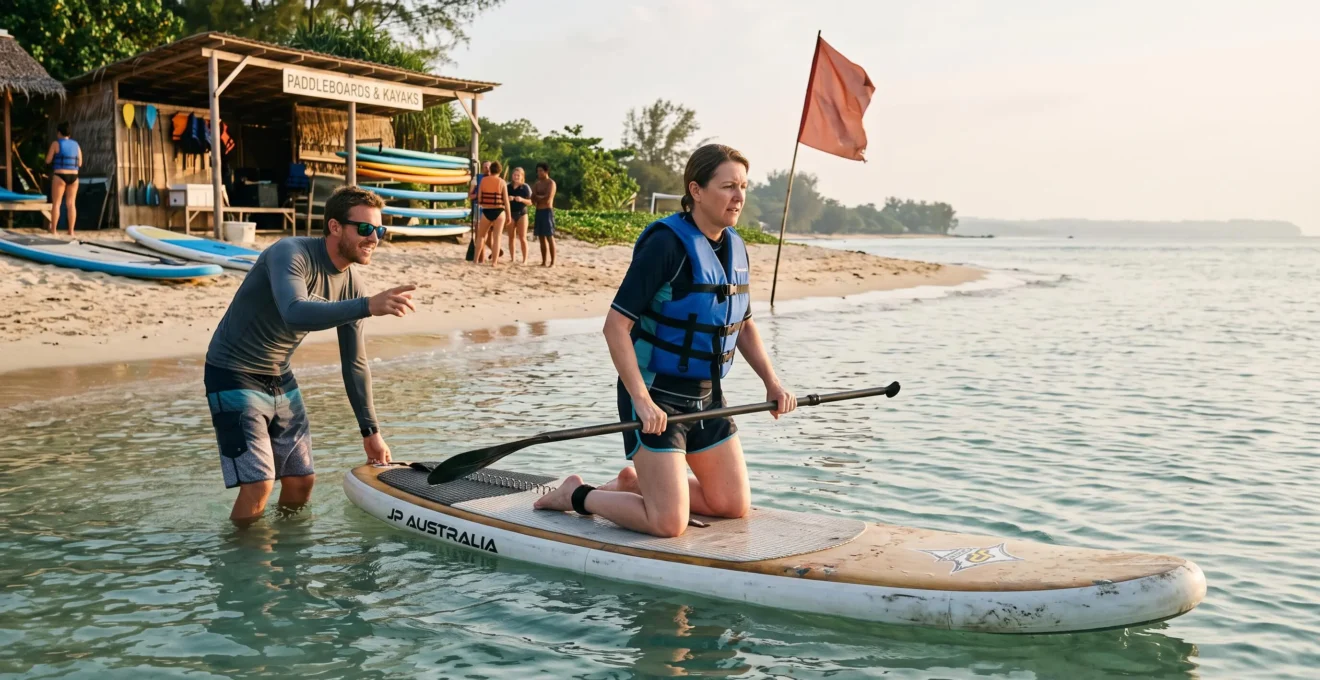
Stand-up paddleboarding in sheltered water is often a sensible first choice for nervous beginners who want a manageable challenge. A guided jet ski session may suit someone seeking stronger thrills, while kayaking and bodyboarding offer different ways to build confidence without immediately taking on a motorised activity.
The right choice depends less on how adventurous an activity looks and more on how much control you will have, what happens if you fall, how demanding the conditions are, and whether an instructor can help when you feel overwhelmed.
Holiday water sports can be exciting without requiring you to pretend you are fearless. You should be able to ask questions, practise basic movements, choose an appropriate pace, and decline conditions that feel beyond your abilities.
Before paying, match the activity to your swimming ability, physical comfort, and appetite for uncertainty. Then check the operator’s supervision, equipment, weather decisions, and insurance arrangements. Those practical details matter far more than a brochure promising an unforgettable adventure.
Water sports for nervous beginners: the essentials
- Choose controllable thrills: Try sheltered-water paddleboarding or kayaking for gradual progression, or a guided jet ski experience if you want more speed and can follow the controls confidently.
- Check the operator before paying: Ask about qualifications, group size, equipment, emergency procedures, insurance, and weather-related cancellations.
- Respect the actual conditions: Calm-looking water does not guarantee safe currents, suitable tides, or manageable offshore winds. Confirm the day’s conditions with a competent local professional.
- Why Do First-Time Water Sports Sessions Feel Chaotic Even With “Beginner-Friendly” Labels?
- How to Vet a Water Sports Operator With 6 Questions Before You Pay a Deposit?
- Jet Ski or Paddleboard: Which Is Better for a 60-Minute Slot With Zero Experience?
- The Beginner Error That Leads to Most Holiday Water Injuries in the First 15 Minutes
- When Is the Best Time for Water Sports to Get Calmer Seas and Better Visibility?
- How to Vet a Dive Operator With 7 Questions Before Your First Reef Day?
- How to Vet a Desert Safari Operator With 8 Safety Questions Before You Book?
- How to Book a Reef Diving Adventure if You’re Newly Certified and Afraid of Strong Currents
Why Do First-Time Water Sports Sessions Feel Chaotic Even With “Beginner-Friendly” Labels?
First-time water sports sessions can feel chaotic because “beginner-friendly” is not a standardised guarantee of personal instruction, calm conditions, or a gentle learning pace. An operator may accept inexperienced customers while still using large mixed-ability groups, brief demonstrations, and fixed schedules. Nervous beginners need to verify the actual teaching arrangements, not rely on the label.
Picture arriving for a first paddleboarding session. Staff are distributing equipment, experienced participants are already preparing to launch, and an instructor delivers several unfamiliar commands while the wind begins to strengthen. Nobody has necessarily behaved irresponsibly, but the experience can still feel overwhelming.
Several practical factors contribute to that pressure:
- Rushed briefings: Instructions arrive before participants have time to understand the equipment, safety signals, or recovery procedure.
- Poorly fitted equipment: An uncomfortable buoyancy aid, unsuitable board, or badly adjusted helmet makes basic movements harder.
- Mixed-ability groups: Confident participants move ahead while inexperienced customers feel pressured to keep up.
- Changing conditions: Wind, waves, visibility, and currents may change between booking and launching.
- Social pressure: Embarrassment about asking questions can prevent someone from admitting they did not understand the demonstration.
These problems become more manageable when a beginner has time to practise in a controlled environment. The RNLI‘s paddleboarding tips for beginners recommend taking a lesson, starting on calm water such as a protected bay, checking weather and tidal conditions, and practising how to climb back onto the board after falling.
Those recommendations offer a useful way to evaluate a supposedly easy holiday activity. A genuine introductory session should explain what to do before launch, what happens after a fall, and how the instructor will respond if someone struggles.
Before booking, ask three questions: How many participants will each instructor supervise? Can you practise in sheltered or shallow water first? Can the session be postponed if conditions become unsuitable?
There is no universal instructor-to-participant ratio that makes every water sport safe. The appropriate level of supervision depends on the activity, local conditions, participant abilities, and operator procedures. An operator should nevertheless be able to explain its staffing decisions.
If the answers sound reassuring but remain vague, ask for specifics. The next step is to turn those concerns into a structured pre-booking conversation.
How to Vet a Water Sports Operator With 6 Questions Before You Pay a Deposit?
Vet a water sports operator by asking six questions about instructor qualifications, supervision, equipment, emergency response, insurance, and weather cancellations. A reputable provider should explain how its procedures work for your specific activity and location. Evasive answers, unclear costs, or pressure to pay before understanding the terms are reasons to reconsider the booking.
Use the following questions as a screening tool rather than treating a polished website or high review score as sufficient proof of safety.
- Who will instruct or guide the session, and what qualifications do they hold? Look for activity-relevant training, local authorisations where applicable, and a clear explanation of who is responsible for safety decisions. Vague claims that staff are simply “experienced” deserve further questions.
- How many customers will each instructor supervise? Ask whether beginners receive additional assistance and whether the instructor can pause the session. An unexplained group size or refusal to describe supervision is concerning.
- How is the equipment inspected and fitted? Expect an explanation of pre-use checks, appropriate sizing, and how defective equipment is taken out of service. Customers should not be expected to use visibly damaged or unsuitable gear.
- What happens if someone falls, becomes exhausted, or needs medical assistance? The answer should identify communication arrangements, rescue responsibilities, first-aid capability, and how emergency services would be contacted.
- What insurance does the business carry, and what must participants arrange themselves? Ask about operator liability coverage and its scope without assuming it pays for your personal medical treatment.
- What happens to my deposit if wind, waves, or other conditions make the session unsuitable? Establish whether you receive a refund, a free rescheduling option, or a credit voucher, and whether any conditions apply.
An operator who answers these questions clearly before payment gives you useful evidence of how its booking process works. Written answers also make it easier to compare competing offers.
Operator liability insurance and personal travel insurance serve different purposes. The operator’s policy may respond to certain liabilities under its terms, but that does not automatically mean your treatment, emergency evacuation, or repatriation expenses are covered.
The UK government guidance on foreign travel insurance recommends checking that your policy covers the activities you intend to undertake. It specifically identifies jet skiing among activities not usually included in standard travel policies. Coverage and exclusions depend on the individual contract and may differ between countries and insurers.
For an additional cross-check, examine recent reviews that mention safety briefings, equipment condition, instructor behaviour, and cancellations rather than focusing only on excitement. Verify the centre’s physical location, applicable permits or recognised affiliations, and responsiveness to written questions.
Do not assume that an operator cancelling for unsafe weather guarantees a cash refund. Some booking terms provide credits or alternative dates instead.
Your five-action pre-booking safety check
- Request the instructor’s credentials: Save the provider’s written description of relevant qualifications and supervisory arrangements.
- Confirm your beginner setup: Obtain the group size, equipment fitting process, and available introductory practice options in writing.
- Ask for the emergency procedure: Record who coordinates a rescue and how emergency assistance is requested.
- Verify personal insurance: Save confirmation from your insurer that your specific activity, destination, and intended conditions are covered.
- Check cancellation terms: Keep a written copy showing what happens to your payment if weather prevents the session or the operator cancels.
Once you have a provider that meets your expectations, choosing between activities becomes much easier: you can focus on the experience itself rather than uncertainty about basic safety arrangements.
Jet Ski or Paddleboard: Which Is Better for a 60-Minute Slot With Zero Experience?
For a nervous beginner with one hour and no experience, paddleboarding in sheltered water generally offers a more gradual introduction, because you control your pace and can begin kneeling. A guided jet ski experience offers more immediate acceleration and excitement but requires confidence with powered controls, steering, and stopping procedures. Neither is automatically the safer choice in every environment.
The difference becomes clearer when you compare what you will actually do during the session.
| Decision factor | Stand-up paddleboarding | Guided jet skiing |
|---|---|---|
| Initial learning | Balance, paddling and board recovery | Throttle control, steering, stopping and separation distances |
| Speed control | Mostly self-paced, although wind and current influence movement | Powered acceleration requiring deliberate throttle management |
| Distance from shore | Can remain in a sheltered training area | Depends on the designated riding zone or guided route |
| Physical effort | Balance, core stability and paddling | Grip, posture and active body control |
| Thrill profile | Balance challenges and a sense of exploration | Acceleration, speed and powered movement |
| Falling into the water | Practise reboarding and suitable flotation and leash procedures | Learn the engine stop procedure, safe separation and supervised remounting |
| Preferred conditions | Light wind and sheltered, manageable water | Conditions approved by the operator for beginner riding |
Choose paddleboarding if your main worry is losing control. Starting on your knees lowers the balance challenge, and a suitable beginner board provides space to practise movements without needing to stand immediately. Water depth, wind direction, and recovery arrangements still matter.
For paddleboarding, appropriate leash selection is especially important. An ankle or calf leash suitable for relatively still water may be dangerous in flowing tidal water because of entrapment risks. Follow knowledgeable local instruction rather than assuming one attachment works everywhere.
Choose a guided jet ski session if speed is central to your enjoyment and you are comfortable learning controls before accelerating. Ask whether the craft has an appropriate beginner mode or speed restriction, where you will ride, and whether the guide can intervene or stop the activity.
A beginner should never assume that a guided ride eliminates collision, falling, or loss-of-control risks. The craft must be operated according to its specific controls, the operator’s instructions, and local requirements.
For someone still undecided, kayaking offers a seated position with a controllable pace, while bodyboarding can provide wave-related excitement when conditions and supervision suit a novice. Both have distinct hazards and require appropriate instruction.
During a one-hour slot, allow time for fitting, instruction, and familiarisation rather than treating the advertised duration as uninterrupted riding. Confirm how much time is actually spent on the water.
The activity matters, but your behaviour during its opening minutes matters too. Understanding the safety briefing is more valuable than trying to impress other holidaymakers.
The Beginner Error That Leads to Most Holiday Water Injuries in the First 15 Minutes
One preventable beginner mistake is entering the water without fully understanding the safety briefing, particularly what to do after a fall or loss of control. This can create avoidable problems during the opening minutes, when movements and equipment are unfamiliar. However, available evidence here does not establish that this is the leading cause of holiday water injuries or that most injuries occur within 15 minutes.
The opening phase deserves special attention because beginners are still learning how their bodies and equipment respond. A paddleboard may move unexpectedly underfoot, a jet ski can accelerate more abruptly than anticipated, and a wave can interrupt a bodyboarder’s planned movement.
When someone feels embarrassed about asking for clarification, an unfamiliar situation can quickly become more stressful.
Before leaving the shore or boat, confirm three things:
- What happens if I fall? Understand how your flotation equipment works, how to recover safely, and when to wait for assistance rather than attempting to recover independently.
- How do I signal that I need to stop? Learn the agreed hand signal or communication method and how the instructor will respond.
- Where is the permitted operating area? Identify the boundaries, obstacles, safe exit points, and any current or wave hazards.
This short mental check does not replace activity-specific instruction. It helps you recognise missing information before a manageable mistake becomes an emergency.
Fear can also affect physical reactions. A tense paddler may grip excessively, adopt a rigid posture, or move too suddenly after losing balance. Someone who falls unexpectedly may be tempted to rush towards equipment or swim against moving water without assessing the situation.
If you feel overwhelmed, follow your training, use your flotation equipment, and signal for assistance. Where safe and appropriate, slow your breathing and avoid unnecessary exertion. Do not attempt to fight strong currents or improvise an underwater response.
Risk also changes with water depth, temperature, wave action, current, swimming ability, and equipment. Cold water can create additional hazards even when the surface looks peaceful. A properly fitted buoyancy aid or activity-appropriate personal flotation device is important, but it is not a substitute for supervision.
For powered activities, fully understand the manufacturer’s and instructor’s stopping procedures before moving. For paddleboarding, practise getting back onto the board in a suitable controlled area. For diving, follow the specific training and emergency procedures associated with your certification.
A good operator makes these questions easy to ask. The next decision is when to book, because even careful instruction cannot make unsuitable sea conditions appropriate for a nervous first-timer.
When Is the Best Time for Water Sports to Get Calmer Seas and Better Visibility?
Early morning can offer calmer water at some coastal destinations, especially where daytime heating creates stronger afternoon sea breezes. It is not a universal rule. Tides, swell, local wind patterns, currents, seasonal weather, and visibility can make another time safer or more comfortable. Ask the operator which session has the most suitable conditions for beginners on the specific day.
The appeal of a morning booking is understandable. Less wind can mean fewer surface ripples and easier balance for paddleboarders. A quieter launch area may also give instructors more space to supervise newcomers.
However, the sea does not follow a universal holiday timetable.
- Wind: Local breezes may strengthen or change direction during the day. Offshore winds can carry paddleboarders away from shore even when nearshore water initially looks flat.
- Tides: Water depth, current direction, exposed obstacles, and launch conditions can change throughout a tidal cycle.
- Swell: Distant weather systems may generate waves independently of the local wind.
- Season: Typical wind, temperature, visibility, and sea conditions vary by region and season.
- Visibility: Sediment, waves, rainfall, plankton, and changing light can affect how clearly you see through the water.
A sheltered bay may be comfortable in one wind direction but exposed in another. Likewise, low tide may create calmer-looking water while exposing rocks or making a launch area too shallow for certain equipment.
For a practical pre-booking check, compare a reputable local marine forecast with the operator’s assessment. Look at wind direction and strength, swell, tides, and any relevant marine warnings. At the beach, observe flags, breaking waves, boat activity, and whether the actual conditions match the description you received.
Forecast apps provide useful context, but they do not certify a location as safe. Local hazards and the operator’s experience remain important.
Clearer water and manageable surface conditions can help nervous participants feel more oriented. That psychological benefit does not remove underwater hazards or establish that the activity is technically easier.
Late afternoon and sunset sessions can be attractive, but fading daylight may complicate visibility and rescue arrangements. An apparently peaceful low-tide session may also present different hazards from a mid-tide session.
For beginners, the best time is the period when suitable conditions, adequate light, and competent supervision coincide. That principle becomes even more important when choosing a reef diving experience.
How to Vet a Dive Operator With 7 Questions Before Your First Reef Day?
Before a first reef dive, assess the operator’s guide qualifications, rental equipment, underwater emergency procedures, assisted ascent arrangements, supervision, current assessment, and emergency oxygen capability. A suitable dive centre should also ask about your certification, recent diving experience, and comfort level. An operator that treats every certified diver as equally prepared for challenging conditions deserves particular caution.
Reef diving requires additional checks beyond general holiday water sports because depth, breathing-gas management, boat recovery, and underwater currents introduce risks that cannot be managed like a surface activity.
Ask these seven questions before booking:
- What qualifications do the guide and instructor hold, and what depth limits apply? Ask who will supervise the dive, which professional credentials are relevant, and whether the planned site is within your training, certification, experience, and applicable local limits.
- How is rental scuba equipment checked and maintained? Request an explanation of regulator servicing, buoyancy compensator inspection, cylinder checks, and pre-dive testing. Ask to examine the equipment before committing to use it.
- What is covered in the underwater emergency briefing? Expect clear procedures for low gas, separation, communication, loss of visibility, and other foreseeable problems.
- What is the procedure for assisting a diver and making a controlled ascent? The guide should explain how assistance would be provided within the diving team’s training, how the surface team is alerted, and what happens after surfacing.
- Can a newly certified or anxious diver receive dedicated supervision? Ask about smaller groups, a suitable guide arrangement, and whether an easier dive is available without being pressured into a more demanding site.
- How are currents assessed on the day? The operator should describe how local reports and actual observations influence site selection, entry and exit procedures, and cancellation decisions.
- Is emergency oxygen available, and who is trained to use it? Ask about oxygen equipment, trained personnel, emergency communication, evacuation arrangements, and access to appropriate medical support.
A certification card demonstrates completion of a training standard, not guaranteed readiness for every reef. A newly certified diver may have practised in sheltered water without encountering meaningful current, reduced visibility, or a demanding boat entry.
The operator should ask how many dives you have completed, when you last dived, which environments you have experienced, and whether you have any concerns.
Currents deserve particular attention. Divers Alert Network‘s article on diving in currents explains how moving water can increase physical exertion and breathing-gas use, why detailed dive briefings matter, and why divers should understand ascent and boat recovery procedures.
Current direction and strength may change during a dive or at different depths. An appropriate site assessment must therefore go beyond a generic description such as “usually easy.”
During an equipment inspection, ask for the regulator’s maintenance status and inspect the mouthpiece, hoses, pressure gauge, buoyancy compensator, alternative air source, and cylinder suitability. Check that the fitted configuration matches your training and the planned dive.
A pressure-gauge reading does not establish that a regulator has been recently serviced, and a visual inspection cannot verify every internal component. Maintenance records and functional checks provide different kinds of evidence.
The available cylinder size and gas supply must also suit the dive plan, your expected consumption, and applicable procedures. Do not accept equipment substitutions you have not been trained to use.
An operator who proposes sending inexperienced and confident divers to the same challenging site without considering their individual abilities may be prioritising scheduling convenience over appropriate matching.
The purpose is not to eliminate every possibility of discomfort. It is to find an operator capable of matching the experience to your actual abilities and changing the plan when necessary.
How to Vet a Desert Safari Operator With 8 Safety Questions Before You Book?
Vet a desert safari operator by checking vehicle condition, driver qualifications, breakdown support, heat precautions, passenger insurance, medical response, communications, and extreme-weather policies. Desert excursions involve different hazards from coastal water sports, including remote locations, high temperatures, difficult terrain, and limited mobile coverage. These eight questions provide a practical screening method, not an internationally standardised safety certification.
For travellers comparing several adventure activities during one holiday, the underlying principle remains the same: an exciting itinerary is only one part of a responsible booking decision.
Desert safaris require additional attention because emergency assistance may be harder to access than at a supervised public beach.
- What vehicle will be used, and how is it maintained? Ask about suitable four-wheel-drive equipment, seat belts, passenger capacity, safety checks, and recovery gear.
- What training and experience does the driver have? Look for relevant off-road driving qualifications or authorisations where required, along with knowledge of the intended terrain.
- What happens if a vehicle becomes stuck or breaks down? Ask whether vehicles travel together, what recovery equipment is available, and how a stranded group would receive assistance.
- How are hydration and heat risks managed? Check drinking-water provision, planned rest stops, shade, appropriate timing, and procedures for participants who become unwell.
- What passenger insurance applies? Request the scope of the operator’s coverage and check whether your personal policy includes the exact excursion and any optional activities.
- What is the medical emergency plan? Ask about first-aid capability, personnel responsibilities, evacuation arrangements, and access to emergency services.
- How will the group communicate where mobile reception is unavailable? The operator should explain its communication equipment, location-sharing arrangements, and contingency procedures.
- What happens if extreme weather makes the excursion unsafe? Confirm cancellation, postponement, refund, and credit policies before paying.
For example, a traveller considering an excursion in the United Arab Emirates should account for the risks of desert driving and remote travel. Official UK government advice for that destination recommends properly equipped four-wheel-drive vehicles, travelling with other vehicles, carrying water and communications equipment, and choosing reputable tour companies with adequate safety procedures.
Those recommendations are specific to travel in the UAE and should not be mistaken for a complete legal or operational standard governing desert tours worldwide.
Price deserves scrutiny, but a cheaper safari is not automatically an unsafe safari. Compare the vehicle type, passenger numbers, maintenance explanations, driver arrangements, and emergency support included in each offer.
A hypothetical comparison illustrates the point. Operator A advertises a lower price but cannot explain who maintains its vehicles or how many passengers share one. Operator B costs more and provides clear answers about vehicle checks, passenger capacity, and breakdown support. Those details make Operator B easier to assess, although they do not independently prove that it is safer.
Most importantly, distinguish a gentle scenic desert drive from dune bashing, which deliberately involves more demanding off-road manoeuvres. Ask whether the itinerary includes aggressive dune driving, whether you can opt out, and whether an alternative gentle route is genuinely available.
Passengers who are uncomfortable with sudden movements should not assume that every family-oriented safari avoids them. Get an explicit description of the driving style.
Whether the experience takes place on sand or underwater, booking the gentler option first can create room for more ambitious activities later. For newly certified divers, that gradual approach is particularly valuable.
Key takeaways before booking your next adventure
- Choose the environment before chasing a famous activity: sheltered conditions and an appropriate season can matter more than a destination’s reputation.
- Describe your actual experience and concerns to the operator rather than relying on a certification or a generic “beginner” label.
- Keep the option to downgrade, reschedule, or decline an unsuitable session; understand the financial consequences before paying.
How to Book a Reef Diving Adventure if You’re Newly Certified and Afraid of Strong Currents
Newly certified divers who fear strong currents should book a sheltered, beginner-appropriate reef experience rather than starting with an exposed or current-dependent dive site. Choose a suitable destination and season, then a qualified operator willing to assess conditions and your experience, and finally an appropriate site. Build confidence progressively, with a refresher or check dive if needed, before considering drift diving.
Being certified does not require you to accept every dive advertised for certified customers. The best initial booking is one that matches the environment in which you have already demonstrated competence.
Use the following progression to organise your first reef trip.
- Choose a destination for its suitable diving conditions. Research seasonal current patterns, sheltered reef options, water temperature, visibility, and the availability of appropriate beginner sites. Avoid assuming that an entire destination is always calm.
- Select an operator that asks about your experience. Explain your certification level, logged dives, most recent dive, training conditions, and concerns about currents before making a deposit.
- Request a manageable first site. Ask about sheltered, relatively shallow options within your certification, training, personal limits, and local operating requirements.
- Discuss supervision. Ask whether a dedicated guide, instructor, or smaller group is available, and clarify what assistance that arrangement actually provides.
- Consider a refresher or check dive. Practise buoyancy, communication, equipment familiarity, and appropriate emergency skills in conditions suited to your abilities before attempting more demanding environments.
- Decide about current diving separately. Only progress when the conditions, training, supervision, and your demonstrated competence support it. Additional instruction may be appropriate before a first drift dive.
It helps to distinguish fear of an actual hazard from uncertainty about an unfamiliar situation. Strong currents are a real operational concern, not something to dismiss as unnecessary anxiety. At the same time, understanding how a dive is planned can make less demanding conditions feel more predictable.
During suitable training, divers can learn about streamlined positioning, controlled movement, ascent planning, gas monitoring, and how to respond when currents affect the planned route. These skills require practice and context-specific instruction.
Do not deliberately grab or pull on reef structures to resist current. Contact can injure marine life, damage fragile habitats, and create further risks. Any use of a fixed reference or line must be appropriate to the site and explained by a qualified professional.
Likewise, avoid attempting to swim forcefully against a strong current as an improvised solution. Follow the dive plan and your training, communicate with the guide and buddy, and use the agreed ascent and surface recovery procedures.
Before departure, clarify how the boat tracks divers, what happens if the group separates, what surface signalling equipment is required, and which conditions would cause the operator to switch sites or cancel.
Insurance is another important part of this decision. Confirm that your policy explicitly covers recreational scuba diving at the destination and within your intended depth and activity limits. Ask about medical treatment, emergency evacuation, recompression chamber treatment, and repatriation.
Some policies impose restrictions concerning certification, depth, solo diving, specific diving practices, or excluded activities. These terms vary by insurer and policy, so no universal diving depth or coverage guarantee should be assumed.
The final booking decision should consider how the operator responds when you say, “I am newly certified and would prefer a sheltered dive without challenging currents.” A suitable response is a realistic discussion of available sites, conditions, supervision, and the option not to dive.
Choose a first reef dive that allows you to practise comfortably, ask questions openly, and finish within your abilities. Contact the operator with your certification details and specific concerns, request an appropriate site and written booking conditions, and book only when the proposed experience genuinely matches your readiness.
Can I try water sports if I am not a confident swimmer?
Some supervised activities may accommodate people with limited swimming confidence, but requirements vary considerably. Tell the operator about your actual swimming ability before booking, including whether you can remain calm after unexpected immersion. Ask about flotation equipment, water depth, supervision, and recovery procedures. Never assume that wearing a life jacket eliminates the need for suitable swimming ability or that every activity accepts non-swimmers.
Is a private instructor worth paying extra for on a first water sports session?
Private instruction can be useful when you need more time to understand equipment, practise recovery techniques, or ask questions without group pressure. It does not automatically make difficult conditions safe. Compare the instructor’s qualifications, session location, teaching arrangements, and additional cost before deciding.
What should I do if I feel too frightened to continue once the activity starts?
Use the agreed communication signal and tell your instructor or guide that you want to stop. Follow the activity-specific instructions for returning or receiving assistance rather than abruptly leaving equipment or attempting an unfamiliar manoeuvre. For scuba diving, follow your training and the established controlled ascent and buddy procedures. Never improvise a rapid ascent. Discuss stopping arrangements before starting so the process is clear.
Does a travel insurance policy automatically cover holiday water sports?
No. Coverage depends on the specific policy, activity, destination, and applicable conditions. Some activities, including jet skiing, may fall outside standard travel insurance coverage. Check exclusions and any required adventure-sports extension, along with emergency medical, evacuation, and repatriation benefits. For scuba diving, verify depth and certification restrictions as well as recompression treatment coverage.
Can I refuse an activity because the conditions look worse than expected?
You can tell the operator that you do not want to participate and should not feel pressured to enter conditions beyond your abilities. Whether you receive a refund, credit, or alternative session depends on the booking agreement and applicable consumer law. Ask about weather-related and customer-requested cancellations separately before paying, and keep the terms in writing.